Test-Time Adaptation for Vision
Adapt the deployed model on each incoming batch without labels, by tuning a few normalization statistics toward the new conditions.
Why Does This Exist?
A classifier trained on clean daylight images meets night rain in production. Labels for the new conditions do not exist, retraining pipelines take days, and every hour ships errors. Domain adaptation wants source and target data together at training time, which the deployment moment cannot provide.
Test-time adaptation updates the model during inference using only the unlabeled test batch itself. It tunes a small set of parameters, usually normalization scales and shifts, to make current predictions confident and consistent. The sibling that also trains an auxiliary self-supervised head is test-time training.
Think of It Like This
Adjusting your eyes to a dark room
Walking into a dark cinema, you first see nothing, then shapes emerge as your eyes adapt without any teacher telling you what is where. The room did not change and your knowledge did not change; your sensor gain adjusted to the statistics of the new light. Test-time adaptation adjusts model gain to the statistics of the new batch. The analogy stops at memory: eyes keep adapting continuously, while the model must avoid drifting so far it forgets daylight.
How It Actually Works
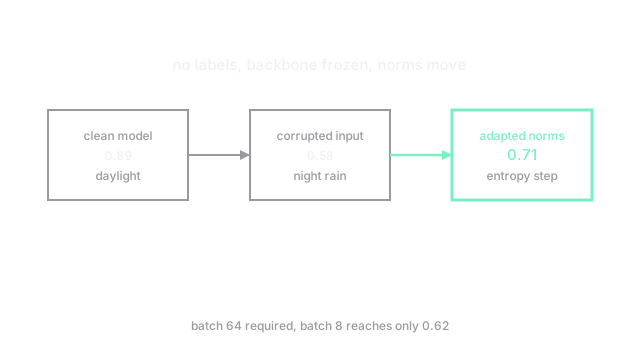
Freeze nearly everything. Update only normalization affine parameters on each incoming batch to minimize prediction entropy, sometimes plus a consistency term between an image and its augmentation. Entropy minimization pushes each prediction toward one confident class without needing the true label. After predicting, either keep the adapted statistics for the stream or reset per batch, which decides whether adaptation accumulates or stays local.
Worked example with recomputed numbers
Take 1,000 clean validation images at 0.89 accuracy and corrupt them with moderate blur plus noise, dropping accuracy to 0.58. Adapt only the normalization scales and shifts for one entropy step per batch of 64 at step size 0.001. Accuracy climbs to 0.71, recovering 0.13 of the 0.31 lost. Shrink batches to 8 and the same update reaches only 0.62 with three times the variance across batches, because tiny batches misestimate the new statistics.
The assumption that carries it
The batch must carry the shift signal: dozens of same-condition images with balanced classes. Single-image streams, wildly mixed conditions per batch, or one dominant class break the statistics and adaptation can push accuracy below the 0.58 baseline. Check batch size and class mix before enabling it.
Watch Out For
Adapting on tiny or single-class batches
A traffic camera at 3am sees near-empty roads, and entropy minimization confidently locks onto the majority class for everything. The symptom is accuracy that falls below doing nothing, worst on skewed streams. Require minimum batch sizes, reset statistics between regimes, and monitor prediction diversity alongside accuracy.
The Quick Version
- Test-time adaptation tunes normalization on unlabeled test batches, no labels or source data needed.
- The worked corruption recovers 0.58 to 0.71 with batches of 64.
- Only small parameters move; the backbone stays frozen.
- Batches must be large and mixed enough to estimate the new statistics.
- Reset or carry statistics deliberately, since drift accumulates across regimes.