Test-Time Training for Vision
Train the model with a helper self-supervised task alongside labels, then keep training only the helper on each test image to adapt before predicting.
Why Does This Exist?
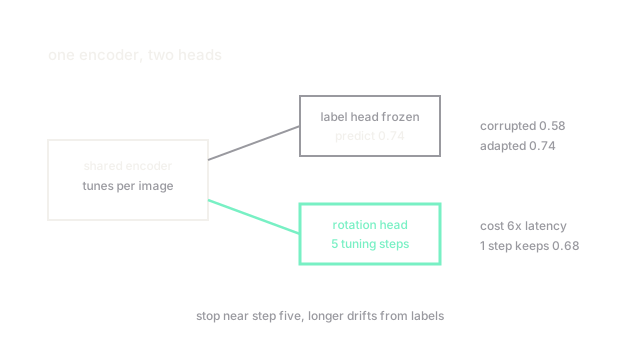
Test-time adaptation tunes normalization on whole batches, so single images and tiny streams defeat it. Test-time training prepares differently at training time: the encoder is shared between the main classifier and an auxiliary self-supervised head such as rotation prediction, which needs no labels. At deployment each test image first updates the shared encoder through the auxiliary task, then the main head predicts with adapted features.
The cost is paid upfront in training design and per image in latency. Use it where batches are unavailable and per-image conditions shift, such as robotics and field devices.
Think of It Like This
Warming up with scales before the solo
A violinist plays scales backstage before every performance, adjusting fingers to the cold hall without changing the memorized piece. The auxiliary task is the scales: always available, needing no audience. The shared encoder is finger placement, used by both scales and solo. The analogy stops at forgetting: a long warm-up can drift into new habits, while the model must adapt briefly and stop.
How It Actually Works
Training minimizes the main classification loss plus the auxiliary loss on rotated copies, with a shared encoder feeding both heads. At test time, freeze both heads, run a few gradient steps of the auxiliary loss on the incoming image alone, predict the class from the adapted encoder, then restore or carry the encoder per policy. The auxiliary task must share features with classification for the update to help rather than scramble.
Worked example with recomputed numbers
Same corruption as the adaptation page: clean 0.89 down to 0.58. With a rotation head weighted equally during training, five auxiliary steps per test image at step size 0.0005 lift accuracy to 0.74, a gain of 0.16 against 0.13 for batch adaptation. The price is five extra forward-backward passes per image, about six times the latency of a frozen forward pass here. Cutting to one step keeps 0.68, so latency budgets map directly to retained gain.
The auxiliary must be honest
Rotation helps natural scenes with clear orientation and hurts symmetric textures, digits, and aerial views where rotation is meaningless. Pick the helper whose invariances match the deployment shift, and verify on corrupted validation that auxiliary improvement predicts classification improvement rather than assuming it.
Watch Out For
Adapting so long the encoder forgets the labels
Twenty auxiliary steps keep improving rotation accuracy while classification peaks near step five and then decays, because the encoder drifts from label features toward rotation features. The symptom is both heads agreeing the image is well oriented while the class is wrong. Fix it with a fixed small step budget tuned on corrupted validation, never open-ended tuning.
The Quick Version
- Joint training adds a label-free auxiliary head sharing the encoder.
- Each test image first tunes the encoder through the auxiliary task, then gets classified.
- The worked setup recovers 0.58 to 0.74 at five steps per image.
- Cost is latency, roughly six times a frozen pass here, tunable by step count.
- The auxiliary must match the deployment shift or its updates mislead.