Thermal Imaging
Visible cameras go blind in darkness, smoke, and glare. Thermal cameras see heat itself, reading temperature differences through conditions that stop RGB cold.
Why Does This Exist?
Night, smoke, fog, and glare erase visible scenes while leaving the mission: find people, watch engines, monitor perimeters. Active infrared (night-vision goggles) needs illumination and blooms on headlights; RGB needs light that is not there. The gap is colonized by sensing what objects emit rather than what they reflect.
Thermal (long-wave infrared, – –m) cameras read emitted heat. Warm bodies glow against cool backgrounds with no illumination at all, through smoke and light fog that scatter visible wavelengths. Firefighting, night driving, and fever screening run on it. The family map is alternative sensing; the spectral sibling is multispectral imaging.
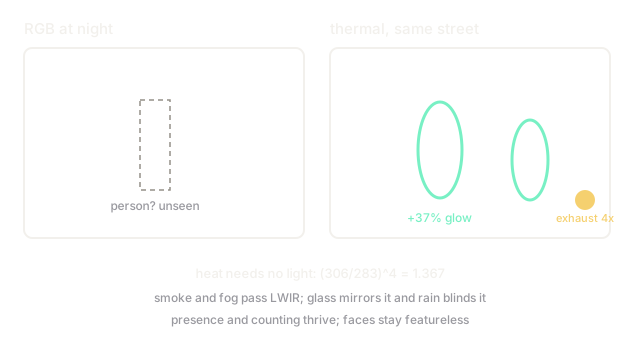
The one idea you need first. Radiated exitance grows with the fourth power of absolute temperature (Stefan-Boltzmann: ). Small temperature gaps compound into large radiation gaps: skin at K against a K night is only warmer in Kelvin yet radiates over a third more energy. Contrast comes free with the physics.
Think of It Like This
Finding a warm mug in a dark kitchen
You wake thirsty in a pitch-black kitchen. Eyes useless, you sweep a hand over the counter: the mug radiates warmth into your palm from inches away while everything else reads room-cold. No light, no reflection — emission alone guides the hand, through steam and darkness alike.
Thermal cameras are that palm with a thousand fingers. Each microbolometer pixel reports incoming heat; warm shapes assemble from the gradient. And like the hand, it reads warmth only: the mug's logo, color, and lettering stay invisible, because emission carries no pattern detail.
How It Actually Works
Microbolometer arrays absorb LWIR and convert tiny resistance changes into temperature maps — uncooled, silent, video-rate. Calibration maps raw values to temperatures against a blackbody reference; automatic gain control stretches the scene's span for display. Detection pipelines threshold or segment warm blobs, track them over time, and classify by shape and motion since texture is unavailable. Fusion with RGB restores identity detail where light allows.
Atmospheric windows matter: LWIR passes smoke and thin fog far better than visible light, but heavy rain and glass stop it — windows become mirrors showing the camera its own heat.
Worked example
Person skin K; night background K. Exitance ratio:
Square twice: , then . The person radiates about more energy than the background — a contrast no exposure trickery is needed to see. Vehicle exhaust at K against the same night gives squared again : fourfold glow, visible for hundreds of meters.
Code
The point of this snippet is the free contrast: fourth-power arithmetic turns small Kelvin gaps into detection margins.
def heat_contrast(t_hot_k: float, t_cold_k: float) -> float: return (t_hot_k / t_cold_k) ** 4 # Stefan-Boltzmann ratio
print(round(heat_contrast(306.0, 283.0), 3)) # -> 1.367print(round(heat_contrast(400.0, 283.0), 2)) # -> 3.99Watch Out For
Faces without features
Thermal resolves heat, not identity: eyes, tattoos, and clothing logos vanish, and identical-temperature faces match each other. Access control or suspect ID built on thermal alone confuses people routinely — the detection half works, the recognition half does not exist.
Fuse with visible or near-infrared for identity; use thermal for presence, counting, and liveness. A glowing blob is a person somewhere, never a person someone.
Glass lies and rain blinds
Ordinary glass is opaque in LWIR: car windows show cabin reflections and building windows mirror the street, so "person inside the car" reads as empty seats plus ghost reflections. Heavy rain scatters thermal nearly as badly as visible.
Survey the optics of the deployment: shoot through open air or germanium windows, derate range claims for rain, and test reflections explicitly. The spectrum giveth, and materials taketh away.
The Quick Version
- Thermal cameras read emitted LWIR heat, needing no illumination and piercing smoke and light fog.
- The worked fixture gives more radiation for skin over a cool night, for hot exhaust.
- Detection and counting thrive; identity recognition does not exist in heat alone.
- Glass mirrors LWIR and heavy rain blinds it, so survey materials and weather first.
- Fuse with RGB where light allows: heat finds, visible identifies.