UCF101 Small Action Clips
A hundred-plus short realistic action clips per class set, the lighter classic for action baselines before large video grounds.
Why Does This Exist?
Large video grounds cost heavy compute. A smaller realistic set lets ideas fail fast on true motion before scaling. UCF101 gathered realistic web clips across just over a hundred actions with fixed splits, serving action baselines that train on one GPU.
This page covers clip contract and appropriate use. Larger pretraining lives in Kinetics.
Think of It Like This
A community league before the majors
UCF101 is a community league: real games, smaller stadiums, same rules. You test plays here before renting the big arena.
Kinetics is the majors. Graduate when the league no longer separates good plays from great ones.
How It Actually Works
Purpose is small-scale action classification. Input is a short clip, output is one action label. Appropriate use is teaching, ablations and light baselines. Camera motion and background bias are known limits, so confirm on larger sets before claiming generality.
Toy split walkthrough
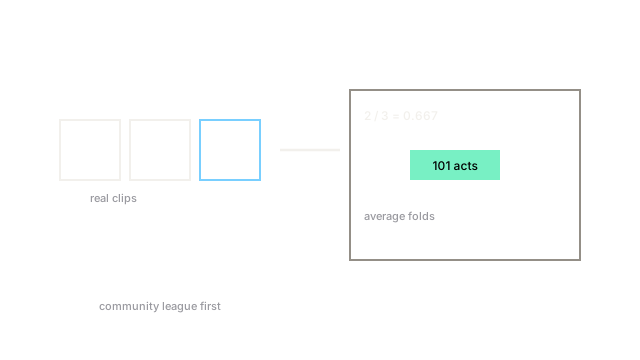
Take 20 clips across 4 actions, 5 each. Split 14 train, 3 validation, 3 test. A model getting 2 of 3 test right scores . Per-action hits then reveal which motion failed.
Code
Tiny accuracy on toy test counts.
def accuracy(hits: int, total: int) -> float: return round(hits / max(total, 1), 3)
print(accuracy(2, 3))# -> 0.667Two of three gives 0.667 on the toy test slice.
Watch Out For
Overreading small-test wins
Three test clips per split swing wildly with one mistake. The symptom is rank flips across seeds. Fix it by averaging folds and reporting spread, not one seed.
The Quick Version
- UCF101 maps short realistic clips to just over a hundred action labels.
- Input is a clip, output is one action class with fixed splits.
- Toy 2 of 3 test gives about 0.667 accuracy.
- Use it for light baselines and teaching before large video.
- Average folds because tiny tests swing.