Kinetics Action Video Set
Short web clips labeled by human action, the default ground for learning motion rather than single frames.
Why Does This Exist?
Single frames confuse running with standing and pouring with holding. Actions live across time. Kinetics gathered short web clips labeled by action so action models could learn temporal patterns on shared classes.
This page covers clip I/O, temporal signal and appropriate use. Two-stream ideas are in two-stream networks.
Think of It Like This
Ten-second tryouts
Photos are portraits. Kinetics clips are ten-second tryouts where you watch someone move before judging the sport.
One still frame guesses, the clip decides. That gap is why video sets exist.
How It Actually Works
Purpose is clip-level action classification. Input is a short RGB clip, output is one action label. Appropriate use is pretraining video backbones and benchmarking motion models. Link rot and class overlap are known limits, so verify availability and report per-class rather than one headline.
Toy temporal walkthrough
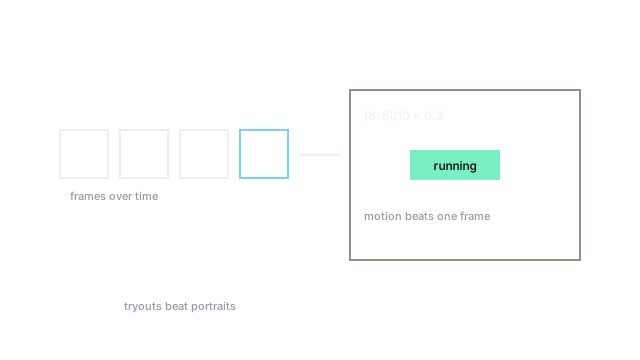
Take 10 clips where frame-only models get 5 right and clip models get 8 right. The temporal lift is . That 0.3 prices motion itself on this toy slice.
Code
Lift arithmetic for frame versus clip models.
def lift(clip: int, frame: int, total: int) -> float: return round((clip - frame) / max(total, 1), 3)
print(lift(8, 5, 10))# -> 0.3Eight versus five on ten gives a 0.3 motion lift.
Watch Out For
Learning backgrounds instead of actions
Some actions correlate with places, so models score by scenery. The symptom is strong validation with weak new-place clips. Fix it by testing cross-scene slices and masking background ablations.
The Quick Version
- Kinetics maps one short clip to one action label for motion learning.
- Input is frames over time, output is a single action class.
- Toy 8 versus 5 on 10 gives a 0.3 temporal lift.
- Use it to pretrain video models and benchmark actions.
- Watch background bias and link availability.