Underwater Vision
Water steals color and contrast with depth, so underwater models restore true hues before they count fish, pipes, and reefs.
Why Does This Exist?
Ten meters down, reds are gone. Thirty meters down, everything is blue green murk. A reef survey that works in a pool fails at sea. Underwater vision exists to restore and then recognize: correct color by depth, boost contrast, then count fish, segment coral, and inspect pipes.
Enhancement differs. Image enhancement brightens photos. Object detection finds boxes. This page is the water column fix: estimate depth and turbidity, restore channels, then detect on restored frames.
Basics first: attenuation is exponential with distance. Red fades fastest. A depth map plus water coefficients predicts how much of each channel was lost.
Think of It Like This
Sunglasses that tint by depth
A diver wears lenses that add back the reds the water stole, stronger with depth. The camera is the eye, the restoration is the lens tint, and detection is the fish count after. The analogy stops at uniformity: glasses tint the whole view, while true restoration varies per pixel with distance to each fish.
How It Actually Works
Sonar or stereo gives range per pixel. A water model with attenuation coefficients per channel inverts the loss: true color equals observed plus backscatter, scaled by exp of distance times coefficient. A dehaze step removes floating particle glow. The restored frame feeds a fish detector trained on restored images, not raw dives.
Turbidity breaks the assumption. Heavy plankton scatters like fog and depth reads noisy. Systems estimate a turbidity score and widen boxes or refuse counts past a cutoff.
Worked fish count
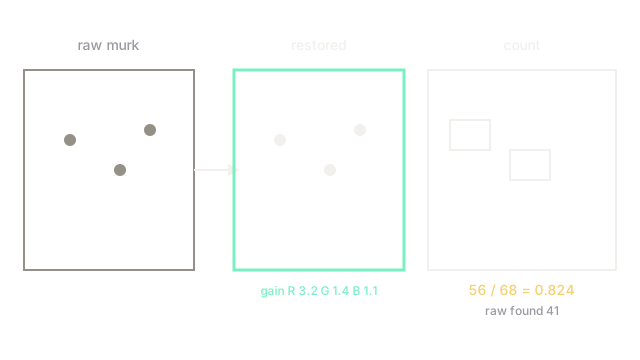
One transect holds 68 true fish in murk. Raw detection finds 41. Restored detection finds 56 with 8 false on debris. Precision is 56 divided by 64 which equals 0.875. Recall is 56 divided by 68 which equals 0.824. Restoration gained 15 fish for the same detector weights.
Watch Out For
Pool trained models that drown at sea
Clear pool water has low scatter, so models learn crisp edges and fail on green haze. The symptom is pool mAP above 0.9 with sea recall near half. Fix it by training on turbid sites and by reporting visibility bands separately.
The Quick Version
- Water removes reds first, so restore by depth before detecting.
- Range plus attenuation inverts color loss per pixel.
- Our transect found 56 of 68 fish, recall 0.824 after restore.
- Train on turbid water, not pools alone.
- Gate counts on turbidity or debris false alarms spike.