Video Captioning Clip Narrator
Video captioning narrates clips in sentences, watching frames in order and writing what happens the way image captioning cannot.
Why Does This Exist?
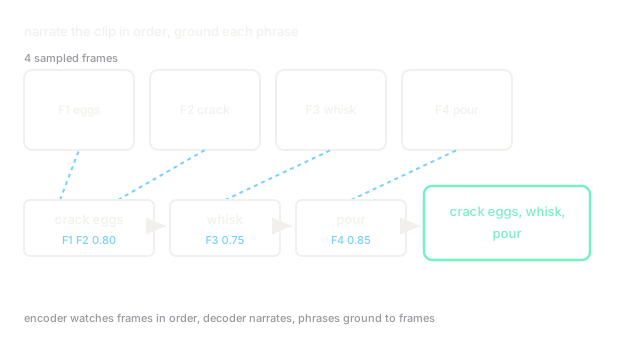
Image captioning describes one frame, but a clip of cracking eggs, whisking and pouring needs verbs in order, not a still life. Accessibility tracks, video search and highlight narration all need sentences that follow time. Video captioning exists to write them: spatiotemporal encoders watch the clip, language decoders narrate it, and grounding links each phrase to its frames. The visual-temporal backbone comes from video understanding and action recognition.
Think of It Like This
A radio commentator at a match
A commentator watches the whole pitch in motion and speaks sentences timed to events: buildup, strike, goal. She never describes one frozen frame; her words chase the play with a second of delay. Video captioning commentates clips the same way, decoding words while attending across sampled frames. The analogy stops at the evaluation: her bonus is listener thrill, while the model's score is CIDEr consensus against several human reference sentences.
How It Actually Works
Sampled frames pass through a 2D, 3D or transformer video encoder into a sequence of clip features. An autoregressive language decoder emits words while cross-attending to those features, so nouns ground in objects and verbs in motion spans. Dense captioning variants first propose event segments (borrowing temporal localization) then caption each. Training mixes cross-entropy with consensus-optimized reinforcement on caption metrics.
A worked grounding
A 10-second cooking clip encodes 16 frame features. Decoding "cracks two eggs" attends strongly to frames 2-5 (peak weights 0.4, 0.35), while "whisks the mix" shifts to frames 8-12. The attention migration is the grounding: swap the two phrases and the attended frames mismatch, which trained models penalize. Single-image captioning of frame 3 alone could never place the whisking that happens at frame 10.
Watch Out For
Generic captions that describe every video
Models collapse to safe phrases ("a person is cooking") that score passably everywhere and inform nowhere. The symptom is high metric averages with useless outputs. Fix it with diversity-promoting decoding, distinctive-word rewards, and human checks on specificity rather than metric worship.
The Quick Version
- Encode the clip temporally, decode words with attention over frames.
- Phrases ground in frame spans; verbs need motion, nouns need objects.
- Dense captioning localizes events first, then narrates each.
- Consensus metrics (CIDEr-style) grade against multiple references.
- Fight generic collapse with diversity rewards and specificity checks.