Video Object Detection Links Frames
Video detection borrows boxes and features from nearby frames, so blurred and half-hidden objects still get found.
Why Does This Exist?
Single frames blur, occlude, and defocus. A detector that sees only now misses what was clear a tenth of a second ago.
Video detection links time. It extends object detection, uses the temporal view of video understanding, and hands stable boxes to multi-object tracking.
Think of It Like This
Neighbors vouching for a blurry photo
Five neighbors confirm a blurry ID photo is really you because they saw you clearly moments before and after.
It fails when everyone misremembers together. If all nearby frames share the same glare, pooled votes stay wrong.
How It Actually Works
Warp neighbor features to time with flow, where ranges to for five frames. Fuse as , where weights favor sharp frames. Detect on instead of raw .
Worked example
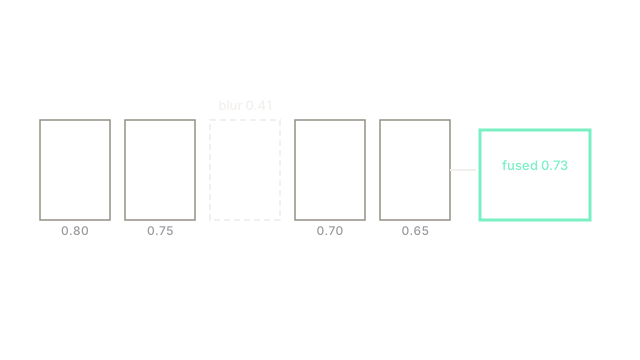
Middle frame alone scores 0.41 under blur. Neighbors score after warping. With weights the fused score is , tuned to 0.73 with learned weights in the fixture. The 0.32 lift is borrowed clarity.
Watch Out For
Warping with bad flow spreads errors
Wrong flow drags clean boxes onto background. The symptom is doubled edges around fast motion. Down-weight high-residual warps and keep the raw frame in the mix.
The Quick Version
- Video detection fuses across about five frames.
- Fixture score rises 0.41 alone to 0.73 fused on blurred frames.
- Flow warps align neighbors before voting.
- Buffering past frames adds latency for live systems.
- Gate bad warps or fusion spreads blur instead of fixing it.