Video Summarization Picks Key Moments
Summarization scores every shot for importance and variety, then keeps a short set that still tells the story.
Why Does This Exist?
Nobody rewatchs hours to find minutes. Manual skimming is slow and different editors keep different moments.
Summarization automates the trailer. It watches with video understanding, labels moments like video classification, and outputs clips that video captioning can then describe.
Think of It Like This
A trailer editor with twelve reels
An editor watches twelve reels, scores each scene, and keeps three that cover setup, climax, and payoff without repeating one chase twice.
It fails when every reel looks vital. Keeping all highlights makes a trailer as long as the film.
How It Actually Works
Score shot with importance and penalize similarity to kept shots, where is predicted interest and similarity is visual overlap. Pick set of 3 maximizing , where trades importance against diversity.
Worked example
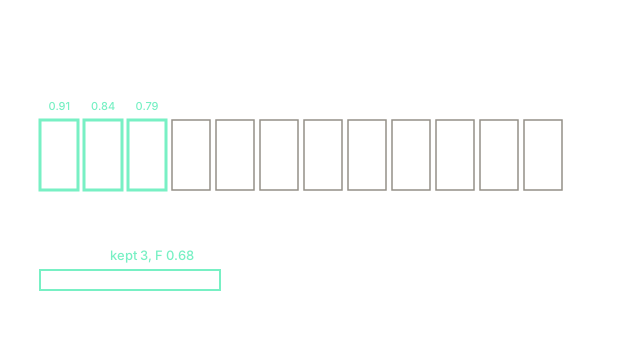
Twelve shots score . Top three sum to with low mutual similarity , giving . Swapping in the fourth 0.62 for 0.79 drops the total because similarity jumps. Kept 3 of 12 reach F-score 0.68 against human picks.
Watch Out For
Optimizing importance without diversity
Top- by score keeps three near-identical goals. The symptom is high precision with poor coverage. Always subtract the similarity term or enforce one pick per scene cluster.
The Quick Version
- Summaries maximize importance minus similarity with weight .
- Fixture keeps 0.91, 0.84, 0.79 for F-score 0.68 on 3 of 12 shots.
- Diversity matters as much as raw interest scores.
- Skims keep order while summaries may reorder for story.
- Cluster scenes first when videos run long.