Visual Navigation
Visual navigation steers a mobile robot to a goal using what it sees, building maps or policies that avoid obstacles without perfect localization.
Why Does This Exist?
Wheel odometry drifts, GPS drops indoors, and hallways change with moved furniture. A delivery robot still must reach room 204 without hitting a cart. Visual navigation exists to do that from cameras: track motion, map obstacles, and replan continuously when the world differs from memory. It trades survey-grade maps for robust-enough behavior.
For mapping see visual SLAM and for motion see optical flow.
Think of It Like This
Finding a gate in a busy terminal
You glance at signs, dodge suitcases, and reroute around a closed walkway without a floor plan. The robot does the same with cost maps and goals. The analogy stops at signs: the robot also integrates motion to avoid counting the same obstacle twice.
How It Actually Works
Visual odometry estimates motion between frames from matched features. Depth or stereo builds local occupancy. Semantics marks walkable versus blocked. A planner such as A-star or a learned policy converts cost plus goal into velocity commands. Replanning at several hertz absorbs new obstacles. Success is measured by arrival rate and collisions, not map beauty.
Worked example
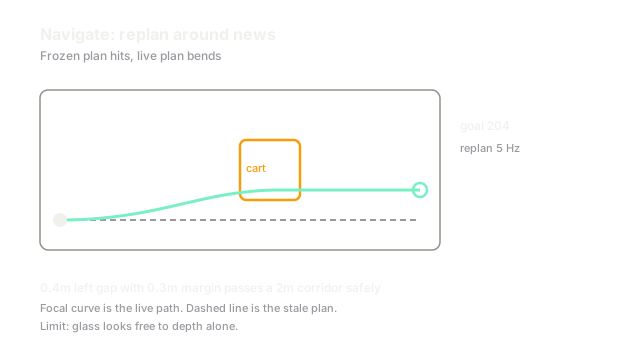
A corridor 2 m wide holds a 0.8 m cart dead ahead at 5 m. The cost map marks a 1.2 m blocked span with 0.4 m clearance on the left. Replanning bends the path 0.5 m left with 0.3 m safety margin and passes. A frozen plan drives into the cart. The 0.3 m margin is the parameter that decides scrapes versus detours.
Watch Out For
Glass and mirrors that look like free space
Depth fails on glass doors and mirrors report phantom corridors, so cost maps mark blocked as free. The symptom is confident drives into glass. The fix fuses semantics for glass, keeps a prior for known doors, and slows near reflective surfaces until touch or parallax confirms.
The Quick Version
- Navigation outputs velocity toward a goal through current obstacles.
- Odometry plus local cost maps replace perfect global maps.
- Replanning absorbs moved furniture and carts.
- Glass and mirrors need semantic caution beyond depth.
- Score arrivals and collisions, not trajectory beauty.