Wavelet Transform for Images
Wavelets split a photo into scale layers that remember where each detail sits. Coarse shape and fine texture separate without losing addresses.
Why Does This Exist?
The Fourier transform tells you which frequencies an image holds but not where they sit: a crack's location dissolves into global phase. Wavelets fix that with short oscillating probes at many scales and positions, so each coefficient reports one scale at one place. That locality powers progressive compression, multiscale denoising, and texture analysis that stays registered to the image.
It extends frequency-domain processing the way band-pass rings extend fixed filters: every band keeps its address, at every scale, simultaneously.
Think of It Like This
Map zoom levels that stay pinned
A map app holds the same city at country, street, and doorstep zooms, each pinned to the same GPS. Wavelets are those zoom tiles: coarse coefficients sketch districts, fine ones etch doorways, and every tile knows its coordinates. Fourier instead hands you one nationwide average of road curviness with no map at all. Zoom tiles cost more storage than one average, which is why wavelet coefficients outnumber pixels across levels.
How It Actually Works
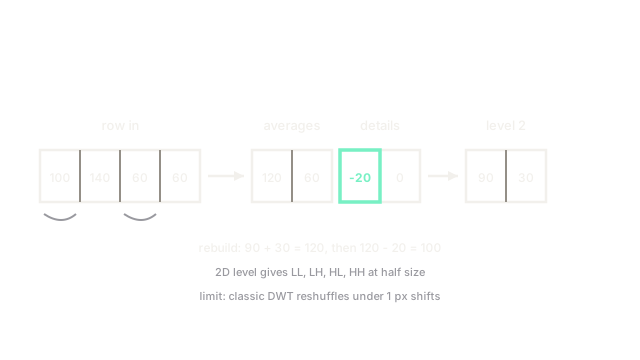
The discrete wavelet transform passes rows, then columns, through a low-pass (average) and high-pass (difference) filter pair and downsamples by two. One level yields four subbands: LL (coarse shape), LH, HL (edges each way), and HH (diagonal detail). Repeating on LL builds a pyramid of scales. The Haar pair is the simplest: average and difference per neighbour pair. Thresholding small detail coefficients denoises with locations intact, and coarse-to-fine search runs fast on tiny LL copies first.
Worked example
Haar-transform the row . Pair one gives average and difference . Pair two gives average and difference . Level one is averages plus details . Level two on the averages gives overall mean with detail . Rebuild checks out: , then . Every number round-trips exactly.
Watch Out For
Shift variance in the classic DWT
Move the input one pixel and critically sampled wavelet coefficients reshuffle unpredictably, so threshold rules tuned on one alignment misbehave on the next. The symptom is denoising quality that flickers with tiny shifts. Use undecimated or dual-tree variants when shift stability matters, at the cost of redundant coefficients.
The Quick Version
- Wavelets report frequency content per location at many scales.
- One level makes LL, LH, HL, and HH subbands at half resolution.
- Haar averages carry shape while differences carry detail, exactly invertible.
- Thresholding details denoises without smearing positions.
- Classic DWT shifts unpredictably; redundant variants fix alignment.