Band-Pass Filters in Imaging
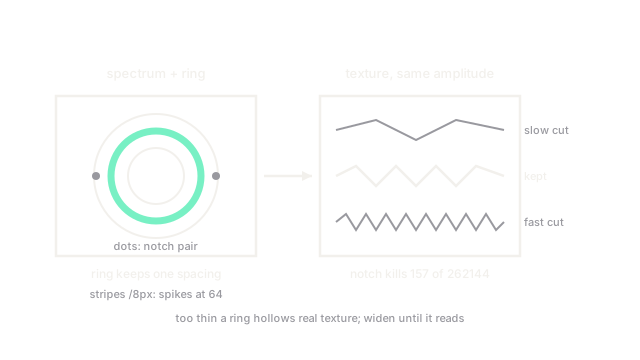
A band-pass filter keeps one ring of frequencies and drops the rest. Textures of one chosen scale pop out alone.
Why Does This Exist?
Low-pass keeps everything slow and high-pass keeps everything fast, but textures live between: print grain at one spacing, fabric weave at another, vessels of one width in a scan. A band-pass ring isolates exactly one scale so you can measure, enhance, or delete it without touching the rest. Its surgical twin, the notch filter, deletes one address instead of keeping one ring, erasing periodic stripes outright.
It completes the filter trio of frequency-domain processing beside low-pass and high-pass, all riding the Fourier transform.
Think of It Like This
One sieve from a stack
Gold panners stack sieves of many meshes and keep what lodges between two adjacent screens. The lower screen is the low cutoff, the upper is the high cutoff, and the trapped grade is your texture scale. A notch filter instead picks one pebble out of the pan by hand. Rings keep grades, notches remove pebbles, and both beat sifting the whole riverbed.
How It Actually Works
FFT the image and multiply the centered spectrum by a ring mask: 1 between inner radius and outer radius , 0 elsewhere. Only waves of that spacing band rebuild. The Difference of Gaussians builds the same idea cheaply in pixel space by subtracting two blurs. Notch filters flip the logic with tiny zeroed discs at the exact spectral addresses of periodic interference, then inverse-transform to a clean image.
Worked example
Stripes repeat every 8 pixels across a -wide image, planting spectral spikes at cycles from center. A notch pair of radius 5 zeroes about coefficients out of , under of the spectrum. Deleting a tenth of a percent removes the stripes everywhere at once, which no local pixel edit can match.
Watch Out For
Ring too narrow hollows real texture
An ultra-thin pass ring keeps so little energy that legitimate texture of nearby scales also dies, leaving ghostly fragments. The symptom is texture that reads in the original but vanishes into outlines after filtering. Widen the ring until the target texture reads continuously, then stop.
The Quick Version
- Band-pass rings keep one frequency band and drop slower and faster content.
- One scale of texture isolates cleanly for measurement or enhancement.
- Difference of Gaussians approximates a band-pass in pixel space.
- Notch filters delete tiny spectral addresses to kill periodic stripes.
- A fraction of a percent of coefficients often holds the whole defect.