Boosting
Bagging fits models in parallel and averages the variance away. Boosting fits them in sequence, each cleaning up after the last, and takes bias down instead.
Why Does This Exist?
Some models aren't unstable. They're wrong in the same direction every time, and averaging does nothing at all for that.
Here's the case we'll carry down the page. A batching plant mixes concrete and you want the 28-day compressive strength in megapascals before the truck leaves. Eight numbers per batch: cement, water, fly ash, aggregate, superplasticiser, slag, curing days. A thousand past batches, one crushed cylinder each.
Fit a depth-2 tree to that. Four leaves, four predicted strengths, roughly 8 MPa off across most of the yard. Now fit five hundred of them the way bagging does — resample the rows, fit in parallel, average — and you get 8 MPa off with a steadier hand. Resampling can't change what a procedure systematically misses, so bias walks through the average untouched. That's the wall, and the reason a second family exists.
The way out is almost rude in its directness. Don't average the four-leaf trees. Line them up, and give each one the job of predicting what the ones before it got wrong.
Think of It Like This
Skimming a wall in thin coats
A plasterer skimming a wall doesn't try to get it flat in one pass. The first coat goes on thin and gets the shape roughly right, leaving hollows an inch across. The second isn't a second wall — it goes only where the first left a dip, carrying almost no material. The third fills what the second couldn't reach.
Each coat alone is a bad wall. Stacked in order, each addressing what the previous one left, they're flat.
Two things follow, both true of boosting. Order can't be shuffled: coat three makes no sense without coats one and two under it. And past some point more coats hurt: once the hollows are gone you're filling the wall's own texture, bumps that were never defects.
How It Actually Works
One sentence separates the two families
Bagging fits models in parallel on resampled data and averages them, which cuts variance and leaves bias where it was. Boosting fits models in sequence, each one targeting what the previous ones got wrong, which cuts bias and can push variance up.
That's the taxonomy; the rest is detail hanging off it. Keep the bias–variance tradeoff in view and the choice is obvious. A deep tree on 1,000 batches is nearly all variance, so bag it. A four-leaf tree is nearly all bias, so boost it.
Why the learners have to be weak
Boosting runs on weak learners, usually depth-2 or depth-3 trees. Odd, until you notice the mechanism removes one thing only: a stump is high bias and low variance, badly wrong but reliably so, and reliable wrongness is what a correction step can chase.
Hand it a fully grown tree and there's nothing to do — round one fits the training set almost exactly, so round two is handed near-zero errors, which is noise, and fits that. Two to six levels, no deeper.
The additive model, and its two dials
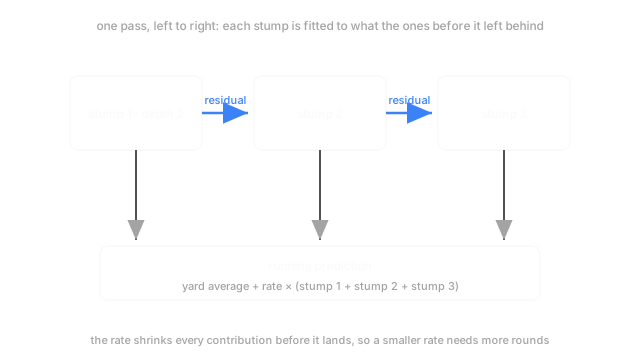
After rounds the model is a sum, not a vote:
is the starting guess, usually the mean strength across all batches. Each is a weak learner fitted to what still got wrong. is the learning rate, a number like 0.1 that shrinks every contribution before it's added, and is the round count.
Those two trade almost directly: halving roughly doubles the you need for the same fit, since each round moves you half as far. A small rate with many rounds beats the reverse, so fix low and let validation error decide .
Which is the real cost of going sequential. A forest converges: add trees and the curve flattens. Boosting has no floor, and keeps going until it's fitting the noise in your crushed cylinders, so early stopping on unseen data is part of the method, not a precaution.
One more family, briefly. Stacking fits several different models — a forest, a boosted ensemble, a linear fit — then trains a small meta-model on their predictions to learn how to blend them. It wins competitions and stays rare in production, because those base predictions have to be out-of-fold. Feed it predictions the base models made on their own training rows and it learns to trust whichever memorised hardest.
Code
One-dimensional concrete: strength against a single mix ratio, boosted with stumps. Watch the rate and the round count trade.
import numpy as np
rng = np.random.default_rng(1)mix = rng.uniform(0.0, 1.0, 300)strength = 40.0 + 12.0 * np.sin(6.0 * mix) + rng.normal(0.0, 2.0, 300) # 2 MPa of test noise
def boost(rate: float, rounds: int) -> float: pred = np.full(300, strength.mean()) # round 0 predicts the yard average for _ in range(rounds): r = strength - pred # what the ensemble still gets wrong cuts = np.quantile(mix, np.linspace(0.05, 0.95, 19)) fits = [np.where(mix <= c, r[mix <= c].mean(), r[mix > c].mean()) for c in cuts] pred = pred + rate * fits[int(np.argmin([((r - f) ** 2).sum() for f in fits]))] return float(np.sqrt(((strength - pred) ** 2).mean()))
print(" | ".join(f"rate {a} x {b} rounds -> {boost(a, b):.2f}" for a, b in ((0.1, 100), (0.05, 200), (0.5, 400))))# -> rate 0.1 x 100 rounds -> 2.21 | rate 0.05 x 200 rounds -> 2.22 | rate 0.5 x 400 rounds -> 1.98Halving the rate and doubling the rounds lands within 0.01 MPa of the same fit. The third run is the warning: training error 1.98 is below the 2 MPa of noise the cylinders carry, so those rounds bought memorisation.
Watch Out For
Boosting trees that were already deep enough to win alone
Someone raises max_depth from 3 to 20 because deeper trees scored better standalone. Training error hits zero in eleven rounds and validation comes back worse than a single pruned tree.
Deep trees leave no bias for the sequence to remove, so from round two each learner is fitted to residuals that are almost pure noise — and boosting fits whatever you give it. The signature is a training curve that collapses inside a dozen rounds instead of easing down over hundreds. Cap depth in the low single digits, drop the rate, add rounds.
Choosing the number of rounds by training error
Training error under boosting falls monotonically by construction: every round is fitted to reduce exactly that number. A curve still creeping down at round 3,000 says nothing about round 3,000 being a good place to stop. It carries no signal at all.
You need a validation set the sequence never touches, scored every round, with the count taken from where that curve turns up. Keep the best iteration rather than the last — most libraries have a flag for it. Short on data, pick the count by cross-validation and refit with it fixed.
The Quick Version
- Bagging: parallel, on resampled rows, averaged. Cuts variance. Boosting: sequential, each learner fitted to the leftover error. Cuts bias.
- Boosting wants weak learners, depth 2 to 6. Boost a deep tree and it overfits in a few rounds: after round one there's nothing left but noise.
- The model is a sum of shrunken contributions rather than a vote, so order is load-bearing and rounds can't be parallelised.
- Learning rate and round count trade directly: halve the rate, roughly double the rounds. Small rate, many rounds, wins.
- Unlike a forest, boosting will overfit given enough rounds. Early stopping on held-out data is part of the method.
- Stacking is the third family: a meta-model blending diverse models. It leaks unless the base predictions are out-of-fold.