Long-Horizon Agents
Most agents crash after 5 minutes because they forget what they are doing. Long-Horizon Agents are designed to run for hours or days by continuously saving their progress, summarizing their history, and adjusting their long-term plans.
Why Does This Exist?
If you ask a standard agent to "Check the weather in New York," it will succeed in 10 seconds. If you ask a standard agent to "Write a 300-page fantasy novel," it will fail spectacularly.
Standard agents suffer from two massive problems over long periods of time:
- Context Degradation: After 50 steps, the chat history is so long that the LLM forgets the original instructions. It starts writing a sci-fi novel instead of a fantasy novel.
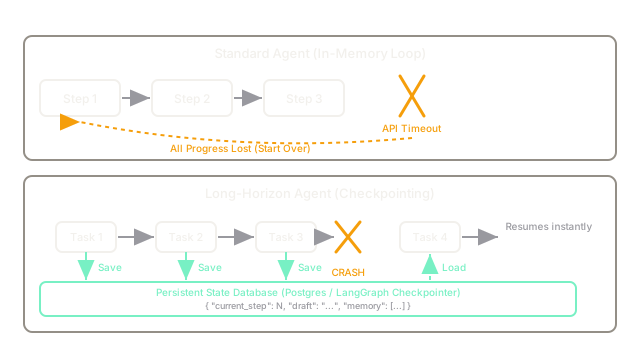
- Execution Fragility: If the python script crashes on step 49 (because an API key expired), the entire
whileloop crashes. All 49 steps of progress are deleted from RAM, and you have to start completely over from step 1.
Long-Horizon Agents are specifically architected to survive tasks that take hours, days, or even weeks to complete (like migrating a legacy codebase or conducting a comprehensive academic literature review).
Think of It Like This
The Cross-Country Road Trip
Standard Agent: Tries to memorize the entire 3,000-mile route from New York to LA in their head before starting the car. Halfway through Kansas, they forget the route, get lost, run out of gas, and have to be towed back to New York to start over.
Long-Horizon Agent: Breaks the trip into 50-mile milestones. They drive to the first milestone, pull over, write down exactly where they are in a journal (saving state), check the map for the next milestone, and start driving again. If the car breaks down, they just resume the trip from the last saved milestone.
How It Actually Works
Building a Long-Horizon Agent requires heavy orchestration outside of the LLM. You cannot just use a single while loop.
1. Hierarchical Planning
The agent cannot just start working. It must first write a "Master Plan." This plan is saved to a database. The agent then selects Task 1 from the Master Plan and executes it. When Task 1 is done, it marks it as complete in the database and moves to Task 2.
2. Checkpointing (State Persistence)
Every time the agent finishes a sub-task, the orchestration code must take a snapshot of the agent's memory (variables, downloaded files, partial code) and save it to a persistent database (like Postgres). If the server restarts or an API crashes, the orchestrator simply loads the last checkpoint and resumes execution exactly where it left off.
3. Context Compaction
Because the agent might run for 5,000 steps, you cannot feed the entire chat history into the LLM prompt. You must use Context Compaction to summarize older steps into a dense "scratchpad," ensuring the prompt stays small, cheap, and focused.
Code
Frameworks like LangGraph (with its checkpointer feature) are built specifically to handle the state persistence required for long-horizon tasks.
# Conceptual example of a Long-Horizon Checkpoint Loopimport sqlite3import json
def load_checkpoint(session_id): # Load the agent's progress from a database # e.g., {"current_step": 3, "plan": [...], "draft_text": "Chapter 1..."} return db.query("SELECT state FROM checkpoints WHERE session_id = ?", session_id)
def save_checkpoint(session_id, state): # Save the agent's exact state to the database db.execute("UPDATE checkpoints SET state = ? WHERE session_id = ?", json.dumps(state), session_id)
def execute_long_horizon_agent(session_id): # 1. Resume from exactly where we left off (even if the server crashed yesterday) state = load_checkpoint(session_id) while not state["is_finished"]: current_task = state["plan"][state["current_step"]] print(f"Executing Task {state['current_step']}: {current_task}") # 2. Execute a small, scoped action result = call_llm(task=current_task, current_draft=state["draft_text"]) # 3. Update the state state["draft_text"] += result state["current_step"] += 1 if state["current_step"] >= len(state["plan"]): state["is_finished"] = True # 4. 🚨 CRITICAL: Save the state immediately after every step! save_checkpoint(session_id, state) # Now, if the server crashes right here, we only lose 1 step of progress, not the whole job.
# --- Execution ---# Imagine this script is run by a cron job every hourexecute_long_horizon_agent(session_id="novel_writing_job_123")Watch Out For
The Sunk Cost Fallacy
If a long-horizon agent makes a critical mistake on Day 1 (e.g., it misunderstands the fundamental premise of the novel), but it doesn't realize it, it will spend the next 5 days writing 300 pages of garbage. Because long-horizon tasks consume massive amounts of API credits, you must implement Human-in-the-Loop checkpoints. The agent should be forced to pause and request human approval after completing major milestones (e.g., "Review the outline before I start writing").
The Quick Version
- Standard agents keep their memory in RAM (the chat history array). If the app crashes, the memory is deleted.
- Long-Horizon Agents are designed to survive tasks that take days to complete.
- They rely on Hierarchical Planning (breaking big tasks into small milestones).
- They rely on Checkpointing (saving their exact state to a database after every single step).
- They require continuous Context Compaction to ensure their prompts don't grow infinitely large.