Model Supply Chain Security
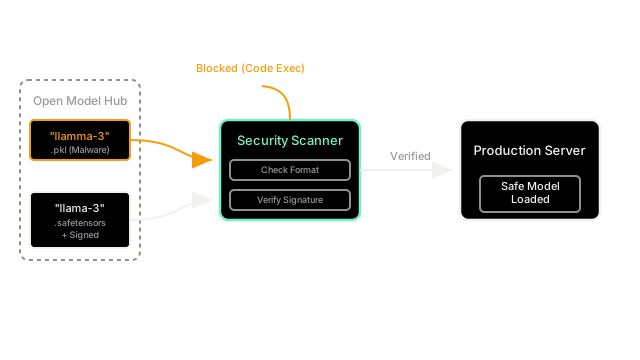
Before downloading and running a model from the internet, developers must verify its cryptographic signature and scan its weights for malware to ensure it hasn't been tampered with.
Why Does This Exist?
In the early days of software, developers wrote everything from scratch. Today, modern software is assembled using thousands of open-source libraries. If an attacker compromises a popular library, they compromise every company that uses it. This is a "Supply Chain Attack."
The AI industry is undergoing the exact same transition. Instead of training models from scratch, almost everyone downloads pre-trained foundation models from hubs like Hugging Face. But a model file (like a PyTorch .pt or Python pickle file) is not just passive data—it can contain executable code. If a developer downloads a compromised model, simply loading it into memory can execute a payload that steals the company's AWS keys or installs ransomware.
Model Supply Chain Security is the set of practices used to guarantee that the models, datasets, and tokenizers you download are exactly what their creators intended them to be, and not malicious imposters.
Think of It Like This
Accepting a sealed package from a courier
Imagine you order a highly sensitive piece of machinery online.
When the courier hands you the box, you don't just blindly open it and plug the machine into your home's power grid. First, you check the wax seal on the box to ensure it hasn't been tampered with during shipping (Cryptographic Signing). Then, you put the box through an X-ray scanner to ensure no explosives were hidden inside it by the manufacturer (Malware Scanning). Only then do you plug it in.
Model Supply Chain Security is the wax seal and the X-ray machine for downloaded AI models.
How It Actually Works
The Danger of Pickle Files
In Python, the standard way to save a machine learning model is using a serialization format like pickle. The massive problem with pickle is that it allows for arbitrary code execution. When you "unpickle" a file, Python can run scripts embedded inside it.
An attacker can take a legitimate, highly-performing open-source model, inject a script that opens a reverse shell to their server, repackage it as a pickle file, and upload it to a model hub under a slightly misspelled name (e.g., llama-3 vs llamma-3). If a developer downloads it and runs torch.load(), the attacker instantly owns their machine.
Safe Tensors
To mitigate the pickle vulnerability, the industry created Safetensors. This is a new, secure file format for storing model weights. Safetensors files only store math (tensors). They physically cannot execute code when loaded. A core rule of model supply chain security is to never download a pickle file if a safetensors version is available.
Cryptographic Provenance (Signing)
How do you know that the Meta-Llama-3 model on Hugging Face was actually uploaded by Meta?
Model signing (using frameworks like Sigstore) allows creators to cryptographically sign their model files before uploading them. When a developer downloads the model, their local system verifies the signature against the creator's public key. If a hacker intercepts the download and changes even a single weight in the model (e.g., to insert a Backdoor), the signature breaks, and the system refuses to load the model.
Code
# BAD: Loading an untrusted model using an insecure formatimport torch# If "untrusted_model.pt" is a malicious pickle file, # this line executes the attacker's code instantly.insecure_model = torch.load("untrusted_model.pt")
# GOOD: Loading a model using Safetensorsfrom safetensors.torch import load_file# If the file contains executable code, Safetensors will throw an error # and refuse to load it. It only parses raw tensors.secure_model = load_file("trusted_model.safetensors")Watch Out For
Typosquatting and social engineering
The easiest way to compromise a supply chain isn't to hack Hugging Face; it's to trick a tired developer. Attackers constantly upload malicious models with names that are one letter off from popular models, or they create organizations that look official (e.g., Microsoft-AI instead of microsoft). Always verify the organization's verified badge and the exact spelling of the model ID.
Compromised datasets
Supply chain security doesn't stop at model weights. If you download an open-source dataset to fine-tune your model, that dataset might contain Data Poisoning. Scanning models for malware is easy; scanning datasets for subtle, mathematical poisoning triggers is incredibly difficult.
The Quick Version
- Model Supply Chain Security protects organizations from downloading and executing malicious AI models or datasets from the internet.
- Traditional model file formats (like Python
pickle) allow for arbitrary code execution, meaning loading a model can install malware. - The
safetensorsformat was created to fix this; it only stores data, not executable code. - Cryptographic signing ensures that a model was actually created by the claimed author and hasn't been tampered with in transit.
- Developers must use automated scanners to check for malware, verify signatures, and enforce the use of safe formats before deploying external AI assets.