Prompt Regression Testing
Because language models are highly sensitive to phrasing, editing a prompt to fix one edge case frequently breaks ten other use cases. You cannot edit prompts safely without a regression test suite.
Why Does This Exist?
In traditional software engineering, if a function fails on a specific edge case, you add an if statement to handle it. You know with 100% certainty that your if statement will not alter the behavior of the else block. Classical code is deterministic and isolated.
Prompt engineering is not classical code. Prompts are highly coupled, non-deterministic distributions. If an AI agent fails to process a refund correctly, a prompt engineer might add the sentence: "Always process refunds immediately." This fixes the refund edge case, but because the model's entire attention mechanism shifts to accommodate the new tokens, it might suddenly start issuing refunds for completely unrelated, inappropriate queries.
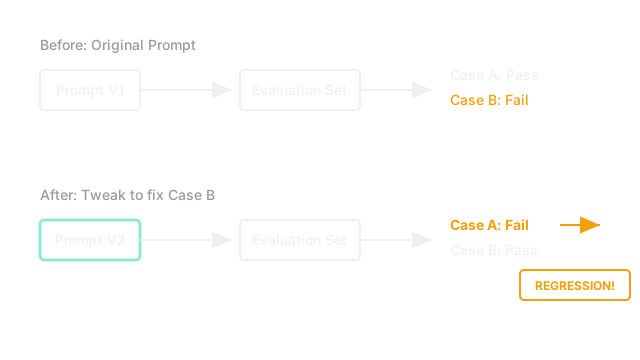
This is prompt collateral damage. You cannot simply "tweak" a prompt in production. Every time you change a single word in a system prompt, you must treat it as a fundamentally new model deployment. Prompt regression testing exists to ensure that your fix for Case B did not silently destroy Case A.
Think of It Like This
Think of editing a prompt like pulling a single string on a spiderweb.
If you see a bug caught on the left side of the web, you might pull a string on the right side to tighten it. It fixes your immediate problem, but it warps the entire structure of the web, causing three other strands to snap on the opposite side.
A regression test suite is like mapping the exact tension of every string in the web. Before you are allowed to pull the new string, you must prove that the tension on all the other strings remains perfectly intact.
How It Actually Works
Prompt regression testing requires a mindset shift from "prompt hacking in a playground" to "software engineering discipline." It relies on three core components:
1. The Golden Dataset (The Regression Suite)
You must build a static, version-controlled dataset of hundreds of historical inputs and their expected behaviors. This dataset must contain a diverse mix of:
- Standard Use Cases: The everyday traffic your model handles easily.
- Historical Bugs: Every time a user reported a failure and you fixed the prompt, that failure input gets permanently added to the dataset so it never regresses.
- Adversarial Edge Cases: Tricky, complex inputs that test the boundaries of the prompt's constraints.
2. The Automated Harness
When an engineer wants to change the prompt, they cannot just test it manually on three examples in a chat UI. They must submit a pull request. The CI/CD pipeline intercepts the pull request, boots up an evaluation-harness-design, and runs the new prompt against the entire Golden Dataset.
3. Delta Analysis (The Diff)
The harness does not just output a pass/fail score; it outputs a delta. It compares the results of Prompt V2 against Prompt V1, case by case.
- Fixed: Examples that V1 failed but V2 passed.
- Regressed: Examples that V1 passed but V2 failed.
- Unchanged: Examples where the behavior remained the same.
If the number of Regressed examples is greater than zero, the pull request is blocked. The engineer must go back to the drawing board and figure out how to fix the new edge case without destroying the old ones.
Code
Here is a conceptual example of a regression testing script that compares two prompts against a test suite and flags regressions.
def run_regression_test( baseline_prompt: str, new_prompt: str, test_suite: list[dict], evaluator_fn: callable) -> dict: """ Runs both prompts against the test suite and calculates the delta. """ results = {"fixed": 0, "regressed": 0, "unchanged": 0, "details": []} for case in test_suite: input_data = case["input"] expected = case["expected_behavior"] # Evaluate Baseline base_pass = evaluator_fn(baseline_prompt, input_data, expected) # Evaluate New Prompt new_pass = evaluator_fn(new_prompt, input_data, expected) if not base_pass and new_pass: results["fixed"] += 1 status = "FIXED" elif base_pass and not new_pass: results["regressed"] += 1 status = "REGRESSED" else: results["unchanged"] += 1 status = "UNCHANGED" if status == "REGRESSED": results["details"].append(f"Regression on input: {input_data}") return results
# If results["regressed"] > 0:# raise CI_CD_Error("Prompt change caused regressions. Deployment blocked.")Watch Out For
The Playground Trap
The most dangerous tool in generative AI is the web-based "Prompt Playground" provided by API vendors. It encourages engineers to tweak a prompt, test it on a single example, and copy-paste it into production. You must ban copy-pasting prompts into production. All prompt changes must go through version control (Git) and trigger the automated regression suite.
Prompt Bloat
Without regression testing, engineers are terrified to delete anything from a prompt because they don't know why it was put there originally. As a result, prompts grow into massive, unreadable essays filled with contradictory rules (e.g., "Be concise. Also, make sure to explain everything in detail.") A regression suite allows you to safely refactor and shrink your prompts, proving that you deleted fluff without breaking functionality.
The Quick Version
- Modifying a prompt to fix one specific edge case almost always alters the model's behavior on unrelated tasks.
- You cannot verify a prompt edit manually; you must use an automated regression test suite.
- A regression suite is a large, static dataset of historical inputs and expected behaviors (including all past bugs).
- Before a new prompt is deployed, it must be run against the entire suite to prove that no old behaviors have regressed.
- If an engineer is tweaking prompts in a web UI and deploying them without running a full suite, they are flying blind and will inevitably break production.