Advanced Non-Convex Optimization
Deep learning trains on rugged loss surfaces with saddles and uneven valleys, so this overview maps which tools handle each terrain and when each guarantee holds.
Why Does This Exist?
Convex theory promises that any local minimum is global. Deep networks break that promise on purpose: with millions of parameters and nonlinear activations, the loss surface has saddles, flat plateaus, and valleys of uneven sharpness. Standard convex guarantees go silent exactly where training spends its time.
Without a map, practitioners misdiagnose stalls. A flat gradient could mean a minimum, a saddle, or a plateau, and each needs a different response. This page is the map. It names the terrains (non-convex landscapes), the escape tools (saddle-point escape), and the guarantees that survive without convexity, such as the Polyak-Lojasiewicz condition and non-convex SGD convergence.
The one idea you need first
A critical point is any spot where the gradient is zero. In convex problems every critical point is a minimum. In non-convex problems it can be a minimum, a maximum, or a saddle, so you need curvature (the Hessian) to tell them apart. The full treatment of that split is in convex and non-convex optimization.
Think of It Like This
Hiking a mountain range in fog
You are crossing rough mountains in thick fog with only an altimeter and a slope meter. Sometimes the ground is flat because you reached a valley floor. Sometimes it is flat because you stand on a mountain pass with drops on two sides and climbs on the other two. Sometimes it is flat because you crossed a wide mesa.
Your slope meter reads zero in all three cases. What saves you is feeling the curvature under your boots: bowl in every direction means valley, bowl one way and dome the other means pass, flat everywhere means mesa. Non-convex optimization is learning to tell those three flats apart and carrying the right gear for each.
Where the analogy stops: real loss surfaces have millions of dimensions, so a pass can drop in 5 directions and climb in 5 million others.
How It Actually Works
Three questions organize the whole area:
- What does the terrain look like? Minima, maxima, saddles, and plateaus, classified by Hessian eigenvalues. One negative eigenvalue out of a million still makes a saddle.
- How do you move through it? Noise, momentum, and curvature corrections that escape saddles without destroying convergence.
- What can you still prove? Stationarity rates, PL linear convergence, and minimax equilibria instead of global optimality.
Worked example
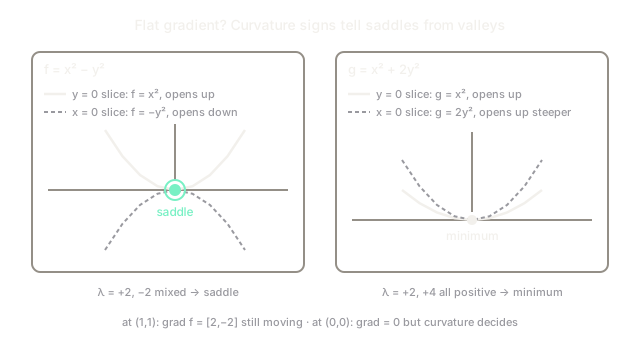
Take at the point :
- Gradient: , so the slope is nonzero and you keep moving.
- Hessian: with eigenvalues and . Mixed signs mean every critical point is a saddle.
- At the gradient is but the Hessian signs still mix, so stopping there would strand you at a saddle, not a minimum.
Contrast at : gradient , Hessian , both eigenvalues positive, so the critical point at the origin is a true minimum. Same zero-gradient test, opposite verdict. Curvature decides.
Watch Out For
Treating every flat gradient as a minimum
When the gradient norm drops below , teams often declare convergence and ship. On non-convex surfaces that flat spot is frequently a saddle with one small negative eigenvalue hiding among thousands of positive ones.
Check the symptom: loss stalls while the gradient stays small for hundreds of steps, then drops suddenly when noise pushes you off. Fix it by adding a little isotropic noise or running a few curvature-seeking steps before concluding you are done.
Demanding a global-optimality proof before training
Some teams delay training until theory guarantees a global minimum. That guarantee never comes for deep networks, and waiting wastes months.
The workable standard is stationarity: gradient norm small, curvature not strongly negative, validation loss flat. Prove and monitor that instead.
The Quick Version
- Non-convex surfaces contain minima, saddles, and plateaus that all look flat to first order.
- Hessian eigenvalue signs classify critical points: all positive means minimum, mixed means saddle.
- Escape tools use noise, momentum, and curvature rather than raw gradient steps.
- Surviving guarantees cover stationarity and PL linear convergence, not global optimality.
- Flat gradient plus mixed curvature means saddle, so check curvature before stopping.