Algorithmic Stability
A catalogue of stabilities: uniform, hypothesis, leave-one-out and SGD stability each bound a different gap. Pick the variant matching the claim you want about test error.
Why Does This Exist?
Stability is not one definition. Uniform stability controls the worst test point under the worst swap and gives high-probability bounds. Hypothesis stability averages over the swapped example and suits squared error. Leave-one-out stability tracks retraining without each point and connects to cross-validation. SGD stability grows with steps and learning rate, explaining early stopping. Using the wrong variant proves the wrong gap.
This page separates the four so the companion page can use them. Stability-based generalization turns these definitions into test-error guarantees; here the job is precise meanings, standard rates and which algorithm earns which variant.
Prerequisite in one paragraph. You need training sets and differing in example , plus outputs and . Loss measures one prediction's error. Background is in sampling distributions and stochastic gradient descent variants.
Think of It Like This
Four ways to test a recipe
Uniform stability tastes every dish after swapping any ingredient: the worst change anywhere must be small. Hypothesis stability tastes the average dish after an average swap. Leave-one-out recooks the meal missing each ingredient in turn and compares. SGD stability watches the cook stir: each extra stir lets one ingredient spread further.
All four test insensitivity, but the strictness differs wildly. The uniform taste test fails recipes the average test passes, and the stir count explains why a briefly stirred soup is stable while an overnight stew is not.
Where the analogy stops: recipes mix ingredients physically while algorithms mix them through optimisation geometry. Only convexity or step limits make the stir count quantitative.
How It Actually Works
Uniform stability: , the worst swap and worst test point move loss by at most . Hypothesis stability takes expectation over the swap. Leave-one-out stability bounds on the held-out point. On-average stability bounds the mean over .
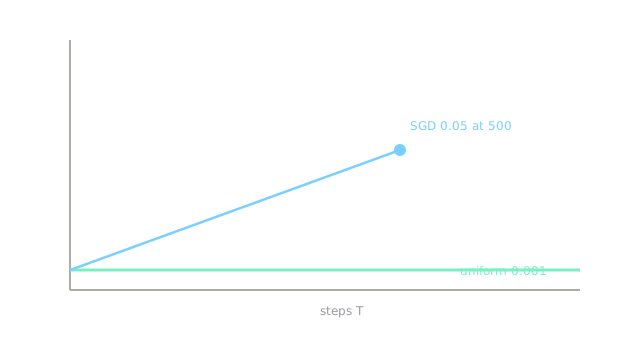
Standard rates: -strongly convex regularised ERM has uniform for -Lipschitz loss. SGD with steps, rate and smooth loss has uniform up to logs. With , and , times smoothness constants near , giving about in the diagram. Halve the steps and stability halves; double the rate and it doubles.
Worked example
Ridge with , , gives uniform as on the companion page. Its leave-one-out error then estimates test error within in expectation, so -fold CV at per fold tracks truth tightly.
SGD on a smooth convex loss with for steps on the same gives . Train at and the stability gap alone allows test up to . Train for steps and grows toward , vacuous: the bound itself recommends early stopping, which matches practice.
Watch Out For
Quoting uniform rates for a hypothesis-stable algorithm
kNN has good hypothesis stability but poor uniform stability: one swap can flip a neighbourhood and move one test loss a lot while the average barely moves. The uniform bound goes vacuous while the hypothesis bound stays meaningful. Demanding uniform stability everywhere rejects algorithms that generalise fine on average.
Fix: match variant to loss. Bounded regression can use hypothesis stability; high-probability claims need uniform.
Ignoring the step count in SGD stability
SGD stability grows with , so the bound at step says nothing about step . Reporting the early beside final-epoch test accuracy borrows a guarantee the run already spent.
Fix: state with every SGD stability number. No steps, no claim.
The Quick Version
- Uniform caps the worst swap on the worst test point; hypothesis and leave-one-out average instead.
- Strongly convex ERM gets uniform , which is 0.001 for ridge at 2000 samples.
- SGD gets about , which is 0.05 at 500 steps of 0.01 on 2000 samples.
- Early stopping is a stability decision: fewer steps mean smaller .
- Always state steps and variant; uniform, average and SGD numbers are not interchangeable.