Integration Techniques
Two moves handle most integrals: substitution unchains a composition, and integration by parts trades a hard product for an easier one.
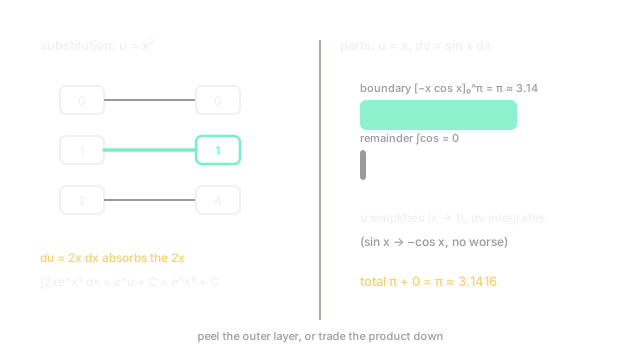
Why Does This Exist?
Real integrals are rarely bare powers. Gaussian expectations hide compositions like , variational bounds multiply polynomials by trig or exponential factors, and normalizing constants chain transformations together. The antiderivative table alone cannot touch them. These two techniques are the chain rule and product rule run backwards, which makes them the integration half of the differentiation toolkit you already own.
Definite and indefinite integrals defines what we are computing, and change of variables generalizes substitution to probability densities. This page teaches the two moves with verified numbers.
The one idea you need first
Every technique here reverses a differentiation rule. Substitution reverses the chain rule; parts reverses the product rule. When stuck, ask which differentiation rule would have created the integrand, then run it backwards.
Think of It Like This
Unwrapping a parcel two ways
Substitution is noticing the parcel was wrapped in layers and peeling the outer one first: spot an inner function whose derivative also sits in the integrand, rename everything to , and the composition collapses into a table entry. Integration by parts is a swap negotiation for products: agree to differentiate one factor if the other becomes easier to integrate, formalized as choosing and .
Both moves convert an unfamiliar integral into a familiar one. Neither promises success on the first try; experienced integrators attempt, inspect the remainder, and switch moves when the remainder gets uglier instead of simpler.
How It Actually Works
Substitution. For , set so , then integrate in :
In plain words: absorbs the into , leaving the table entry . Verify by differentiating: by the chain rule. Round trip confirmed.
Integration by parts. From rearranged and integrated:
In plain words: differentiate down to something simpler while integrating into something no worse. Choose as the factor that simplifies when differentiated (polynomials first: the ILATE guideline suggests Inverse trig, Log, Algebraic, Trig, Exponential priority for ).
Worked example
Evaluate by parts. Choose (differentiates to 1) and (integrates to ):
Boundary: at , ; at , . So the boundary term is . The remaining integral . Total: . The product traded into a boundary term plus a vanishing cosine, exactly the bargain parts promises.
Watch Out For
Substituting without the du factor
The symptom is a -integral missing its differential: setting in but forgetting leaves a stray factor of 2. The fix is mechanical: always write explicitly and divide it out before integrating. If the integrand lacks the derivative up to a constant factor, adjust with constants only; if it lacks it structurally, substitution was the wrong move.
Choosing u and dv backwards in parts
Picking and in the worked example gives , a harder remainder, and repeated rounds spiral upward in degree. The symptom is remainders that grow instead of shrink. Apply ILATE (logs and polynomials as first), and abort a choice whose remainder is uglier: swap roles and retry rather than pushing through. Two failed arrangements mean the integral wants a different technique entirely.
The Quick Version
- Substitution reverses the chain rule: set to the inner function, absorb its derivative into .
- Parts reverses the product rule: .
- , verified by differentiating back.
- : boundary term survives, cosine remainder vanishes.
- Always write out; missing differentials are the top substitution bug.
- Choose to simplify under differentiation (ILATE), and switch moves when remainders grow.