Fundamental Theorem of Calculus
Differentiation and integration undo each other: accumulate a rate and then ask the rate of the accumulation, and you get the rate back.
Why Does This Exist?
Without this theorem, every area needs an infinite limit of rectangles computed by hand. With it, one subtraction replaces the infinity: find any antiderivative, evaluate twice, subtract. It also runs backwards, differentiating an accumulated quantity recovers the rate being accumulated, which is how probability densities emerge from cumulative distributions and how conservation laws turn flows into totals.
Definite and indefinite integrals defines both integral kinds. This page is the bridge between them and the derivative: two statements, two directions, one idea.
The one idea you need first
Accumulation from a fixed start, , is itself a function of the endpoint : push right and more area piles in. The theorem asks what happens when you differentiate that pile with respect to where you stopped.
Think of It Like This
An odometer and a speedometer calibrating each other
Drive with a broken odometer that only shows distance since 1pm. Glance at how fast its reading climbs: that climb rate always equals your current speed. Accumulate speed, then measure the accumulation's rate, and speed returns. That is the first half.
Now reverse it. Given only the speed log, recover distance between 1pm and 3pm: any odometer history consistent with those speeds will do, because all candidates differ by a constant starting value that cancels in the subtraction. Differentiate-then-accumulate and accumulate-then-differentiate both round-trip, up to that one constant.
How It Actually Works
Part 1: differentiate the accumulation, recover the rate. If is continuous,
In plain words: the slope of the area-so-far at equals the curve's height at . Area piles in exactly as fast as the curve is tall.
Part 2: integrate the rate, subtract the endpoints. If , then
In plain words: total accumulation is the antiderivative's net change. Any antiderivative works because competing s cancel.
Worked example
Both directions with .
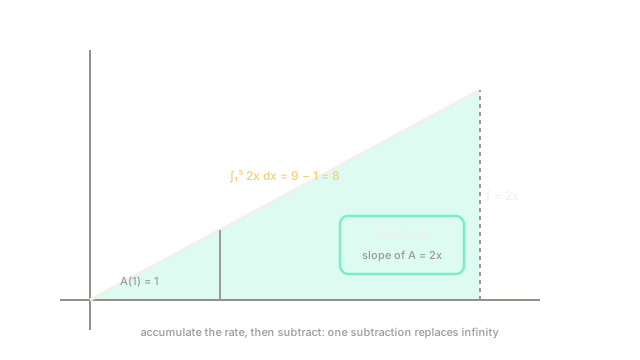
Part 1: . The theorem promises without computing. Verify: the area under from 0 to is a triangle of base and height , area , and . Promise kept.
Part 2: . Antiderivative . Subtract: . One subtraction replaces the rectangle limit, and geometry agrees: the trapezoid under from 1 to 3 has widths summing to over run 2, area .
Watch Out For
Applying part 1 where the integrand jumps
Part 1 needs continuity: if jumps at a point inside, the area function develops a corner there and no single derivative exists. The symptom is a "density" recovered by differentiating a CDF across a point mass, producing nonsense at exactly the atom that matters. Split the accumulation at every jump first, apply the theorem on each continuous piece, and handle point masses as discrete lumps, not densities.
Forgetting the chain rule on variable limits
For , the upper limit moves at , not 1, so the answer is , not . The symptom is an off-by-a-factor gradient in every reparameterized expectation and every Leibniz-rule differentiation under the integral. Multiply by the limit's own derivative: rate of accumulation equals height times how fast the boundary advances.
The Quick Version
- Part 1: differentiating accumulated area recovers the curve height.
- Part 2: integrating a rate over is for any antiderivative.
- , and .
- Any antiderivative works for part 2 because constants cancel in the subtraction.
- Part 1 needs a continuous integrand; jumps need splitting first.
- Moving limits multiply by the boundary speed via the chain rule.