Product Measures
How to build joint distributions from marginals, so pairs, sequences and independence have rigorous mass.
Why Does This Exist?
Pairs need probabilities: from data and label, from two latents, sequences . Declaring marginals is not enough; the joint must give every rectangle a mass consistent with iterated integration.
Product measures provide the joint for independent components and the base for kernels in dependent ones. Fubini's theorem then computes its integrals in either order.
This page builds the independent case. Dependent joints via kernels extend it, and integration order is in Fubini's theorem.
The one idea you need first
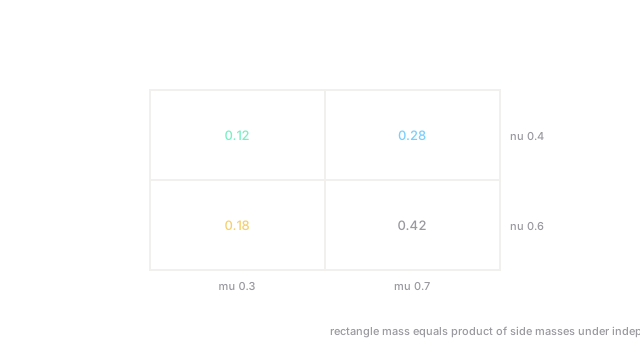
A rectangle pairs an -event with a -event. The product rule sets , then extends to the generated sigma-algebra.
Think of It Like This
Area from side lengths
A tiled floor has width distribution and length distribution . The area of one tile is width times length. Whole-floor area adds tile areas.
Rectangles are tiles. Countable additivity extends tiles to oddly shaped rooms. Where the analogy stops: floors are finite, while product measures handle infinite sequences by extension theorems like Kolmogorov.
How It Actually Works
For -finite and , a unique product measure on satisfies . Sections of measurable sets are measurable, and equals either iterated integral for non-negative or integrable .
Independence is product structure: independent exactly when .
Worked example
Two fair coins: on . Rectangles: , , each product of halves. With biased and : masses summing to . Marginals recover by summing rows or columns.
Watch Out For
Multiplying marginals for dependent pairs
Symptom: joint built as product while data has correlation , so modeled misses the diagonal by . Fix: product is independence; dependent joints need a copula or kernel, not side multiplication.
Assuming products exist without sigma-finiteness
Symptom: uncountable products with counting measure give non-unique extensions and contradictory integrals. Fix: check -finiteness; for arbitrary processes use Kolmogorov with consistent finite-dimensional laws.
The Quick Version
- Product measures set rectangle mass to side-mass product, then extend uniquely.
- They are the definition of independence for pairs and sequences.
- Biased coins by give joint .
- Iterated integrals against products agree by Tonelli and Fubini.
- Dependent structure needs kernels; products alone assert independence.