Sets, Logic and Proofs
Sets collect the objects, logic tests claims about them, and proofs chain tested claims into conclusions you can trust without rechecking.
Why Does This Exist?
Every ML argument stands on three legs and most confusion comes from mixing them up. "The training set" is a set question: which objects are in? "If accuracy drops then rollback" is a logic question: which claims follow? "This optimizer converges" is a proof question: why should anyone believe it? Practitioners who cannot separate the three debug the wrong layer: rewriting data pipelines when the logic was faulty, or doubting verified code when the dataset was misdefined.
This page is the map of the territory: what each leg does, how they connect, and where each gets its full treatment. The details live in set theory, propositional logic, truth tables, quantifiers, and proof techniques.
The one idea you need first
A claim is a sentence that is either true or false, never both, never neither: "7 is odd" qualifies, "wow, big number" does not. Sets collect the objects claims talk about, logic combines claims into bigger ones, and proofs assemble true claims into new true claims. Everything below is machinery for handling claims responsibly.
Think of It Like This
A kitchen, a recipe, and a tasting panel
A kitchen stocks ingredients (sets): exactly what is available, no more. A recipe combines them with steps (logic): if the oven is hot and the timer rings, the bread is done. A tasting panel certifies the result (proof): independent judges confirm the bread is good, so future diners need not re-taste.
Skip the inventory and the recipe names missing items. Skip the recipe and tasting is random. Skip the tasting and every meal is a gamble. ML systems fail the same three ways: undefined data, faulty conditional logic, and unproven convergence claims served with confidence.
How It Actually Works
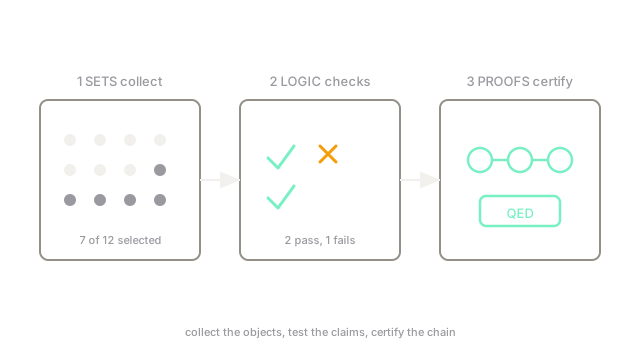
The pipeline runs in three stages, each with its own question:
- Sets answer "what is in?" A set like selects 7 of 12 by a membership rule. Operations (union, intersection, complement) combine selections; see set theory and Venn diagrams.
- Logic answers "what follows?" From "all are " and " is in ", logic derives " is in " mechanically. Connectives (and, or, not, implies) build compound claims; see propositional logic.
- Proofs answer "why certain?" A proof chains logic steps from agreed starting points to the conclusion so any checker reaches the same verdict. Methods include direct, contradiction, and induction; see proof techniques.
In plain words: sets draw the boundaries, logic moves truth across them, proofs record the journey so it never needs repeating. A dataset definition, a training conditional, and a convergence theorem are the same three stages wearing work clothes.
Worked example
Twelve shelter cats: 7 black, 5 tabby. Define as the black ones.
- Sets: , complement , union with tabbies . Selection is exact.
- Logic: claim "every cat in is black." Check each of the 7: all pass. Claim "every cat here is black": the 8th check fails on a tabby, so the universal claim is false. One counterexample kills it.
- Proof: "some cat here is not black" follows by exhibiting that tabby. A single verified example proves an existence claim conclusively.
Seven in, two claims tested, one certified: the whole pipeline on twelve cats.
Watch Out For
Proving a claim about a misdefined set
A flawless proof over the wrong collection convinces everyone of nothing useful: "the model never errs on the test set" proven while the test set silently overlaps training. The logic is valid, the proof checks out, and the conclusion misleads because the set was wrong.
Define and audit the set first, in writing, before any reasoning about it. If a result surprises you, re-examine membership before re-examining logic.
Treating an unproven hope as a proven lemma
"It usually converges" slides into "it converges" inside long arguments, and everything downstream inherits the gap. Training lore is full of steps that hold on the author's data and nowhere else.
Label each claim's status as you go: assumed, tested-once, or proven. Never let an assumed claim support a conclusion without flagging the dependency.
The Quick Version
- Sets collect: membership rules define exactly which objects count.
- Logic derives: connectives move truth from premises to conclusions mechanically.
- Proofs certify: chained steps let any checker reach the same verdict.
- 7 of 12 cats selected, universal claim felled by one tabby, existence proven by example.
- Audit the set before trusting reasoning about it.
- Track whether each claim is assumed, tested, or proven, and never upgrade silently.