Venn Diagrams
A Venn diagram draws sets as overlapping shapes, so every region is one exact count and the whole picture adds up to the universe.
Why Does This Exist?
Set arithmetic is easy to state and easy to misread: "7 and 5" begs to become 12, and the overlap hides inside the sum. Venn diagrams make the overlap visible as a region with its own number, so inclusion-exclusion stops being a formula to remember and becomes a picture to read.
They are debugging tools as much as teaching aids. Sketch the circles for any filter combination, write one number per region, and double-counts, missing complements, and empty intersections show themselves before they corrupt a split or a probability. The operations underneath are set theory; the probability use is probability foundations.
The one idea you need first
A region is one non-overlapping patch of the drawing: only-A, both, only-B, neither. Every member of the universe sits in exactly one region. The diagram is correct when the region numbers sum to the universe total; that sum is the built-in error check.
Think of It Like This
A seating chart for two clubs
Two clubs share a hall and someone draws the seating chart: left circle for club A, right circle for club B, the lens in the middle for dual members, and the hall corners for guests in neither. Counting heads per patch gives four numbers that add to everyone present.
No member appears twice because no two patches overlap. Anyone who "adds the clubs" and gets 12 forgot the chart has four patches, not two circles. The analogy stops at three sets: three circles still draw cleanly, but four need ellipses and most people should switch to tables.
How It Actually Works
Draw one closed shape per set inside a rectangle for the universe . For two sets the picture has four regions with one rule:
In plain words: each region counts members in exactly that combination; circles may overlap freely because regions, not circles, hold the numbers. Read unions by adding the three inside regions, intersections by reading the lens, complements by reading everything outside the circle.
Area is schematic: circle sizes and overlaps suggest proportions but prove nothing. Only the written numbers count. A Venn with unlabelled regions is decoration; with numbers it is arithmetic.
Worked example
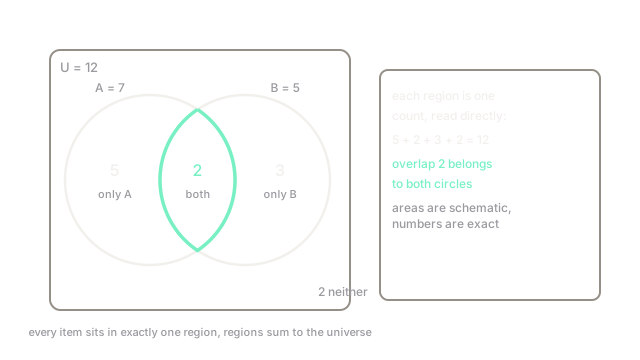
Twelve students, club A has 7, club B has 5, both has 2:
- Lens (both): 2, given.
- Only A: .
- Only B: .
- Neither: .
- Audit: . Exact.
Union reads straight off the inside regions, matching . The picture and the formula agree because they are the same fact drawn two ways.
Watch Out For
Sizing regions by count and reading them back
Drawing the lens twice as large for twice the count feels informative but invites reading area as data. Viewers estimate proportions from pixels, and hand-drawn areas are never exact, so the picture "says" numbers nobody wrote.
Keep shapes schematic and numbers explicit. If proportions matter, say so beside the number; never let area carry information alone.
Forgetting the outside region
Two circles fill the eye and the rectangle corners go unwatched, so the "neither" group vanishes from totals. Probabilities then sum past 1 and test splits quietly lose their negatives.
Always label the outside explicitly, even when it is zero. "Neither: 0" written down beats a forgotten corner every time.
The Quick Version
- One shape per set, one number per non-overlapping region, rectangle for the universe.
- 7 and 5 sharing 2 give regions 5, 2, 3, plus 2 outside of 12.
- Regions always sum to the universe: the free error check.
- Read unions, intersections, and complements straight off the regions.
- Areas are schematic; only written numbers are data.
- Label the outside region even when it holds zero.