Vision-Language-Action Models
Vision-Language-Action models cast robot control as a multimodal sequence modeling task, mapping camera images and natural language instructions directly into end-effector action tokens or continuous trajectories.
Why Does This Exist?
Classical robot manipulation pipelines stitch together distinct subsystems: object detectors identify bounding boxes, 6D pose estimators locate objects, grasp planners calculate finger contacts, and motion planners generate collision-free joint trajectories. While modular, this pipeline breaks down when instructions are nuanced ("hand me the sponge, but not the wet one") or when interacting with novel, unmodeled objects.
Vision-Language Models (VLMs) trained on billions of internet web pages can identify nuanced objects and follow semantic instructions, but they output text strings—they cannot operate physical actuators.
Vision-Language-Action (VLA) models (such as RT-1, RT-2, and OpenVLA) bridge this divide. By co-training or fine-tuning multimodal transformer backbones on paired datasets of robot teleoperation traces, VLAs represent physical robot actions within the same embedding space as words and image patches:
- Semantic grounding to physical action: Instead of just outputting the text
"I will pick up the red mug", the model outputs action tokens that directly command the robot's physical end-effector to advance forward and close its gripper. - Transfer of internet-scale semantic knowledge: By initializing robot policies with weights pre-trained on internet-scale text and images, the robot inherits visual reasoning, object identification, and semantic spatial concepts (such as "to the left of" or "inside the bowl") without requiring thousands of physical robot demonstrations for every new object.
- Unified sequence-to-action architecture: Replaces separate detection, segmentation, and planning components with a single transformer network that consumes RGB camera frames and natural language, producing closed-loop motor commands.
Think of It Like This
Think of a Vision-Language-Action model like a bilingual culinary translator standing in a commercial restaurant kitchen next to an automated vegetable prep machine.
The head chef shouts an English instruction across the kitchen: "Dice the ripe tomato, but discard the green stem." At the same time, the translator looks down at the cutting board through their own eyes (camera images).
If the translator were merely a standard Vision-Language Model (like an internet chatbot), they would respond verbally in English: "Understood, the ripe tomato has been identified on the left cutting board." While informative, the chef still has to do all the manual work.
A VLA model is a translator whose output is directly wired to the prep machine's numeric keypad. The translator maps the semantic English words and visual tomato pixels directly into motor commands: pressing Key 179 to slide the conveyor blade forward 2 centimeters, Key 045 to rotate the carousel, and Key 255 to press the blade down.
Where the analogy stops: Culinary machines use fixed discrete settings (dicing vs slicing) that tolerate loose timing. A robot VLA must produce 7-dimensional continuous action trajectories (3D translation, 3D rotation, gripper state) every 100 milliseconds, where a millimetric error in coordinate transformation can crush an object against the table.
How It Actually Works
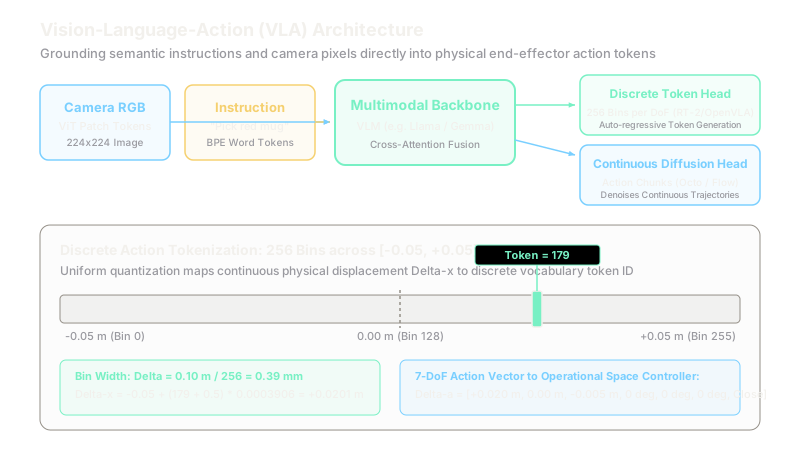
A VLA system processes sensory observations through three sequential stages:
[Camera Image I_t] ──> [Vision Encoder (ViT)] ──> [Visual Tokens] │[Natural Language] ──> [Text Tokenizer] ──> [Prompt Tokens] ──> [Transformer Backbone] │ (Autoregressive / Head) ▼[Operational Space Controller] <── [Detokenize] <── [Action Tokens: (dx, dy, dz, droll, dpitch, dyaw, grip)]1. Action Representations: Discrete vs. Continuous
To output physical actions from a transformer, modern VLAs use one of two primary architectural approaches:
- Discrete Tokenization (RT-2, OpenVLA): The robot's continuous 7-DoF end-effector delta action is discretized. Each continuous dimension is mapped into uniform bins spanning its physical operating range. These 256 bins are mapped to reserved action tokens added to the transformer's vocabulary. The backbone generates actions autoregressively just like words.
- Continuous Diffusion / Flow Heads (Octo, Diffusion Policy VLA): Instead of discretizing into vocabulary tokens, the transformer's hidden representations feed into a continuous diffusion or flow-matching action head that denoises an entire chunk of continuous future actions ( steps) in parallel. Broader robot foundation models leverage these heads to support cross-embodiment transfer across diverse arm morphologies.
2. Discretization and Detokenization Mathematics
Let and represent the operational limits for end-effector displacement along the -axis in a single control cycle. The continuous interval has total width:
Dividing this range into equal bins yields a bin width :
Given a continuous target displacement , the discrete token index is obtained by uniform quantization:
During execution, when the transformer emits token , the deployment runtime detokenizes the index back to a continuous physical setpoint using the bin center:
3. Worked Example: Decoding an Action Token
Consider an OpenVLA-style model controlling a tabletop robot arm at ().
- Translation range along the -axis: (), ().
- Total width: ().
- Number of discrete token bins: .
Calculate the bin width:
Suppose the model receives the camera image of a tabletop mug and the prompt "Pick up the red mug". The autoregressive language head predicts token ID for the dimension.
Decode the physical displacement:
The decoded action commands the robot's end-effector to advance forward by along the camera-calibrated workspace -axis.
Code
The following Python script demonstrates how a VLA tokenizer quantizes continuous 7-DoF robot actions into discrete token IDs and reconstructs them into physical metric setpoints for the controller:
from dataclasses import dataclassfrom typing import List, Tupleimport numpy as np
@dataclassclass ActionSpec: min_val: float max_val: float num_bins: int = 256
@property def bin_width(self) -> float: return (self.max_val - self.min_val) / self.num_bins
def continuous_to_token(self, val: float) -> int: """Quantizes continuous scalar into discrete token ID [0, num_bins - 1].""" clamped = max(self.min_val, min(self.max_val, val)) idx = int(np.floor((clamped - self.min_val) / self.bin_width)) return min(idx, self.num_bins - 1)
def token_to_continuous(self, token_id: int) -> float: """Reconstructs continuous scalar at bin center from token ID.""" if not (0 <= token_id < self.num_bins): raise ValueError(f"Token ID {token_id} out of bounds for {self.num_bins} bins") return self.min_val + (token_id + 0.5) * self.bin_width
class VLATokenizer: """Manages discrete tokenization for a 7-DoF robot action."""
def __init__(self) -> None: # Translation: [-0.05, +0.05] meters per 100 ms step # Rotation: [-0.20, +0.20] radians (~11.5 deg) # Gripper: [0.0, 1.0] (0 = fully open, 1 = fully closed) self.specs: List[ActionSpec] = [ ActionSpec(-0.05, 0.05), # dx (meters) ActionSpec(-0.05, 0.05), # dy ActionSpec(-0.05, 0.05), # dz ActionSpec(-0.20, 0.20), # droll (radians) ActionSpec(-0.20, 0.20), # dpitch ActionSpec(-0.20, 0.20), # dyaw ActionSpec(0.00, 1.00), # gripper ]
def encode(self, action: List[float]) -> List[int]: return [spec.continuous_to_token(val) for spec, val in zip(self.specs, action)]
def decode(self, tokens: List[int]) -> List[float]: return [spec.token_to_continuous(tok) for spec, tok in zip(self.specs, tokens)]
tokenizer = VLATokenizer()
# Target forward displacement: +0.020 m (2 cm)continuous_action = [0.020, 0.000, -0.005, 0.000, 0.000, 0.000, 1.000]
tokens = tokenizer.encode(continuous_action)print(f"Encoded tokens: {tokens}")# dx token is 179assert tokens[0] == 179
# Detokenize back to continuous metric controldecoded = tokenizer.decode(tokens)print(f"Decoded dx: {decoded[0]:.4f} m") # -> 0.0201 m
# Quantization error is strictly bounded by half bin width (< 0.20 mm)max_error = tokenizer.specs[0].bin_width / 2.0assert abs(decoded[0] - continuous_action[0]) <= max_errorWatch Out For
Assuming internet semantic grounding implies physical spatial precision
A large VLA model will correctly identify an antique porcelain teapot from an ambiguous language prompt because its visual backbone was pre-trained on millions of internet images.
However, the symptom is the robot accurately recognizing the teapot but missing its handle by or knocking it over upon contact. Web images lack 3D metric depth, calibrated camera extrinsics, and contact physics. High semantic intelligence on web benchmarks does not guarantee high spatial precision. Fix this by incorporating 3D spatial priors (such as wrist-mounted cameras, depth tokens, or fine-tuning with precise teleoperated demonstrations).
Accumulating latency from autoregressive token generation
In discrete token VLAs (like RT-2), generating a 7-DoF action requires the language model to autoregressively sample 7 sequential tokens: Token_dx Token_dy Token_grip.
The symptom is severe control lag: if each forward pass on a 7B parameter model takes , generating all 7 tokens takes (). At that low frequency, the robot moves with a stop-and-go stutter and fails to track moving objects. Fix this by predicting multi-action chunks in parallel, using non-autoregressive parallel action heads, or distilling the VLA backbone into a lightweight continuous diffusion policy.
The Quick Version
- Vision-Language-Action (VLA) models combine visual encoders, language models, and robot action heads into a unified multimodal transformer.
- Web-scale pre-training provides general object recognition and semantic reasoning, while fine-tuning on robot demonstrations connects semantics to motor control.
- In discrete token architectures (RT-2, OpenVLA), continuous actions are quantized into 256 uniform bins per dimension and mapped to vocabulary tokens.
- Discretizing into 256 bins yields a bin resolution; token index 179 detokenizes to ().
- Autoregressive token generation introduces latency: modern production systems use parallel chunking or continuous diffusion action heads to maintain reactive control rates.