Learning Robot Manipulation from Demonstrations
Imitation learning trains manipulation policies directly from human teleoperation traces, pairing visual and proprioceptive observations with commanded actions. To overcome compounding error and multimodal demonstrations, modern systems predict action chunks or continuous action distributions.
Why Does This Exist?
Hand-crafting state machines and analytical controllers for complex manipulation tasks—like folding laundry, peeling vegetables, or threading wires through clips—fails rapidly. The visual diversity of deformable objects and unpredictable contact friction are too complex to hard-code with geometric rules.
Imitation learning (often called Learning from Demonstration) approaches the problem empirically: a human operator teleoperates a robot using twin leader-follower arms, VR controllers, or 3D mice, demonstrating the task dozens or hundreds of times. A neural network policy is then trained to map observations (camera streams and joint encoders) directly to motor actions via supervised learning.
However, naive behavioral cloning (predicting a single action from current observation using mean squared error) encounters two fatal roadblocks:
- Compounding error (distribution shift): A minor execution error at step places the robot in a state never seen in the demonstration dataset. Because the policy was only trained on expert trajectories, it has never learned how to recover, leading to runaway drift.
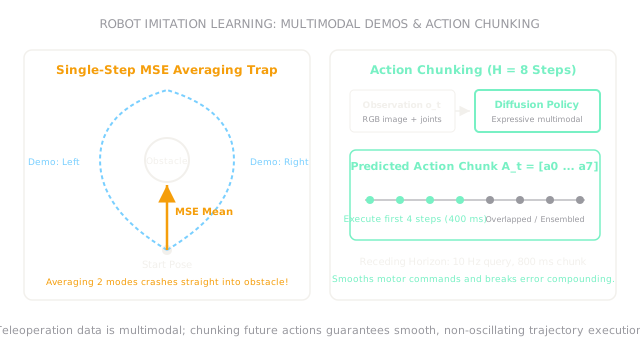
- Multimodality: When humans demonstrate a task, they take different valid paths (for example, bypassing an obstacle to the left in half the trials and to the right in the rest). An MSE loss averages these two modes, outputting a command straight down the middle into a collision.
Modern robot learning overcomes these barriers by reframing imitation learning: predicting action chunks (future trajectory sequences) or using expressive generative distributions (such as Diffusion Policy).
Basics first: the candidate grasp targets that policies aim for live in robot-grasp-targets. Low-level joint tracking loops live in robot-feedback-control. Extending demonstration-trained policies to multi-task vision-language models lives in robot-vision-language-action-models.
Think of It Like This
Guiding a child's hand to draw a cursive letter
Imagine teaching a child to write the cursive letter "S" by gently holding their hand and guiding the pencil across twenty repetitions.
If the child tries to learn by looking only at where the pencil tip is at each millisecond and guessing an isolated instantaneous flick of the wrist, a tiny tremble makes the line wander off the page. Furthermore, if they sometimes loop high and sometimes loop low, trying to average the two motions produces an illegible squiggle.
Instead, the child learns to execute a cohesive motor primitive: an entire curve across hundreds of milliseconds. When they draw, their brain initiates an action chunk representing the full curve, while their eyes monitor the page to adjust future strokes.
Where it stops: human hands have rich tactile feedback in the skin that detects slip in under 5 milliseconds. A robot imitation policy trained only on video frames and joint angles has no tactile feedback unless explicitly instrumented with tactile sensor arrays. If an object is slightly slippery, the robot will repeat its learned open-air grasp motion without realizing the item was dropped.
How It Actually Works
The imitation learning dataset structure
A teleoperation demonstration dataset consists of recorded episodes:
where each trajectory is a synchronized sequence of timestamped observations and actions:
- Observation : Static third-person RGB camera, wrist-mounted RGB camera, and joint position/velocity proprioception.
- Action : Commanded delta end-effector Cartesian pose or target joint angles.
Action chunking and temporal ensembling
Rather than predicting a single action , modern imitation learning (such as Action Chunking with Transformers, ACT, and Diffusion Policy) predicts an entire chunk of future actions simultaneously:
This provides three massive advantages:
- Breaks compounding error: Predicting an internally consistent trajectory avoids high-frequency Markovian drift.
- Smooth motion: Action sequences inherently respect the arm's continuity and momentum.
- Temporal Ensembling: At each query step , the policy outputs a chunk that overlaps with previously predicted chunks. By computing an exponentially weighted moving average across overlapping predictions: the robot executes silky, vibration-free trajectories without motor chatter.
Handling multimodality with diffusion policies
When demonstrations contain multiple valid strategies, deterministic neural networks with Mean Squared Error (MSE) minimize:
The mathematical minimum of MSE on a bimodal distribution is the average: if half the demonstrations go left () and half go right (), MSE commands (straight into the obstacle).
Diffusion Policies solve this by modeling the conditional probability distribution directly via iterative denoising:
- Starts from pure Gaussian noise .
- Iteratively applies learned score-based denoising steps conditioned on visual observation .
- Converges to a single, sharp, consistent mode (either cleanly left or cleanly right), completely eliminating mode averaging.
Worked example: action chunk timing and execution
Consider a tabletop bi-manual manipulation cell running a teleoperated peg-insertion task:
- Control frequency: ().
- Prediction horizon chunk size: .
Compute the total physical time horizon spanned by each predicted chunk:
Execution strategy (Receding Horizon with Replanning Interval ):
- At , the policy observes RGB-D frames and predicts 8 actions: covering the next .
- The robot executes the first steps (, steps ).
- At , fresh camera observation is captured.
- The policy predicts a new 8-step chunk: .
- During execution of steps , the robot blends the overlapping predictions using temporal weights: This guarantees reactive correction to disturbances while maintaining trajectory smoothness.
Code
This Python snippet simulates single-step MSE mode averaging failure versus action chunk temporal blending across receding prediction horizons.
import numpy as np
def demonstrate_multimodal_failure(demo_left: float = -1.0, demo_right: float = +1.0) -> float: """Show how MSE loss averages distinct demonstration modes into an invalid mean.""" # MSE optimal prediction is the expected value mse_action: float = 0.5 * demo_left + 0.5 * demo_right return round(mse_action, 2)
print(demonstrate_multimodal_failure()) # -> 0.0 (Crashes into center obstacle!)
def temporal_ensemble_step( old_prediction: float, new_prediction: float, weight_new: float = 0.60,) -> float: """Blend overlapping chunk predictions using exponentially weighted temporal ensembling.""" blended: float = weight_new * new_prediction + (1.0 - weight_new) * old_prediction return round(blended, 3)
# Blend overlapping predictions for smooth motor executionsmoothed_action = temporal_ensemble_step(old_prediction=0.045, new_prediction=0.050)print(smoothed_action) # -> 0.048Watch Out For
Asynchronous latency mismatch between teleoperation and inference
During demonstration collection, a human operator looks at a monitor with HDMI display lag. If the training pipeline pairs camera frame with the teleoperator's joystick action , the recorded action is actually reacting to what the human saw at .
The symptom is the trained policy displaying severe sluggishness or ringing: it commands motor brakes long after passing an object. Fix it by calibrating operator reaction latency and time-aligning action labels to past observation frames in the training dataset.
Overfitting to static background features (causal confusion)
If all 50 teleoperation demonstrations of picking a mug are collected on the same table with an identical coffee maker sitting in the background, a deep convolutional or vision-transformer backbone can associate the coffee maker's specular reflection with the gripper closing action.
The symptom is the policy working flawlessly during training, but failing completely if the coffee maker is moved 10 cm to the side. Fix it by heavily randomizing camera perspectives, applying aggressive photometric image augmentations (color jitter, random crops, background cutouts), or masking non-manipulation background regions.
The Quick Version
- Imitation learning trains manipulation policies directly from human teleoperation demonstrations using supervised observation-action pairing.
- Naive single-step behavioral cloning suffers from compounding distribution drift and fails on multimodal tasks under Mean Squared Error loss.
- Action chunking predicts future trajectories (e.g. 8 steps at ) rather than single instantaneous actions, ensuring smooth and consistent execution.
- Temporal ensembling blends overlapping chunk predictions across receding horizons, dampening high-frequency motor vibrations.
- Expressive generative policies (such as Diffusion Policy) and vision-language-action models represent multimodal action distributions faithfully, avoiding catastrophic mode averaging.