Dueling Network Architectures
Dueling architectures separate overall state valuation from action advantages, allowing networks to learn which states are valuable without needing to sample every action.
Why Does This Exist?
In standard Deep Q-Networks (DQN), a single neural network takes state observations as input and directly outputs a vector of estimated action-values for every discrete action . To learn whether a particular state is favorable or perilous, standard DQN must experience and backpropagate updates through every action individually in that state.
However, in many real-world environments, the choice of action is completely irrelevant to the agent's overall welfare:
- Cruising an open highway: Whether a vehicle nudges left, stays center, or nudges right, the overall expected return is virtually identical—the state itself is inherently safe.
- Imminent collision: If a vehicle is trapped with obstacles on all sides, every available action results in an immediate crash—the state itself is inherently catastrophic.
- Atari games (e.g., Enduro, Space Invaders): When no obstacles or incoming lasers are on screen, moving left or right does not alter long-term survival probability.
Forcing a network to independently learn separate functions for all actions in such states is sample-inefficient. If an agent with 18 discrete actions visits a safe state 50 times but only chooses 3 of the actions, the remaining 15 actions remain unupdated and vulnerable to estimation error.
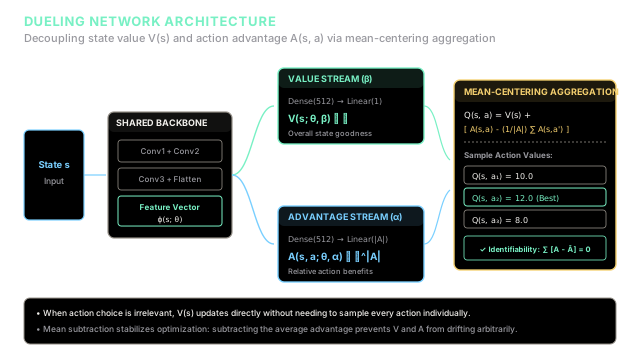
In 2016, Ziyu Wang et al. introduced the Dueling Network Architecture. Instead of estimating action-values directly, the network splits into two separate parallel streams after a shared convolutional feature extractor:
- A State-Value Stream : Evaluates how desirable it is to be in state , independent of any action.
- An Action-Advantage Stream : Evaluates the relative importance of choosing action compared to other candidate actions in that state.
By decoupling these streams and recombining them through an identifiable aggregation layer, the agent updates its understanding of general state value on every single transition, regardless of which specific action was executed.
Think of It Like This
The Highway Driving Instructor
Imagine a veteran driving instructor sitting beside a student on a four-lane highway:
-
Assessing the State Value : The instructor monitors road conditions, weather, and surrounding traffic density. On a clear, empty stretch of highway at 60 mph, the instructor knows the situation is relaxed and hazard-free. That evaluation () is an intrinsic property of the road environment—it does not depend on whether the student turns on the wipers, adjusts the radio, or holds the steering wheel slightly to the left.
-
Assessing Action Advantages : The instructor then evaluates the incremental difference between available maneuvers. Staying in the center lane has an advantage of ; gently passing a slower truck has an advantage of ; swerving abruptly toward the shoulder has an advantage of .
In a standard DQN, the driver would have to learn from scratch what happens when pressing the left turn signal, then learn from scratch what happens when tapping the brakes, and so on—evaluating each combination as an isolated mystery.
In a Dueling Architecture, the instructor immediately recognizes: "This entire situation is worth . Now, within this scenario, lane-changing adds , while swerving costs ." If the student safely passes the truck, the instructor updates their baseline confidence about that stretch of highway (), benefiting all other potential maneuvers without having to execute them.
Where the analogy stops: In real life, humans intuitively know which portion of an outcome belongs to the environment and which belongs to the driver's skill. In neural networks, adding two unconstrained numbers creates a mathematical ambiguity called unidentifiability: the network cannot tell if arose from or . Dueling networks resolve this with a centering constraint.
How It Actually Works
Value-Advantage Decoupling and the Identifiability Problem
Recall the formal definition of the advantage function in dynamic programming:
For the optimal policy , the state value is the maximum action-value: . It follows directly that the optimal advantage satisfies:
For a suboptimal action, , measuring the expected return lost by choosing instead of the greedy choice .
Network Architecture
The dueling architecture processes input state through a shared feature extractor (typically convolutional layers for visual inputs). The features then branch into two separate heads:
- Value Stream: Parameterized by weights , outputting a scalar:
- Advantage Stream: Parameterized by weights , outputting a vector of size :
The Unidentifiability Problem
A naive recombination layer would simply add the two streams:
However, this equation is unidentifiable: given a target value , there are infinitely many pairs of that sum to the exact same . For any arbitrary scalar constant :
During gradient descent, could drift to while drifts to . The network loses all semantic meaning of representing state value and representing action advantage, causing severe optimization instability.
Solution 1: Max-Centering Aggregation
To enforce identifiability, one can force the maximum advantage to be exactly zero:
For the greedy action , the advantage term evaluates to , ensuring that .
Solution 2: Mean-Centering Aggregation (The Practical Choice)
While max-centering is theoretically grounded, Wang et al. discovered that subtracting the mean advantage performs substantially better in practice:
Why Mean-Centering Outperforms Max-Centering:
- Identifiability Preserved: The mean-centered advantage vector satisfies . Given , is uniquely identified as the average Q-value across all actions: .
- Gradient Stability: In max-centering, gradients only flow through the single action that achieves the maximum. In mean-centering, every backward pass updates the advantage stream across all actions simultaneously, stabilizing optimization in the presence of noise.
Worked numerical example
Consider a concrete forward pass through a dueling aggregation module for an environment with 3 actions: .
- Input State:
- Value Stream Output:
- Raw Advantage Stream Output:
Step 1: Compute Mean Advantage
Step 2: Compute Centered Advantages
Subtract the scalar mean from each raw advantage:
- Action 1:
- Action 2:
- Action 3:
Notice that the centered advantages sum to zero:
Step 3: Compute Final Action-Values
- Action 1:
- Action 2:
- Action 3:
Invariance Verification
Suppose the raw advantage head had an arbitrary scalar offset of added to all outputs (). The new mean is . The centered advantages are . The resulting Q-values remain identically , proving that parameter drift cannot perturb the policy.
Code
The following self-contained Python script implements a complete Dueling DQN forward pass, demonstrates the mean-centering aggregation layer, and verifies identifiability invariance with automated assertions.
import numpy as npfrom typing import Tuple, List
class DuelingAggregationModule: """Implements the dueling aggregation layer connecting Value and Advantage streams."""
def __init__(self, mode: str = "mean") -> None: assert mode in ("mean", "max"), "Mode must be 'mean' or 'max'" self.mode = mode
def forward(self, v_scalar: float, a_vector: np.ndarray) -> np.ndarray: """Combine scalar V(s) and vector A(s, a) into Q(s, a).""" if self.mode == "mean": centered_advantage = a_vector - np.mean(a_vector) else: centered_advantage = a_vector - np.max(a_vector) return v_scalar + centered_advantage
def run_dueling_verification() -> None: aggregator = DuelingAggregationModule(mode="mean")
# 1. Worked Numerical Example v_val = 10.0 a_raw = np.array([2.0, 4.0, 0.0])
q_values = aggregator.forward(v_val, a_raw) a_mean = float(np.mean(a_raw)) a_centered = a_raw - a_mean
print("--- Dueling Forward Pass ---") print(f"State Value V(s): {v_val:.4f}") print(f"Raw Advantages A(s, a): {a_raw}") print(f"Advantage Mean: {a_mean:.4f}") print(f"Centered Advantages: {a_centered}") print(f"Final Q-values: {q_values}")
# 2. Identifiability Invariance Test # Adding an arbitrary constant c to raw advantages should NOT change final Q-values c = 5.0 a_shifted = a_raw + c q_shifted = aggregator.forward(v_val, a_shifted)
print("\n--- Identifiability Invariance Test ---") print(f"Shifted Advantages (c={c}): {a_shifted}") print(f"Q-values after shift: {q_shifted}")
# 3. Batch Forward Pass Simulation batch_v = np.array([10.0, -5.0, 3.5]) batch_a = np.array([ [2.0, 4.0, 0.0], [1.0, 0.0, -1.0], [0.5, 0.5, 0.5] ])
batch_q = np.array([ aggregator.forward(v, a) for v, a in zip(batch_v, batch_a) ])
print("\n--- Batch Evaluation (3 States) ---") for i, q in enumerate(batch_q): print(f"State {i}: V={batch_v[i]:+5.1f} -> Q={q.tolist()} (Best action: {np.argmax(q)})")
# Automated assertions assert np.allclose(q_values, [10.0, 12.0, 8.0]), "Q-values must match worked example" assert np.allclose(q_values, q_shifted), "Identifiability failed: Q changed after constant shift" assert np.isclose(np.sum(a_centered), 0.0), "Centered advantages must sum to zero"
if __name__ == "__main__": run_dueling_verification()# -> expected output:--- Dueling Forward Pass ---State Value V(s): 10.0000Raw Advantages A(s, a): [2. 4. 0.]Advantage Mean: 2.0000Centered Advantages: [ 0. 2. -2.]Final Q-values: [10. 12. 8.]
--- Identifiability Invariance Test ---Shifted Advantages (c=5.0): [7. 9. 5.]Q-values after shift: [10. 12. 8.]
--- Batch Evaluation (3 States) ---State 0: V=+10.0 -> Q=[10.0, 12.0, 8.0] (Best action: 1)State 1: V= -5.0 -> Q=[-4.0, -5.0, -6.0] (Best action: 0)State 2: V= +3.5 -> Q=[3.5, 3.5, 3.5] (Best action: 0)Watch Out For
The Unidentifiability Trap of Naive Addition
A frequent bug when hand-crafting custom neural architectures is combining value and advantage heads using naive addition without centering:
Without the centering constraint or , the network suffers from unidentifiability collapse:
- The value stream and advantage stream are not mathematically unique for any given set of target Q-values.
- As backpropagation proceeds, numerical gradients can push into positive billions while pushing into negative billions.
- Because neural network weights grow unchecked in opposing directions, weight decay regularization fights the layers, weight norms explode, and representations in the shared convolutional trunk degrade.
The Fix: Always implement mean-centering in your model's forward pass:
# PyTorch forward aggregationq_values = value_stream + (advantage_stream - advantage_stream.mean(dim=-1, keepdim=True))This single line forces the advantage stream to have zero mean along the action dimension, ensuring mathematically unique representations and bounded parameter growth.
The Quick Version
- Core Motivation: Many states have high or low value regardless of the action taken; dueling networks decouple state valuation from action differentiation to maximize sample efficiency.
- Two-Stream Split: A shared convolutional backbone extracts general representations, which then branch into a scalar value head and an -dimensional advantage head .
- Mean-Centering Aggregation: Combines streams via to eliminate mathematical unidentifiability while ensuring smooth gradient flow across all actions.
- Empirical Superiority: Dueling DQN dramatically accelerates learning in environments with many similar actions or sparse rewards, and forms a foundational component of modern value-based agents like Rainbow DQN.