Multi-Agent PPO (MAPPO)
Multi-Agent PPO adapts on-policy Proximal Policy Optimization to cooperative multi-agent teams using Centralized Training with Decentralized Execution. By evaluating Generalized Advantage Estimation through a centralized value function while executing independent clipped actor policies, MAPPO matches or outperforms complex off-policy algorithms across challenging cooperative benchmarks.
Why Does This Exist?
For years, a dominant consensus in multi-agent reinforcement learning (MARL) held that off-policy value factorization methods—such as QMIX and VDN—or off-policy actor-critic architectures like MADDPG were strictly required to achieve sample efficiency in complex cooperative environments (such as the StarCraft Multi-Agent Challenge, SMAC). On-policy policy gradient methods like Proximal Policy Optimization (PPO) were widely dismissed as too sample-inefficient and prone to non-stationary instability in multi-agent domains.
In 2022, Yu et al. overturned this consensus in their landmark work, "The Surprising Effectiveness of PPO in Cooperative, Multi-Agent Games". They demonstrated that Multi-Agent PPO (MAPPO)—an on-policy PPO framework adapted with a centralized value function and standardized engineering best practices—achieves state-of-the-art performance across SMAC, Google Research Football, and Hanabi, matching or outperforming complex off-policy algorithms while requiring minimal domain-specific hyperparameter tuning.
MAPPO solves three fundamental barriers that previously crippled policy gradients in multi-agent teams:
- Environmental Non-Stationarity during Training: In naive independent PPO, each agent computes advantage estimates using a local value function conditioned only on its private observation. Because all other agents update their policies concurrently, the environment transition dynamics appear non-stationary, causing high-variance advantage estimates that derail learning.
- Actor Sample Inefficiency: In cooperative tasks where agents share similar physical bodies and roles, training separate neural networks for every agent scales parameter complexity as . MAPPO utilizes parameter sharing across homogeneous agents, pooling trajectory rollouts from all teammates into a single training stream.
- Destructive Policy Updates under Joint Dynamics: In MARL, small simultaneous policy updates across multiple agents can compound into catastrophic changes in joint behavior. MAPPO's probability ratio clipping () and value function clipping strictly bound the step size of policy updates, ensuring monotonic progress even under joint policy shifts.
Think of It Like This
Orchestrating an elite tactical firefighting squad
Imagine deploying a specialized team of firefighters into a multi-story industrial blaze.
A naive independent policy gradient approach is like giving each firefighter a standalone radio and telling them to guess the structural integrity of the entire building based solely on the smoke visible through their own helmet visor (). Firefighter A on the second floor might think they are winning because their immediate room is clear, completely unaware that the basement support pillars have collapsed. Training this way leads to panic, conflicting priorities, and high casualty rates.
MAPPO implements an elite Centralized Training with Decentralized Execution (CTDE) command structure:
- The Centralized Command Trailer (The Critic ): Outside the burning building, an incident commander monitors thermal satellite feeds, structural blueprints, and telemetry from all teammates (the global state ). The commander evaluates the true team survival and fire containment probability ().
- The Ground Firefighters (The Decentralized Actors ): Inside the building, individual firefighters make instinctive, split-second decisions (aiming a hose, prying a door) conditioned strictly on their immediate local visor observations () and team ID. They do not wait for radio orders from the trailer to swing an axe.
- The Post-Mission Debrief (Advantage Estimation ): Back at the station, the commander uses the global mission timeline to evaluate each firefighter's actions. If a firefighter opened a vent that helped the entire squad survive, the commander assigns a positive advantage bonus ().
- Bounded Adjustments (PPO-Clip): In tomorrow's training drill, firefighters adjust their instincts conservatively, refusing to change their habits by more than 20% in a single session to preserve team coordination.
Where the analogy stops: human firefighters have distinct physical builds, strengths, and years of service. In MAPPO, homogeneous agents share the exact same neural network weights (), differentiating their roles strictly through observation inputs and one-hot agent identity vectors.
How It Actually Works
Centralized Training with Decentralized Clipped Policy Optimization
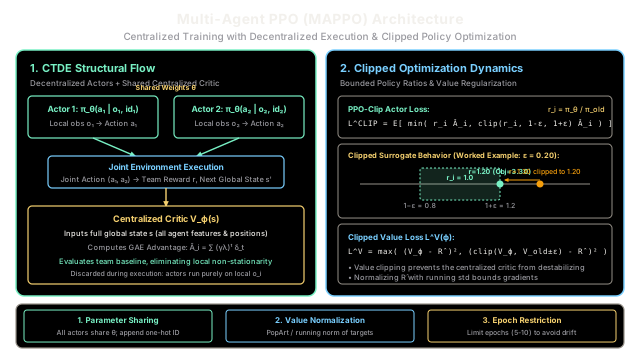
MAPPO adopts the Centralized Training with Decentralized Execution (CTDE) paradigm, decoupling the information available during offline laboratory training from the information available during real-time deployment.
┌────────────────────────────────────────────────────────┐ │ MAPPO Training Pipeline (CTDE) │ └───────────────────────────┬────────────────────────────┘ │ ┌────────────────────────────┴────────────────────────────┐ │ │┌─────▼─────────────────────────┐ ┌─────────────────▼──────────────────┐│ Decentralized Actors π_θ │ │ Centralized Critic V_ϕ ││ Conditioned on local obs o_i │ │ Conditioned on global state s ││ Parameter-shared across team │ │ Evaluates true team baseline ││ Output: Actions a_i │ │ Output: Scalar state value V(s) │└─────────────┬─────────────────┘ └─────────────────┬──────────────────┘ │ │ │ │ ▼ ▼┌───────────────────────────────┐ ┌────────────────────────────────────┐│ Joint Environment Step │ │ Generalized Advantage (GAE) ││ s' ~ P(· | s, a_1, ..., a_N) │ │ δ_t = r_t + γ V(s_{t+1}) - V(s_t) ││ Team Reward: r_team │────────────►│ Â_t = ∑ (γλ)ˡ δ_{t+l} │└───────────────────────────────┘ └─────────────────┬──────────────────┘ │ ▼ ┌────────────────────────────────────┐ │ Clipped PPO Policy Gradient │ │ min( r_i Â_i, clip(r_i) Â_i ) │ └────────────────────────────────────┘1. The Decentralized Parameter-Shared Actor
For a team of homogeneous agents, MAPPO trains a single actor policy network parameterized by .
- At execution time, each agent observes only its local observation , appended with a one-hot agent identity vector .
- The policy outputs a categorical distribution over discrete actions (or Gaussian parameters for continuous controls):
- Sharing weights across all agents pools training data into a single trajectory buffer of size , dramatically accelerating sample efficiency.
2. The Centralized Critic and Generalized Advantage Estimation
During training, the learning algorithm has access to the full simulator state (which includes global entity coordinates, health pools, and hidden map terrain).
The centralized critic maps this global state to a scalar value baseline. The temporal difference residual is computed from global evaluations:
Generalized Advantage Estimation (GAE) computes exponentially weighted multi-step advantage targets:
Because conditions on the full environmental state , it accounts for the actions of all teammates and opponents, eliminating the non-stationarity that destabilizes local value functions.
3. The PPO-Clip Objective in Multi-Agent Settings
The policy parameters are updated by maximizing the clipped surrogate objective averaged across all agents and batch timesteps :
where the importance sampling probability ratio is defined as:
- When , the action was better than average. The objective encourages increasing its probability, but the clipping operator caps the ratio at (e.g., ), preventing an over-ambitious step that might destabilize teammate policies.
- When , the action was worse than average. The ratio is bounded below at (e.g., ), limiting the policy gradient penalty.
4. The Clipped Centralized Value Loss
The centralized critic parameters are trained via mean squared error against empirical return targets , augmented with value clipping:
Value clipping prevents the centralized critic from taking destructive gradient steps on noisy multi-agent reward spikes.
5. Empirical Best Practices Identified by Yu et al. (2022)
The success of MAPPO relies on three crucial implementation details:
- Value Normalization: Use PopArt or running mean/variance normalization on value targets . Cooperative team returns fluctuate drastically as agents discover coordination; normalizing targets bounds gradient magnitudes in the centralized critic.
- Compact Global State Representation: Feeding full concatenations of all agents' raw observation histories into creates severe feature bloat and slows learning. Inputting concise global environmental state features (e.g., global map coordinates, alive units count) yields far superior convergence.
- Restricted PPO Epochs: While single-agent PPO often optimizes for 10–20 epochs per batch, MAPPO performs best with only 5 to 10 epochs. In multi-agent settings, taking too many gradient steps on stale off-policy data causes rapid policy drift.
Worked numerical example
To trace how MAPPO bounds policy updates and computes centralized advantages, consider a single agent taking action at timestep .
Step 1: Centralized Critic State Evaluation and TD Residual
- Global state , private local observation .
- Centralized Critic estimate on current global state: .
- Shared team reward observed: .
- Next global state , Centralized Critic estimate: .
- Discount factor: , GAE parameter: .
Compute the temporal difference residual:
For a 1-step horizon, the GAE advantage is:
Because , taking action yielded superior team return relative to the expected baseline.
Step 2: Policy Ratio and Clipped Surrogate (Case 1: Moderate Update)
- Action probability under old policy: .
- Action probability under candidate new policy: .
- Clipping threshold: (valid range ).
- Compute probability ratio:
- Compute unclipped surrogate:
- Compute clipped ratio and clipped surrogate:
- Evaluate clipped objective:
The update sits exactly on the clipping boundary ().
Step 3: Policy Ratio and Clipped Surrogate (Case 2: Excessive Update)
Now suppose the candidate update attempted an aggressive leap to .
- Compute new probability ratio:
- Compute unclipped surrogate:
- Compute clipped ratio and clipped surrogate:
- Evaluate clipped objective:
Despite the ratio reaching , the objective is capped at . The gradient with respect to further probability expansion vanishes, strictly preventing the actor from out-pacing teammate coordination.
Code
The following pure Python script implements the MAPPOTrainer class, calculates centralized GAE advantages on global states, computes clipped surrogate policy objectives and clipped value function losses, and verifies all worked example invariants with automated assertions.
from typing import Dict, Tupleimport numpy as np
class MAPPOTrainer: """Multi-Agent PPO (MAPPO) with Centralized Critic and Parameter Sharing."""
def __init__( self, clip_epsilon: float = 0.20, gamma: float = 0.95, gae_lambda: float = 1.0, ) -> None: self.clip_epsilon = clip_epsilon self.gamma = gamma self.gae_lambda = gae_lambda
def compute_gae_advantage( self, v_current: float, v_next: float, reward: float, done: bool = False, ) -> float: """Computes 1-step GAE advantage using the Centralized Critic.""" next_val = 0.0 if done else v_next td_delta = reward + self.gamma * next_val - v_current # For 1-step horizon, GAE advantage equals the TD residual advantage = td_delta return float(advantage)
def evaluate_clipped_surrogate( self, prob_new: float, prob_old: float, advantage: float, ) -> Tuple[float, float, float]: """Computes PPO clipped surrogate objective.""" ratio = prob_new / prob_old unclipped_obj = ratio * advantage clipped_ratio = float(np.clip(ratio, 1.0 - self.clip_epsilon, 1.0 + self.clip_epsilon)) clipped_obj = clipped_ratio * advantage surrogate = float(np.minimum(unclipped_obj, clipped_obj)) return ratio, clipped_ratio, surrogate
def evaluate_value_loss( self, v_pred: float, v_old: float, return_target: float, ) -> Tuple[float, float, float]: """Computes clipped value function loss for Centralized Critic.""" unclipped_loss = (v_pred - return_target) ** 2 v_clipped = float(np.clip(v_pred, v_old - self.clip_epsilon, v_old + self.clip_epsilon)) clipped_loss = (v_clipped - return_target) ** 2 value_loss = float(np.maximum(unclipped_loss, clipped_loss)) return unclipped_loss, clipped_loss, value_loss
# --- Verification Matching Worked Example ---trainer = MAPPOTrainer(clip_epsilon=0.20, gamma=0.95, gae_lambda=1.0)
# 1. Centralized Critic Evaluationv_s = 4.00v_s_next = 5.00reward = 2.00adv = trainer.compute_gae_advantage(v_current=v_s, v_next=v_s_next, reward=reward)print(f"Centralized GAE Advantage Â: {adv:.2f}")# -> Centralized GAE Advantage Â: 2.75
# 2. Case 1: Moderate Policy Update (prob_new = 0.48)r1, c_r1, surr1 = trainer.evaluate_clipped_surrogate(prob_new=0.48, prob_old=0.40, advantage=adv)print(f"Case 1 (prob=0.48) - Ratio: {r1:.2f}, ClippedRatio: {c_r1:.2f}, Surrogate: {surr1:.2f}")# -> Case 1 (prob=0.48) - Ratio: 1.20, ClippedRatio: 1.20, Surrogate: 3.30
# 3. Case 2: Excessive Policy Update (prob_new = 0.52 -> Ratio 1.30 capped to 1.20)r2, c_r2, surr2 = trainer.evaluate_clipped_surrogate(prob_new=0.52, prob_old=0.40, advantage=adv)print(f"Case 2 (prob=0.52) - Ratio: {r2:.2f}, ClippedRatio: {c_r2:.2f}, Surrogate: {surr2:.2f}")# -> Case 2 (prob=0.52) - Ratio: 1.30, ClippedRatio: 1.20, Surrogate: 3.30
# Assertions verifying worked example and clipping invariantsassert adv == 2.75, "Advantage must equal 2.75"assert surr1 == 3.30, "Surrogate 1 must equal 3.30"assert surr2 == 3.30, "Surrogate 2 must be capped at 3.30"print("All MAPPO trainer assertions verified successfully.")# -> All MAPPO trainer assertions verified successfully.Watch Out For
The Centralized Critic Feature Bloat and Normalization Trap
A frequent failure mode when deploying MAPPO is constructing the Centralized Critic input by naively concatenating the full observation histories of all agents.
The Symptom: In tasks with 10 or more agents, this creates an enormous input tensor filled with redundant local noise. The Critic overfits rapidly to extraneous features while failing to capture global team dynamics. Simultaneously, if return targets are not normalized, early training return spikes produce massive Critic gradients. This destabilizes value estimation, causing Generalized Advantage estimates () to swing wildly between extreme positive and negative values, destroying policy convergence.
The Fix:
- Curate Compact Global State Inputs: Pass only concise, permutation-invariant global environmental features to (such as global coordinates, team health percentages, remaining unit counts, and terrain maps) rather than raw concatenations of private agent sensor streams.
- Apply Value Normalization (PopArt): Normalize return targets using running mean and standard deviation: before computing value loss. This stabilizes Critic learning dynamics regardless of whether the team is learning early survival or late-stage mastery.
The Quick Version
- Multi-Agent PPO (MAPPO) implements Centralized Training with Decentralized Execution (CTDE) using an on-policy clipped policy gradient, matching or exceeding off-policy MARL algorithms on complex benchmarks.
- The Centralized Critic conditions on the full global state during training to compute Generalized Advantage Estimation (GAE), eliminating environmental non-stationarity without requiring inter-agent communication at execution.
- Decentralized Parameter Sharing pools rollouts across all homogeneous team actors (), scaling sample efficiency by while enabling diverse behaviors via agent ID inputs.
- Value Normalization and Restricted Epochs bound Critic gradients and prevent policy drift, ensuring stable monotonic progress across cooperative multi-agent tasks.