Offline Reinforcement Learning
Offline RL trains policies entirely from pre-collected static datasets without real-world interaction, penalizing out-of-distribution actions to prevent disastrous overestimation.
Why Does This Exist?
In traditional online reinforcement learning, an agent learns by active trial-and-error: taking an action, observing the outcome, and adjusting its weights. However, in safety-critical and high-expense domains—such as clinical healthcare, autonomous driving, chemical refinery control, and e-commerce recommender systems—exploratory trial-and-error is dangerous or financially prohibitive. You cannot let an untrained robot crash a car or test random drug dosages on hospital patients simply to learn which actions fail.
Organizations possess massive static logs of past behavior: electronic health records, driving telematics, and historical user interaction logs . Offline RL (also called batch RL) seeks to train an optimal policy entirely from this fixed historical data without executing a single online exploratory action.
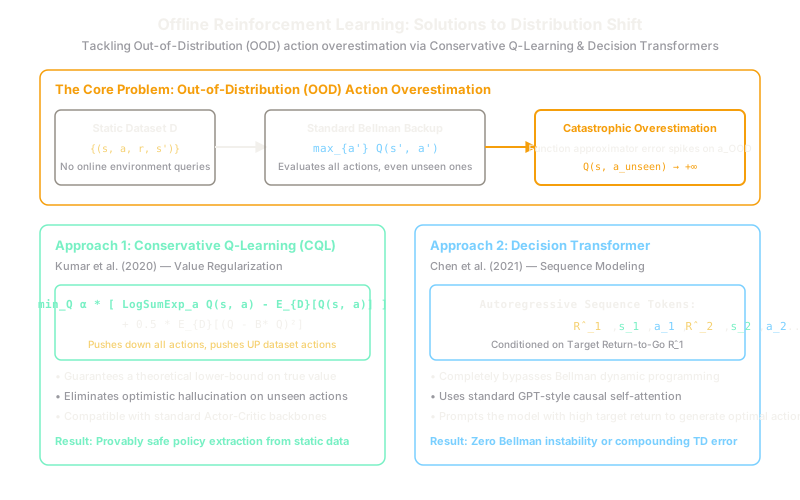
Naively running standard off-policy algorithms like DQN or SAC on static datasets fails catastrophically due to distributional shift. When computing Bellman targets , the maximization operator queries out-of-distribution (OOD) actions never seen in the dataset. Because neural networks extrapolate unpredictably in unconstrained regions, function approximation errors create false positive value spikes. The agent mistakes these hallucinated spikes for brilliant moves, producing policies that fail completely upon real-world deployment.
Think of It Like This
Studying historical chess games from an archive without ever touching a board
Imagine a novice studying chess purely by reading a library of 10,000 grandmaster tournament transcripts. The student cannot play against an opponent or ask a coach questions; they can only read the archived moves.
If the student uses standard off-policy thinking, they might encounter an unrecorded, bizarre move: "In this opening, what if I sacrifice my king's pawn and move my knight to the extreme rim?" Because that move never appears in the grandmaster archive, there is zero historical evidence showing it fails. Due to speculative imagination, the student hallucinates: "Nobody plays this move, so it must be an undiscovered winning stroke worth +100 points!"
An Offline RL student applies rigorous discipline: "If a move has no recorded evidence in this library, I must conservatively assume it is dangerous or penalize its score." Alternatively, a Decision Transformer student treats the library like an interactive novel: "Show me how games played out when the player aimed for a grandmaster win," generating moves autoregressively by matching the style of high-scoring tournament paths without speculating on ungrounded counterfactuals.
How It Actually Works
Conservative Value Regularization and Sequence Generation
Two dominant paradigms have solved the distribution shift bottleneck in offline reinforcement learning:
1. Conservative Q-Learning (CQL) (Kumar et al., 2020)
CQL prevents overestimation by adding a regularizer directly to the standard Bellman temporal difference loss. The regularizer mathematically lower-bounds the expected action-value function:
Where the discrete CQL regularizer is formulated as:
Here:
- is the empirical behavior policy that generated dataset .
- is the soft maximum over all actions, pushing down the Q-values of all actions (especially unseen, out-of-distribution actions).
- pushes up the Q-values of actions that actually appeared in the logged dataset.
- controls the degree of conservatism.
Kumar et al. proved that for sufficiently large , the expected value under the learned policy is guaranteed to be a conservative lower bound of the true value: .
2. Decision Transformer (Chen et al., 2021)
Decision Transformer reframes reinforcement learning entirely away from Bellman dynamic programming and value iteration, casting it as a conditional sequence modeling problem.
Trajectories are tokenized into sequences of triples:
Where is the empirical return-to-go.
A causal autoregressive Transformer (GPT architecture) is trained via supervised cross-entropy or mean squared error to predict the next action given the historical context and the desired target return:
During inference in the live environment:
- The user specifies a high target return (e.g., maximum possible score in the dataset).
- The model observes the current state and predicts action conditioned on that target return.
- As the environment returns actual scalar rewards , the return-to-go is decremented: .
Because the Decision Transformer uses standard supervised teacher-forcing over recorded trajectories, it never bootstraps on ungrounded hypothetical future states, completely immune to the mathematical instabilities of Bellman value iteration.
Worked Example
Consider a state with three possible actions: , , and . The static dataset contains actions and with equal frequency ( each), while is an unseen out-of-distribution action ( in dataset).
Current Q-network estimates:
- (in dataset)
- (in dataset)
- (hallucinated OOD spike)
Let conservatism weight . We calculate the CQL penalty term:
-
Calculate Log-Sum-Exp over all actions:
-
Calculate Expected Q under empirical behavior policy: Since the dataset only observed and equally:
-
CQL Penalty Value:
-
Gradient Penalties on Individual Actions: The gradient with respect to is :
- Softmax probabilities:
- Gradients:
- For (OOD): . Because loss is minimized, is aggressively pushed down.
- For (in dataset): . A negative gradient pushes up.
- Softmax probabilities:
CQL specifically identifies that had an unsupported probability mass and actively suppresses its hallucinated value.
Code
from typing import Dict, Tupleimport numpy as np
def compute_cql_penalty( q_values: np.ndarray, dataset_action_dist: np.ndarray, alpha: float = 1.0,) -> Tuple[float, np.ndarray]: """ Computes discrete Conservative Q-Learning penalty and analytical gradients. q_values: array of Q(s, a) for all actions in state s dataset_action_dist: empirical probabilities of actions in static dataset """ # Numerically stable LogSumExp max_q = np.max(q_values) exp_q = np.exp(q_values - max_q) sum_exp = np.sum(exp_q) log_sum_exp = max_q + np.log(sum_exp) # Expected Q under dataset behavior policy expected_data_q = float(np.dot(dataset_action_dist, q_values)) # CQL objective: minimize (LSE - Expected_Data_Q) cql_penalty = alpha * (log_sum_exp - expected_data_q) # Softmax distribution over actions softmax_probs = exp_q / sum_exp # Analytical gradient d(Penalty) / d(Q) grad_q = alpha * (softmax_probs - dataset_action_dist) return cql_penalty, grad_q
# Setup matching worked example: a1=4.0, a2=2.0, a3=6.0 (OOD)q_vals = np.array([4.0, 2.0, 6.0], dtype=np.float64)data_dist = np.array([0.5, 0.5, 0.0], dtype=np.float64)
penalty, gradients = compute_cql_penalty(q_vals, data_dist, alpha=1.0)
print(f"CQL Penalty: {penalty:.4f}")# -> CQL Penalty: 3.1429
print(f"Gradients dLoss/dQ: {gradients.tolist()}")# -> Gradients dLoss/dQ: [-0.3827, -0.4841, 0.8668]
# Notice positive gradient on action index 2 pushes Q(s, a3) downWatch Out For
The Out-of-Distribution Overestimation Catastrophe
When practitioners train standard online algorithms (like DQN, DDPG, or SAC) on static offline datasets without conservatism, the policy network rapidly learns to exploit blind spots in the value function. During training, the logged evaluation curves will report astronomical, steadily climbing Q-values, giving the illusion of superhuman progress. When deployed to the physical robot or live environment, the agent immediately crashes because its high predicted values were purely fictitious mathematical artifacts.
Never run unconstrained off-policy algorithms on fixed datasets. Use CQL with calibrated to guarantee lower-bound guarantees, or adopt trajectory-conditioned sequence modeling architectures like Decision Transformers that eliminate Bellman bootstrapping entirely.
The Quick Version
- Offline RL optimizes policies strictly from fixed historical datasets without online environment exploration, critical for high-stakes domains.
- Standard Bellman updates fail offline due to distributional shift: queries unseen actions, causing catastrophic value explosion.
- Conservative Q-Learning (CQL) adds a LogSumExp regularizer that provably lower-bounds true state values by penalizing out-of-distribution actions.
- Decision Transformers replace Bellman dynamic programming with causal self-attention, generating actions autoregressively conditioned on target return.