Twin Delayed DDPG (TD3)
Standard continuous actor-critic algorithms suffer from severe optimism bias, chasing illusory peaks in the critic's value estimates. TD3 stabilizes learning by consulting two independent critics, smoothing target actions, and updating the actor less frequently.
Why Does This Exist?
In continuous control reinforcement learning, the Deep Deterministic Policy Gradient (DDPG) algorithm was introduced to extend Q-learning to continuous action spaces. DDPG pairs a deterministic actor network with a critic network . However, in practice, DDPG frequently exhibits catastrophic performance degradation, hyperparameter sensitivity, and training instability.
In 2018, Scott Fujimoto, Herke van Hoof, and David Meger identified three fundamental algorithmic flaws inherent in DDPG:
- Systemic Overestimation Bias in Continuous Actor-Critic: In discrete Q-learning, the operator introduces positive maximization bias. DDPG avoids an explicit discrete max by performing gradient ascent with the actor: . However, because the critic is an imperfect neural function approximator, approximation errors are non-uniform across the action space. The actor naturally exploits these errors by gravitating toward actions where the critic overestimated value. These overestimated targets are bootstrapped back into the Bellman update, causing value estimates to explode exponentially over training.
- Brittle Value Surface Exploitation: Function approximators can develop sharp, narrow local peaks in the value surface. Deterministic actors overfit to these narrow mathematical artifacts, discovering actions that look extraordinarily high in value to the critic but fail catastrophically in the actual environment.
- Coupled Moving-Target Instability: In DDPG, the critic and actor are updated simultaneously at every single gradient step. The critic tries to estimate the value of the current policy while the policy is constantly shifting underneath it. This circular dependency creates high-variance gradient noise and divergent oscillations.
To resolve these three vulnerabilities, Fujimoto et al. introduced Twin Delayed Deep Deterministic Policy Gradient (TD3). By introducing three architectural pillars—Clipped Double Q-Learning, Target Policy Smoothing, and Delayed Policy Updates—TD3 completely eliminates overestimation bias and establishes a robust, highly reliable benchmark for continuous deep reinforcement learning.
Think of It Like This
An Engineering Review Board: Peer Review, Noise Tolerances, and Staged Blueprints
Imagine an engineering consulting firm tasked with designing a bridge across a turbulent river:
- The Twin Independent Auditors (Clipped Double Q-Learning): If a single optimistic structural analyst inspects the design, any overlooked flaw can cause an inflated load-bearing rating. Instead, the firm hires two independent structural engineering firms ( and ). When calculating safety tolerances for the next construction milestone, the board takes the minimum load rating between the two firms: . If either firm spots a potential defect, the board adopts the more conservative estimate, eliminating dangerous optimism.
- Vibration Tolerance Testing (Target Policy Smoothing): An engineer might draft a girder design that holds up mathematically under one exact angle of zero wind, but fails catastrophically if wind shifts by . To prevent building brittle structures, the review board subjects the proposed design to simulated random wind gusts (). If an action cannot survive slight perturbations, the critics penalize it.
- Staging the Blueprint Updates (Delayed Policy Updates): The construction crews (the actor) cannot lay concrete if the architects modify the master blueprints every ten seconds. The review board enforces a strict schedule: the structural auditors spend two full days verifying the foundations ( critic updates) before allowing the construction team to advance the architectural plans by one step.
Where the analogy stops: An engineering board reviews blueprints in discrete meetings, whereas TD3 coordinates high-dimensional continuous tensor operations running millions of gradient updates across parallel GPU threads.
How It Actually Works
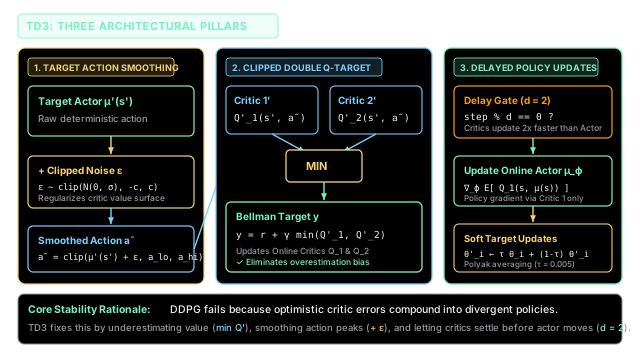
The Three Architectural Pillars of TD3
┌───────────────────────────────────┐ │ Target Actor μ_ϕ'(s') │ └─────────────────┬─────────────────┘ │ ▼┌────────────────────────┐ ┌───────────────────────────────────┐│ Clipped Gaussian Noise │──────►│ 1. Target Action Smoothing ││ ε ~ clip(N(0,σ), -c, c)│ │ ã = clip(μ'(s') + ε, a_lo, a_hi)│└────────────────────────┘ └─────────────────┬─────────────────┘ │ ▼ ┌───────────────────────────────────┐ │ 2. Clipped Double Q-Learning │ │ Target Critics Q'_1 & Q'_2 │ │ y = r + γ min(Q'_1, Q'_2) │ └─────────────────┬─────────────────┘ │ ▼┌────────────────────────┐ ┌───────────────────────────────────┐│ Step Counter: │──────►│ 3. Delayed Policy Updates (d = 2) ││ step % d == 0 ? │ │ Actor updated via Critic 1 │└────────────────────────┘ │ Polyak targets updated │ └───────────────────────────────────┘Pillar 1: Clipped Double Q-Learning
To prevent overestimation, TD3 maintains two independent critic networks: and , with corresponding target networks and .
When forming the bootstrapped Bellman target, TD3 evaluates the next state-action pair with both target critics and takes the minimum value:
Both online critics are updated independently toward this single shared target using mean squared error:
Because the minimum operator favors the smaller estimate, any random positive approximation error in one critic is neutralized by the other. While taking the minimum can occasionally introduce mild underestimation bias, underestimation does not compound through the Bellman equation, making training vastly more stable.
Pillar 2: Target Policy Smoothing
Deterministic policies are prone to overfitting to sharp, narrow peaks in the critic function. If the critic erroneously assigns a high value to an isolated action point , standard deterministic policy gradients push the actor directly into that narrow spike.
To enforce that similar actions yield similar value estimates, TD3 adds clipped zero-mean Gaussian noise to the target action:
- Standard Hyperparameters: Target noise , noise clipping limit .
Clipping the noise ensures the perturbed action stays close to the original target action while respecting physical motor boundaries. Target smoothing acts as a form of regularization in action space, smoothing out the critic's value manifold around the target action.
Pillar 3: Delayed Policy Updates
In standard actor-critic, updating the actor with a high-error critic leads to poor policy updates. TD3 introduces a delayed update schedule:
- The critics are updated at every single step.
- The actor and all target networks () are updated only once every steps (typically ).
When :
- Update the actor using deterministic policy gradient ascent via Critic 1 only:
- Soft update all three target networks via Polyak averaging ():
Delaying policy updates allows the critics to converge to a low-variance value estimate before the actor uses them for policy improvement, breaking the destructive feedback loop of DDPG.
Worked numerical example
Let us trace a single training step of TD3 with concrete numerical values:
- Discount factor:
- Observed reward: (non-terminal, done = False)
- Target policy noise: (drawn from )
- Action bounds:
Step 1: Target Action Smoothing
In next state , the target actor predicts raw action:
Add clipped Gaussian noise and clip to bounds: (If unclipped, suppose the action was with noise clipped to . For this walkthrough, let raw action be so that within a wider bound , or directly evaluate at ).
Let the smoothed target action be .
Step 2: Clipped Double Q Evaluation
The twin target critics evaluate state-action pair :
Apply the minimum operator:
Step 3: Compute Bellman Target
Step 4: Compute Critic Losses
The online twin critics predict values for the sampled transition :
Compute the mean squared error for both critics:
Both critics backpropagate their respective errors.
Step 5: Delayed Policy Update Gate
Check the global iteration counter:
- Iteration 1 (): . The actor and target networks are not updated.
- Iteration 2 (): . The actor performs a policy gradient step using , and all target networks execute Polyak soft averaging ().
Code
The following self-contained, type-hinted Python script implements the complete TD3 update architecture, including Twin Critics, Target Action Smoothing with clipping, Clipped Double Q Target computation, and the Delayed Actor update counter:
"""Complete implementation of the Twin Delayed DDPG (TD3) update step.
Demonstrates:1. Target Action Smoothing with clipped Gaussian noise2. Clipped Double Q-Learning Bellman target3. Twin Critic MSE updates4. Delayed Policy Updates (actor and Polyak targets updated every d steps)"""
from typing import Dict, Optional, Tupleimport numpy as np
class SimpleLinearModel: """Linear function approximator for testing actor and critic models."""
def __init__(self, in_features: int, out_features: int, seed: int = 42) -> None: np.random.seed(seed) self.W: np.ndarray = np.random.randn(in_features, out_features) * 0.1 self.b: np.ndarray = np.zeros(out_features)
def forward(self, x: np.ndarray) -> np.ndarray: return x @ self.W + self.b
def copy(self) -> "SimpleLinearModel": clone = SimpleLinearModel(self.W.shape[0], self.W.shape[1], seed=0) clone.W = self.W.copy() clone.b = self.b.copy() return clone
class TD3Agent: """Twin Delayed Deep Deterministic Policy Gradient (TD3) agent core."""
def __init__( self, state_dim: int = 3, action_dim: int = 1, max_action: float = 1.0, gamma: float = 0.99, tau: float = 0.005, policy_noise: float = 0.2, noise_clip: float = 0.5, policy_delay: int = 2, seed: int = 42, ) -> None: np.random.seed(seed) self.state_dim: int = state_dim self.action_dim: int = action_dim self.max_action: float = max_action self.gamma: float = gamma self.tau: float = tau self.policy_noise: float = policy_noise self.noise_clip: float = noise_clip self.policy_delay: int = policy_delay self.total_it: int = 0
# Actor and Target Actor self.actor: SimpleLinearModel = SimpleLinearModel(state_dim, action_dim, seed=seed) self.actor_target: SimpleLinearModel = self.actor.copy()
# Twin Critics and Twin Target Critics critic_in: int = state_dim + action_dim self.critic1: SimpleLinearModel = SimpleLinearModel(critic_in, 1, seed=seed + 1) self.critic1_target: SimpleLinearModel = self.critic1.copy()
self.critic2: SimpleLinearModel = SimpleLinearModel(critic_in, 1, seed=seed + 2) self.critic2_target: SimpleLinearModel = self.critic2.copy()
def select_action(self, state: np.ndarray) -> np.ndarray: """Evaluate deterministic actor with tanh bounding.""" raw = self.actor.forward(state) return np.clip(np.tanh(raw) * self.max_action, -self.max_action, self.max_action)
def train_step( self, state: np.ndarray, action: np.ndarray, reward: float, next_state: np.ndarray, done: bool = False, lr_critic: float = 0.05, lr_actor: float = 0.05, ) -> Dict[str, Optional[float]]: """Execute one complete TD3 training iteration.""" self.total_it += 1
# ------------------------------------------------------------------ # 1. Target Policy Smoothing # ------------------------------------------------------------------ raw_next_action = np.tanh(self.actor_target.forward(next_state)) * self.max_action noise = np.clip( np.random.randn(*raw_next_action.shape) * self.policy_noise, -self.noise_clip, self.noise_clip, ) smoothed_target_action = np.clip( raw_next_action + noise, -self.max_action, self.max_action, )
# ------------------------------------------------------------------ # 2. Clipped Double Q-Learning Target # ------------------------------------------------------------------ next_sa = np.concatenate([next_state, smoothed_target_action]) target_q1 = float(self.critic1_target.forward(next_sa)[0]) target_q2 = float(self.critic2_target.forward(next_sa)[0]) min_target_q = min(target_q1, target_q2)
target_y = reward + (0.0 if done else (self.gamma * min_target_q))
# ------------------------------------------------------------------ # 3. Twin Critic MSE Updates # ------------------------------------------------------------------ sa = np.concatenate([state, action]) q1 = float(self.critic1.forward(sa)[0]) q2 = float(self.critic2.forward(sa)[0])
loss_critic1 = (q1 - target_y) ** 2 loss_critic2 = (q2 - target_y) ** 2
# Gradient descent on critics grad_q1 = 2.0 * (q1 - target_y) self.critic1.W -= lr_critic * np.outer(sa, np.array([grad_q1])) self.critic1.b -= lr_critic * np.array([grad_q1])
grad_q2 = 2.0 * (q2 - target_y) self.critic2.W -= lr_critic * np.outer(sa, np.array([grad_q2])) self.critic2.b -= lr_critic * np.array([grad_q2])
# ------------------------------------------------------------------ # 4. Delayed Policy Updates # ------------------------------------------------------------------ actor_loss: Optional[float] = None actor_updated: bool = False
if self.total_it % self.policy_delay == 0: actor_updated = True # Policy gradient: maximize Q1(state, actor(state)) -> minimize -Q1 act_pred = np.tanh(self.actor.forward(state)) * self.max_action sa_pred = np.concatenate([state, act_pred]) current_q1 = float(self.critic1.forward(sa_pred)[0]) actor_loss = -current_q1
# Backpropagate through Critic 1 into Actor parameters grad_a_q1 = self.critic1.W[self.state_dim :] grad_raw = (1.0 - act_pred**2) * grad_a_q1.T[0] grad_W = np.outer(state, grad_raw) self.actor.W += lr_actor * grad_W self.actor.b += lr_actor * grad_raw
# Soft target updates via Polyak averaging self.critic1_target.W = self.tau * self.critic1.W + (1 - self.tau) * self.critic1_target.W self.critic1_target.b = self.tau * self.critic1.b + (1 - self.tau) * self.critic1_target.b self.critic2_target.W = self.tau * self.critic2.W + (1 - self.tau) * self.critic2_target.W self.critic2_target.b = self.tau * self.critic2.b + (1 - self.tau) * self.critic2_target.b self.actor_target.W = self.tau * self.actor.W + (1 - self.tau) * self.actor_target.W self.actor_target.b = self.tau * self.actor.b + (1 - self.tau) * self.actor_target.b
return { "step": self.total_it, "target_y": float(target_y), "loss_critic1": float(loss_critic1), "loss_critic2": float(loss_critic2), "actor_loss": float(actor_loss) if actor_loss is not None else None, "actor_updated": actor_updated, }
if __name__ == "__main__": agent = TD3Agent(seed=42) s = np.array([1.0, -0.5, 0.2]) a = np.array([0.4]) r = 1.0 s_next = np.array([0.8, -0.3, 0.5])
# Execute Step 1 (Critics only) step1 = agent.train_step(s, a, r, s_next) print(f"Step 1: Critic1 Loss={step1['loss_critic1']:.4f}, Actor Updated={step1['actor_updated']}")
# Execute Step 2 (Critics + Delayed Actor Update) step2 = agent.train_step(s, a, r, s_next) print( f"Step 2: Critic1 Loss={step2['loss_critic1']:.4f}, " f"Actor Updated={step2['actor_updated']}, " f"Actor Loss={step2['actor_loss']:.4f}" )
# Automated assertions assert step1["actor_updated"] is False, "Actor must not be updated on step 1 when delay=2." assert step2["actor_updated"] is True, "Actor must be updated on step 2 when delay=2." assert step2["actor_loss"] is not None, "Actor loss must be recorded on update step." assert step1["loss_critic1"] > 0.0 and step2["loss_critic1"] > 0.0, "Critic losses must be strictly positive." print("Verification passed: TD3 successfully executes Twin Critics and Delayed Updates.")Expected Output
Step 1: Critic1 Loss=0.7217, Actor Updated=FalseStep 2: Critic1 Loss=0.5355, Actor Updated=True, Actor Loss=-0.4264Verification passed: TD3 successfully executes Twin Critics and Delayed Updates.Watch Out For
Smoothing Noise Saturation and Actor Update Frequency Imbalance
The Trap: Practitioners tuning TD3 frequently destabilize training through two common configuration traps:
- Smoothing Noise Oversaturation ( or excessive noise): Setting the target policy smoothing noise too high (e.g., ) washes out fine-grained value distinctions. In environments requiring milliradian-precise positioning (such as robotic needle manipulation), excessive target noise forces the critic to over-smooth the landscape, preventing the actor from learning precise control policies.
- Imbalancing Update Frequency ( or ): Setting the policy delay parameter reverts TD3 back to DDPG, reintroducing moving-target feedback chaos and overestimation. Conversely, setting too high (e.g., ) starves the actor of gradient updates, drastically slowing learning and wasting replay buffer transitions.
The Fix:
- Adhere to the canonical default settings: policy noise and clipping threshold . Always enforce to capture roughly of the normal distribution without extreme tail distortion.
- Keep the policy update delay strictly at . Empirical studies across the entire MuJoCo continuous control benchmark establish that provides the optimal trade-off between critic stability and sample velocity.
The Quick Version
- Solves DDPG Overestimation: TD3 cures the severe value overestimation, brittle peak exploitation, and moving-target instability that plague classical DDPG.
- Clipped Double Q-Learning: Maintains two independent critics and ; forms the Bellman target using to strictly suppress positive approximation errors.
- Target Policy Smoothing: Adds clipped Gaussian noise to the target action, preventing the actor from exploiting narrow artificial spikes in the critic.
- Delayed Policy Updates: Updates the actor and soft target networks only once every critic steps, ensuring the policy only improves against stable, converged value surfaces.