Visual explainer
U-Net Segmentation
Follow spatial scales, skip connections, channel mixing, and pixel predictions.
1. Predict At Every Pixel
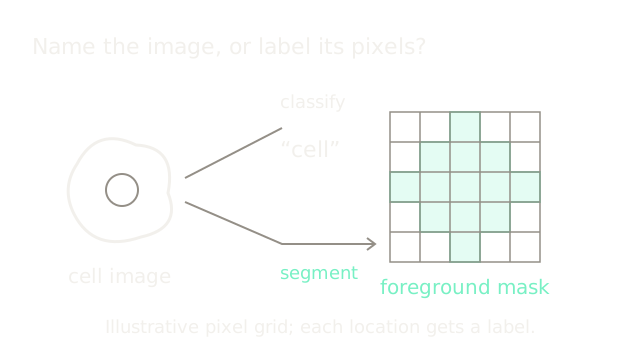
U-Net is an encoder-decoder network for image segmentation. Instead of answering only whether a cell is present, it predicts which pixels belong to the cell. The grid is a small teaching example, not a measured model result.
2. Gather Context By Downsampling
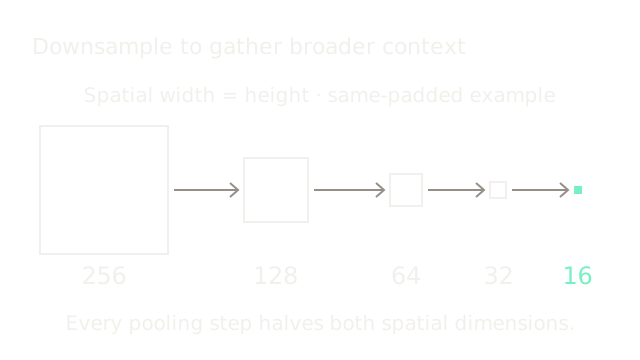
Follow all four halvings: 256, 128, 64, 32, 16. Convolutions learn features between pooling steps. These dimensions describe a same-padded example; the original architecture also shrinks feature maps through unpadded convolutions.
3. Restore Spatial Resolution
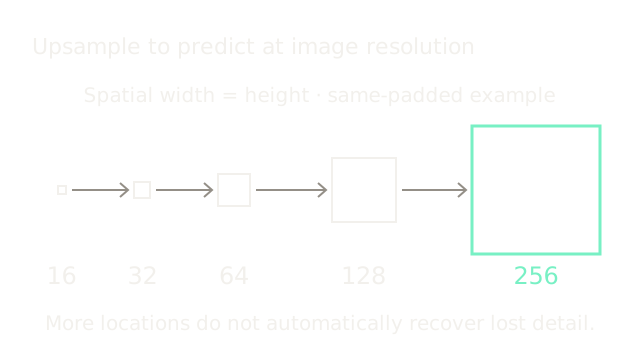
The expanding path upsamples through the matching scales. More output locations do not automatically mean more recovered information: the decoder must learn how to use coarse context and features arriving through the skip connections.
4. Connect Matching Scales
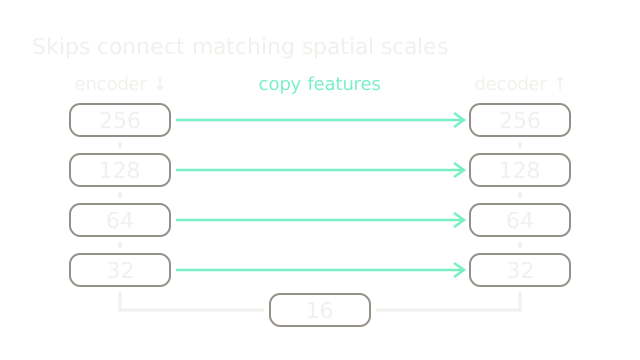
Trace a horizontal bridge alongside the longer route through the bottleneck. Encoder features provide spatial information that can help localization. They are learned feature maps, not ready-made outlines, and their usefulness depends on training.
5. Concatenate Along Channels
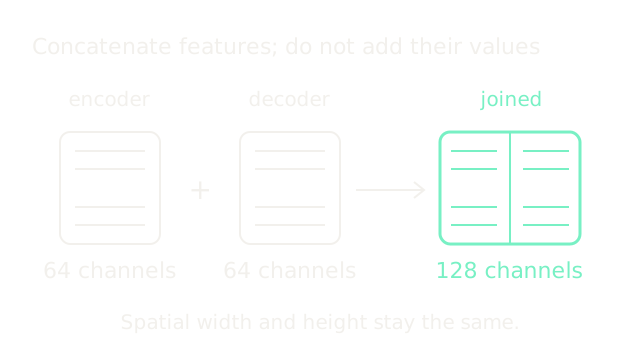
At this illustrative stage, both inputs share height and width. Concatenation stacks their channels; it does not add corresponding values. The decoder now receives both sets of features for subsequent convolutions to combine.
6. Learn How To Combine Features
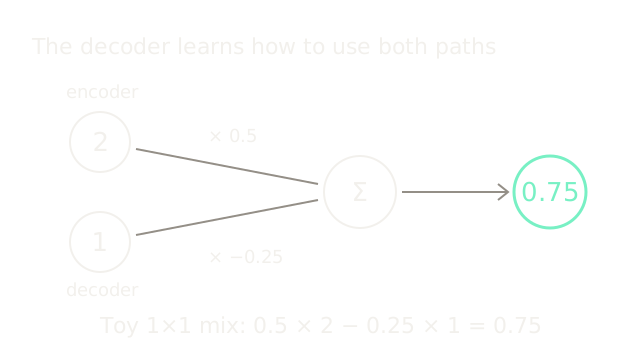
The tiny calculation isolates channel mixing: 0.5 × 2 − 0.25 × 1 = 0.75. A spatial convolution also combines neighbouring positions. Training learns these weights; copying features across a bridge alone does not produce a segmentation.
7. Produce A Pixel Mask
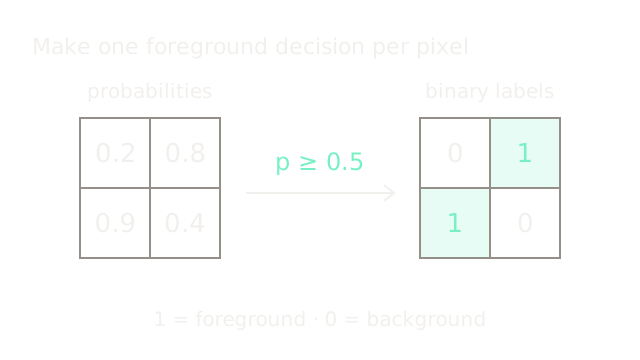
For a binary variant, a 1 × 1 output convolution can produce logits, followed by sigmoid. The example applies a 0.5 threshold. Multiclass segmentation instead predicts class scores at each pixel, commonly using softmax.
8. Account For The Borders
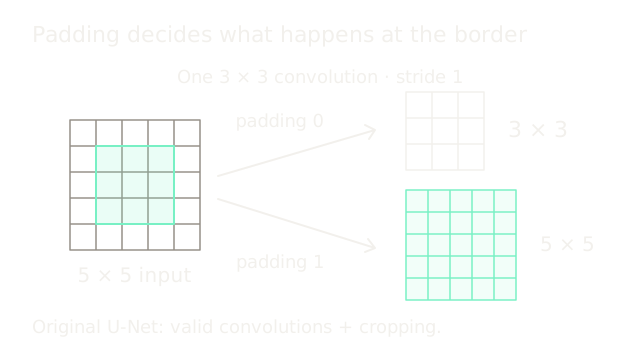
For one stride-one convolution, output size is input size + 2 × padding − kernel size + 1. The original U-Net paper uses valid convolutions and crops encoder features before concatenation; same-padded variants handle dimensions differently.
9. Understand What Pooling Loses
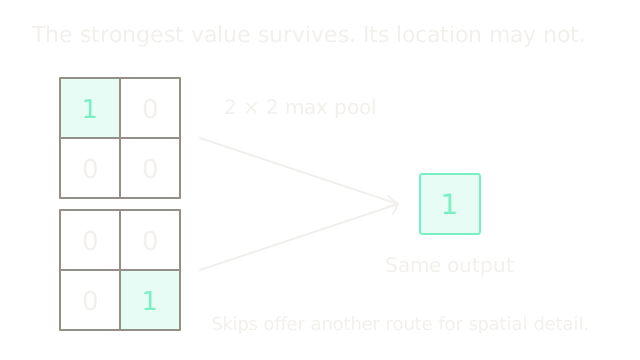
Both patches produce the same maximum. From that value alone, the decoder cannot know which corner was active. Skip features offer another route for spatial information, but fine structures and boundaries still require suitable data, resolution, and training.
10. Separate Classes From Identities
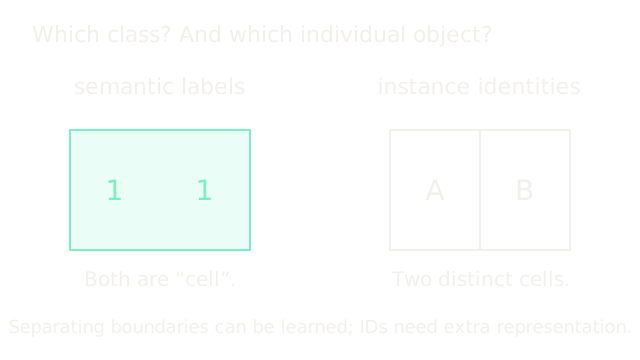
A foreground label says “cell,” not “cell A.” Semantic predictions can learn gaps between touching objects, as the original work demonstrates. Assigning persistent object identities requires an instance representation or additional processing.
The Quick Version
- Segmentation assigns a class to each pixel.
- Four halvings take 256 through 32 to 16.
- Upsampling restores resolution, not automatically lost information.
- Skip connections supply encoder features at matching scales.
- Concatenation appends channels; it does not add values.
- Learned convolutions combine spatial and channel information.
- A prediction head produces pixel scores and labels.
- Padding determines output size and skip alignment.
- Pooling can discard precise locations.
- Semantic classes and instance identities answer different questions.