Visual explainer
Non-Maximum Suppression (NMS)
How greedy box selection removes duplicate detections, with exact overlap arithmetic and the cases it gets wrong.
1. Count Proposals, Not Objects
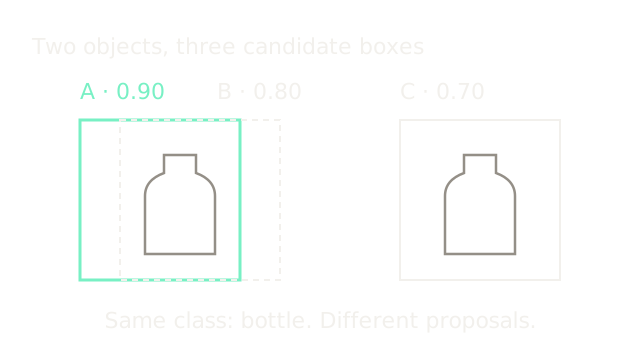
Non-maximum suppression removes overlapping detection proposals using their scores and box overlap. It repeatedly keeps the highest-scoring remaining box, then removes sufficiently overlapping candidates. Here A and B describe one bottle; C describes another.
2. Compute The Overlap
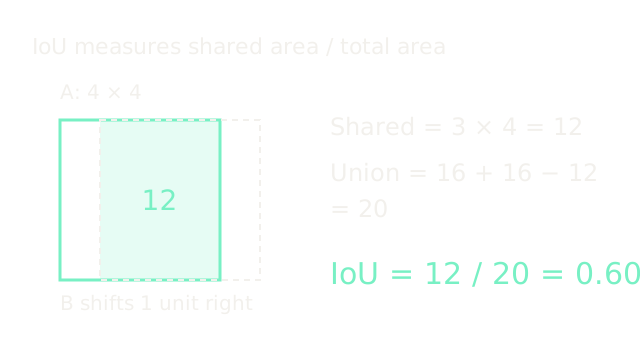
Use continuous coordinates: A is (0,0,4,4), B is (1,0,5,4). Both have area 16. Their shared area is 12; their union is 16 + 16 − 12 = 20. Intersection over union is 12/20 = 0.60.
3. Keep The Highest Score
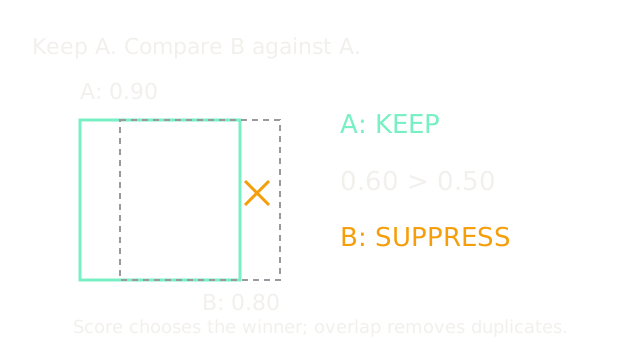
A's 0.90 beats B's 0.80. At an IoU threshold of 0.50, B is suppressed because 0.60 > 0.50. This follows Torchvision's strict greater-than rule. The score ranks candidates; it does not measure their overlap.
4. Repeat On What Remains
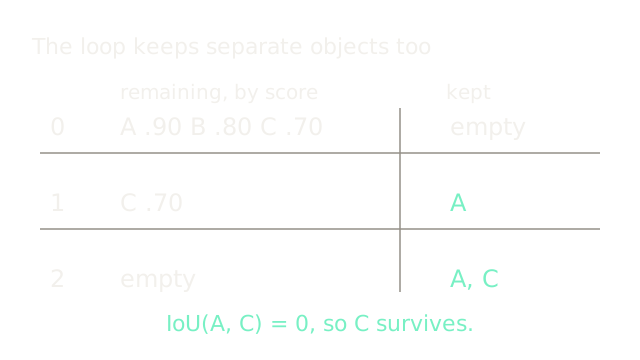
C does not overlap A, so it remains available after the first round. The next round keeps C. Stop when the remaining list is empty. A lower score alone never causes suppression by NMS.
5. Read The Output
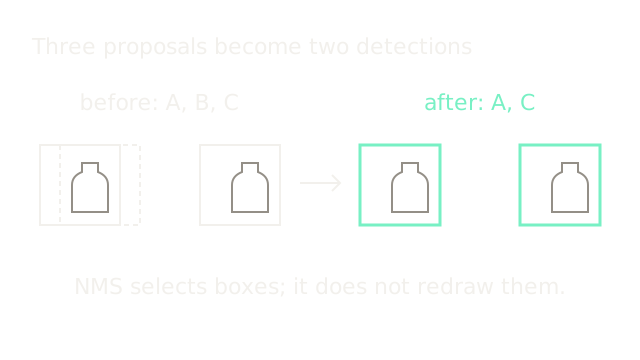
The output is a subset of the input boxes: A and C. Their coordinates stay unchanged. NMS does not refine boundaries, average coordinates, or verify that a retained proposal truly contains an object.
6. Change One Threshold
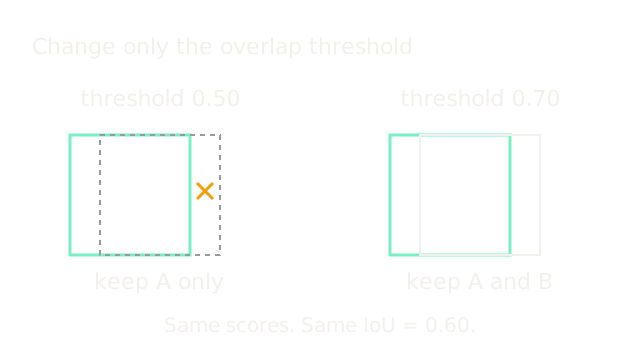
At threshold 0.70, this pair's 0.60 overlap no longer triggers suppression. Higher thresholds tolerate more overlap and can leave duplicates. Lower thresholds remove more overlapping boxes and can lose nearby objects. Choose using validation examples from the target scene.
7. Separate Predicted Classes
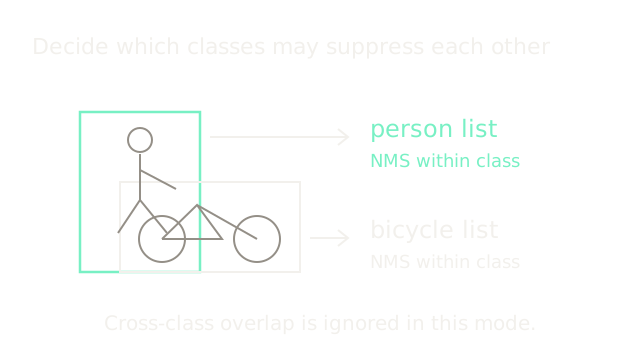
A person and a bicycle may overlap legitimately. Class-wise NMS processes their candidate lists independently. Class-agnostic NMS compares across classes instead; that is a separate policy choice from the numerical IoU threshold.
8. Separate The Two Cutoffs
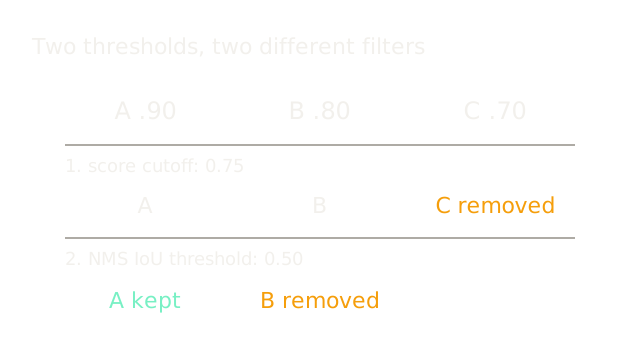
A detector may filter low scores before NMS. With an illustrative score cutoff of 0.75, C's 0.70 is removed before any overlap comparison. Lowering the NMS threshold cannot recover a candidate already discarded by score filtering.
9. Greedy Is A Local Choice
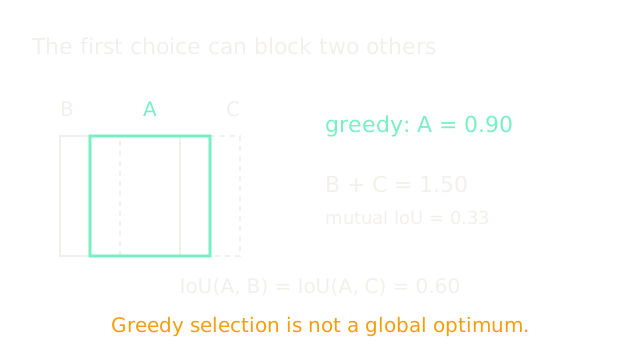
This new fixture places A between B and C. A overlaps each at 0.60, but B and C overlap only at one third. Choosing A first removes both. NMS does not search for a compatible subset with the largest summed score.
10. Where It Breaks
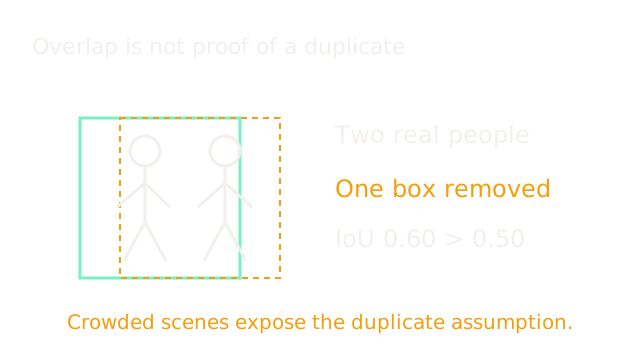
Two people can produce highly overlapping same-class boxes. The same rule that removes duplicates can now remove a true detection. Raising the threshold trades this error against surviving duplicates; overlap and score alone do not reveal object identity.
The Quick Version
- Multiple proposals can describe the same object.
- IoU divides intersection area by union area.
- Keep the highest score, then suppress excessive overlap.
- Repeat with the highest-scoring candidate still available.
- NMS returns existing boxes without redrawing them.
- Higher IoU thresholds suppress fewer candidates on identical input.
- Class-wise NMS does not compare different predicted classes.
- Score cutoffs and IoU thresholds filter different properties.
- Greedy NMS does not optimize total retained score.
- Crowds can cause real detections to be suppressed.