AI Hallucinations Are Not Bugs, They Are Features
The conversation around AI hallucinations is fundamentally flawed. When a model invents a legal precedent or a software library that doesn't exist, we often call it a "hallucination," implying the model experienced a glitch. But hallucination mechanisms are not bugs. They are the exact same mechanism working exactly as intended.
Large Language Models (LLMs) are not databases. They don't look up facts; they perform next token prediction. If the most statistically likely sequence of words happens to be factually incorrect, the model will output it with the same confidence as a verified truth. You cannot eliminate hallucinations without destroying the generative nature of the model itself.
But you can manage them.
The Illusion of Absolute Grounding
As of September 2026, even the most capable frontier models—like GPT-4o, Claude 3.5 Sonnet, and Gemini 1.5 Pro—still confabulate. Fine-tuning models on factual datasets doesn't solve this; it just shifts the probability distribution. When to fine-tune is a question for tone and domain adaptation, not factual grounding.
If you treat a language model as a source of truth, you will eventually get burned. Instead, you must treat the model as a reasoning engine and provide the truth yourself.
How to Pragmatically Reduce Hallucinations
Mitigating hallucinations requires constraining the model's output space. Here are the three most effective strategies in practice today.
1. Retrieval-Augmented Generation (RAG)
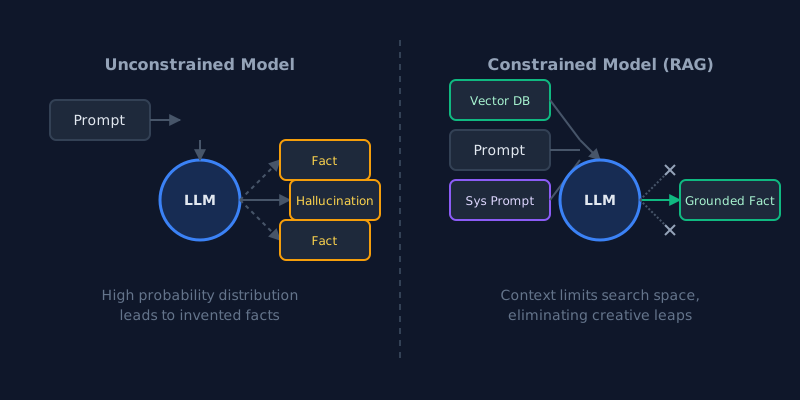
The gold standard for factual grounding is RAG Architecture. Instead of asking the model what the policy says, you search your own vector databases for the relevant policy documents, inject them into the prompt, and ask the model to summarize or answer based only on the provided text.
This shifts the burden of truth from the model's weights to your retrieval system. If the retrieval is accurate, the model is simply performing reading comprehension, at which modern LLMs excel.
2. Strict System Prompts
System prompts are your first line of defense. By explicitly commanding the model to admit ignorance, you alter the probability landscape.
A prompt like "You are a helpful assistant." encourages guessing. A prompt like "You are a technical assistant. Answer ONLY using the provided context. If the answer is not contained in the context, say 'I don't know'." forces the model to weigh the exact phrasing of its constraints over its generalized pretraining data.
3. Temperature and Top-P Controls
Generative diversity is the enemy of factual accuracy. If you are building a creative writing tool, high temperature sampling is necessary. If you are extracting data from an invoice, you want a temperature of 0.0. By lowering the temperature, you collapse the probability distribution toward the single most likely token, eliminating the "creative" leaps that often lead to confabulations.
The Path Forward
We are getting better at identifying when models are guessing. Techniques like self-reflection and cross-examination (where an LLM as a judge verifies the output of another model) are adding layers of resilience.
But until the fundamental architecture of AI shifts away from pure autoregressive generation, hallucinations will remain. Stop trying to cure them. Start designing systems that expect them.
(Correct as of September 2026).