Responsible AI Frameworks in Practice
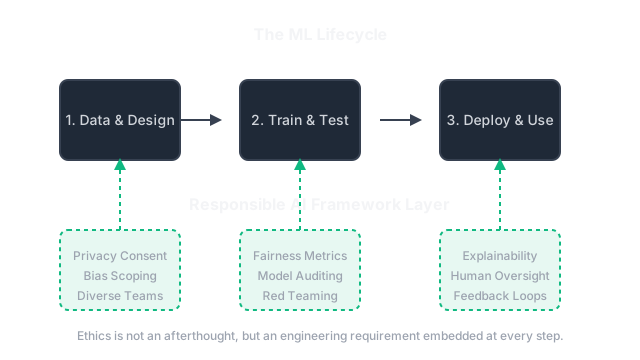
Frameworks turn fairness, privacy and oversight into release gates with owners and thresholds, so a risky model cannot quietly ship.
Why Does This Exist?
A hiring tool screens 400 applicants and advances far fewer from one group, yet nobody can name who approved the launch or which check it passed. You have seen this pattern: a team agrees models should be fair and private, then ships anyway because no check owned the decision.
Principles do not stop that ship. A framework does. It names the checks, the thresholds, the owners and the logs, and it blocks release until each one passes.
This page covers the framework menu: the gates you install across data, training, audit and deployment. The release machinery itself lives in AI governance. The legal tiers that set must-do duties live in AI regulations. How outsiders test your claims lives in model auditing.
You need one idea first. Disparate impact is the smaller selection rate divided by the larger one across groups. Call it . A common floor is . Below that line, the model stays held.
Think of It Like This
A city water plant, not a filter jug
A water plant does not trust one filter at the tap. It checks at intake, at treatment, in the mains and at sample taps across the city. Each point has an owner, a test strip and a logbook. If intake fails, treatment never starts. If a sample fails, the valve stays shut.
Map it across: intake is your data provenance, treatment is training with privacy limits, the mains audit is the bias check, and sample taps are live monitoring with human oversight. The logbook is your model card and audit trail.
Where it stops: water tests read in minutes while model harm shows up weeks later as statistics. That is why your gates need drift watches and appeal routes, not just a one-time pass.
How It Actually Works
A framework is a short list of blocking gates. Each gate names what it checks, the line it must clear, who owns it and where the result is logged. No pass, no ship.
Let be provenance status, true only when every training source is logged with consent and coverage. Let be the disparate impact ratio across groups. Let be the release floor, here . In words: says you may train, says the outcome gap is small enough, and is the line must clear.
The three gates in order
- Provenance gate. must be true. A missing source or an out-of-scope reuse stops training before it starts.
- Audit gate. must clear . A hiring model at against stays held, even with strong accuracy.
- Oversight gate. A named human owns the release, watches drift after launch and can roll back. A dashboard with no stop control does not count.
Worked example with 200 applicants per group
Take 200 applicants in group one and 200 in group two. The model advances 78 in group one and 100 in group two.
Selection rates are and . The ratio is . Since , the release is held before deployment. The diagram draws this chain: four stage boxes feeding one gate diamond marked HOLD.
After a fix the team resubmits at 84 advances in group one. Now the rate is and . Since with true and an owner signed in, the answer flips to ship, and all three numbers go into the log. Privacy and documentation ride the same gates: noise limits and model cards are checked at training and audit, not added after launch.
Code
A two-line gate you can drop into a pipeline script. Standard library only.
def release_ok(provenance_ok: bool, impact: float) -> str: if not provenance_ok: return "hold: provenance missing" if impact < 0.80: return "hold: impact gate failed" return "ship"
print(release_ok(True, 0.78)) # -> hold: impact gate failedprint(release_ok(True, 0.84)) # -> shipThe first call holds at the audit gate with the worked . The second clears and ships. Those printed words are the decision log.
Watch Out For
Filling the checklist after the ship
Symptom: model cards dated after launch, an ethics board that can advise but never block, gates that run as warnings in CI. The paperwork exists and the behavior never changes.
Fix: wire each gate as a blocking step with an owner, so a fail stops the deploy, and date every artifact before the release tag, as in AI governance.
Deleting the sensitive column and calling the model blind
Symptom: you drop the group label, fairness looks unmeasurable, and the model still rejects one group because postcode and purchase history carry the same signal. You lost the ability to measure the gap you kept.
Fix: keep group labels in the audit set, test on intersections that matter, and judge outcomes, not inputs.
The Quick Version
- Frameworks turn principles into blocking gates with owners, thresholds and logs.
- Provenance must be true before training starts: every source logged with consent and coverage.
- The audit gate holds a hiring model at impact 0.78 under a 0.80 floor.
- Our fixture advances 78 and 100 of 200 per group for 0.78, then 84 and 100 for 0.84 to ship.
- Oversight means a named human can hold or roll back the release.
- A gate that cannot block a deploy is decoration, not governance.