Attention-Augmented CNNs
Attention blocks let CNNs dynamically boost informative channels and focus on salient spatial regions while suppressing background noise.
Why Does This Exist?
Standard convolutional layers operate under a fundamental limitation: uniform spatial and channel weighting. In a standard 2D convolution, every channel and every pixel location across the feature map is processed with static filter weights learned over the entire training set. Once trained, the filter weights do not adapt to the specific content of an individual input image.
In practical visual scenes, different feature channels carry vastly different diagnostic value. If an image contains a golden retriever on a grassy lawn, canine texture channels are critical for classification, while background grass and blue-sky channels are irrelevant distractors. Yet standard convolutions sum all channel contributions equally into the next layer.
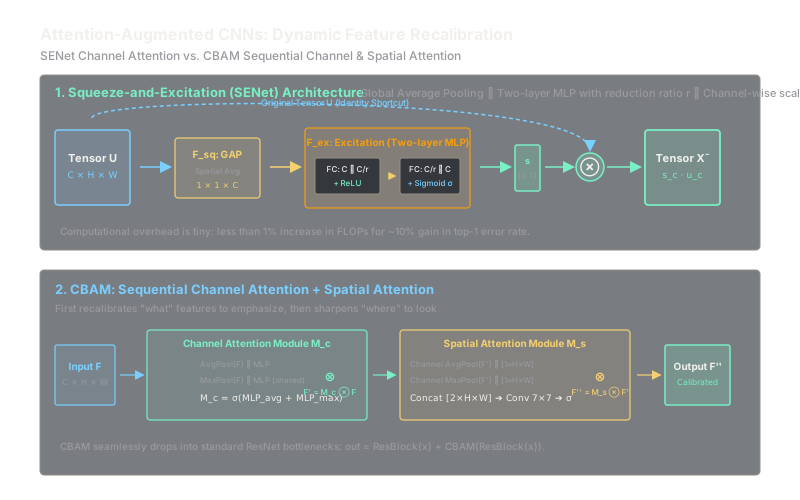
Attention-augmented CNNs introduce dynamic feature recalibration. Instead of treating all channels and pixels symmetrically, lightweight attention modules compute data-dependent scaling factors at runtime:
- SENet (Squeeze-and-Excitation Networks, Hu et al., 2018): Answers the question "Which channels (what features) matter?" by modeling global inter-channel dependencies.
- CBAM (Convolutional Block Attention Module, Woo et al., 2018): Answers both "What features matter?" and "Where in the image are they located?" by chaining channel attention with spatial attention.
These mechanisms require negligible compute—less than a 1% increase in floating-point operations—while winning the final ImageNet classification challenge (SENet achieved a top-5 error of 2.251%).
Think of It Like This
A mixing soundboard and an audio spotlight
Imagine managing a 64-track audio recording of a live orchestral concert. A conventional convolution is an automated recording technician who keeps all 64 faders permanently locked at a fixed volume regardless of who is performing. During an intricate violin solo, the brass and percussion microphones remain at full volume, drowning out subtle string harmonics.
SENet is an intelligent mixing board equipped with a Squeeze-and-Excitation monitor. First, it samples the average level across all tracks (Squeeze). Next, it reasons across the ensemble to predict which instruments are carrying the melody (Excitation). Finally, it pushes the violin faders up to 95% while pulling the background drum microphones down to 5% (Scale).
CBAM adds a directional sound technician with an acoustic spotlight: after balancing which instrument tracks to amplify (Channel Attention), it points a focused spotlight at the exact stage position where the lead soloist is standing (Spatial Attention), suppressing acoustic room echo.
How It Actually Works
Squeeze-and-Excitation (SENet) Mechanics
Let represent the output feature map of a convolutional block, where .
The SE block operates in three sequential phases:
- Squeeze Step (): Global Average Pooling condenses the spatial dimensions of each channel into a 1D channel descriptor :
This embeds a global spatial receptive field into a compact vector.
- Excitation Step (): To capture non-linear, non-mutually-exclusive channel relationships, passes through a two-layer multi-layer perceptron (MLP) with a bottleneck reduction ratio (typically ):
where denotes the ReLU activation, denotes the Sigmoid function, , and . The output represents learned channel importance coefficients.
- Scale Step (): The original feature map is rescaled channel-wise:
The output is passed directly to subsequent layers or added into a residual stream.
CBAM: Combining Channel and Spatial Attention
CBAM decomposes attention sequentially: an intermediate feature map is refined by channel attention and spatial attention :
- CBAM Channel Attention: Unlike SENet (which uses only average pooling), CBAM utilizes both average pooling and max pooling to capture distinct feature statistics, feeding them through a shared MLP:
- CBAM Spatial Attention: Computes channel-wise average and max projections across feature map , concatenates them along the channel axis, and applies a convolution:
where is a tensor. This highlights where in the image informative features reside.
Worked Example
Let us trace an SE block on a feature map with channel reduction ratio :
- Input shape:
- Squeeze: Global Average Pooling across elements per channel yields vector of length 64.
- Excitation Bottleneck:
- reduces from 64 to dimensions:
- Apply ReLU activation to the 4-dimensional vector.
- expands from 4 back to 64 dimensions:
- Apply Sigmoid to produce channel weight vector .
- Total parameters introduced by the SE block: weights (plus biases: ).
- Scale: Multiply each spatial slice by scalar . If channel has score and channel has , channel 3 is preserved at full strength while channel 7 is suppressed by over 90%.
Code
import torchimport torch.nn as nn
class SqueezeAndExcitation(nn.Module): """Squeeze-and-Excitation (SE) channel attention module.""" def __init__(self, in_channels: int, reduction_ratio: int = 16) -> None: super().__init__() reduced_channels = max(1, in_channels // reduction_ratio) self.fc1 = nn.Linear(in_channels, reduced_channels, bias=False) self.relu = nn.ReLU(inplace=True) self.fc2 = nn.Linear(reduced_channels, in_channels, bias=False) self.sigmoid = nn.Sigmoid()
def forward(self, x: torch.Tensor) -> torch.Tensor: b, c, _, _ = x.shape # Squeeze: Global Average Pooling (B, C, H, W) -> (B, C) z = x.mean(dim=(2, 3)) # Excitation: Two-layer MLP with Sigmoid gating s = self.sigmoid(self.fc2(self.relu(self.fc1(z)))) # Scale: Reshape to (B, C, 1, 1) and broadcast multiply s = s.view(b, c, 1, 1) return x * s
# Verification on an intermediate tensor: Batch=2, C=64, H=14, W=14x = torch.randn(2, 64, 14, 14)se = SqueezeAndExcitation(in_channels=64, reduction_ratio=16)out = se(x)
print(out.shape)# -> torch.Size([2, 64, 14, 14])
# Parameter count verificationparams = sum(p.numel() for p in se.parameters())print(params)# -> 512Watch Out For
Over-compressing early layers and ignoring spatial context in segmentation
Setting a fixed reduction ratio (such as ) without boundary clamping can severely harm early convolutional stages where channel counts are low (e.g., or ). At , , creating an extreme informational bottleneck down to a single scalar that prevents the MLP from modeling diverse inter-channel dynamics.
Additionally, applying SENet alone to dense prediction tasks like semantic segmentation or object detection can lead to sub-optimal results because global average pooling flattens out spatial localization cues. For spatial tasks, prefer CBAM or spatial attention blocks that preserve coordinate-specific activation maps rather than relying exclusively on channel recalibration.
The Quick Version
- SENet introduces Squeeze-and-Excitation blocks to dynamically recalibrate channel activations based on global image context.
- Squeeze aggregates spatial information via Global Average Pooling; Excitation computes channel gates via a two-layer bottleneck MLP.
- CBAM builds upon SENet by sequentially combining channel attention with a spatial attention module using convolutions.
- SE blocks add under 1% computational overhead (FLOPs) while delivering consistent accuracy improvements across ResNet and MobileNet backbones.
- Channel weights act as adaptive volume knobs, suppressing background noise and amplifying task-relevant visual patterns.