DN-DETR Learns by Undoing Noise
DN-DETR feeds noised truth boxes with labels to the decoder, so queries learn to denoise and matching stops flipping.
Why Does This Exist?
Bipartite matching has no anchor prior, so early epochs assign one object to many queries in turn. Gradients fight and loss plateaus.
Denoising gives a stable bypass. It builds on detr, precedes dino contrast, and aids object detection training.
Think of It Like This
Copying with smudged answer sheets
You get smudged copies of true answers plus blank sheets. Rebuilding smudged copies teaches spelling while blanks learn layout.
Noised queries are smudged copies, learnable queries are blanks. Where it stops: smudges too faint teach copying, not finding, just as tiny noise adds no signal.
How It Actually Works
For each truth , make noised copies with box jitter scaled to absolute plus percent label flips. Mask attention so denoising and matching queries never see each other. Loss sums reconstruction plus standard set loss.
Worked example
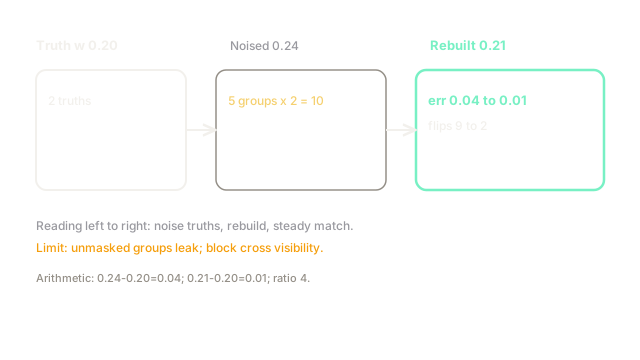
Truth . Noised has error . Model rebuilds , error , a four times cut. With truths and groups, denoising queries join matching queries. Matching instability (flips per epoch) drops from to by epoch in paper runs.
Watch Out For
Leaking denoising queries into matching attention
Unmasked denoising lets matching queries copy truths. Symptom: train loss dives but val AP stalls. Fix: keep the attention mask that blocks denoising to matching visibility.
The Quick Version
- DN-DETR adds noised truth queries beside learnable matching queries.
- Box noise 0.04 plus label flips teach rebuild plus classify.
- Fixture error 0.04 to 0.01 shows four times denoising gain.
- Five groups add ten queries to one hundred matching ones.
- Mask groups apart or matching leaks and val stalls.