Unsupervised Domain Adaptation
Align source and target features using labeled source images plus unlabeled target images, so the classifier works in both.
Why Does This Exist?
The domain gap page measures the fall: 0.91 to 0.63. Often the target domain offers plenty of images but no labels, such as a new city's streets or a new camera's night footage. Unsupervised domain adaptation uses those unlabeled target images during training to pull the two feature distributions together while the classifier learns from source labels.
It needs both domains at training time. When source data is locked away, use source-free adaptation. When no target data exists at all, use domain generalization.
Think of It Like This
Tuning two radios to the same station
Two radios receive the same broadcast through different static. You cannot hear the target radio's words clearly, but you can adjust its dial until its static pattern matches the clear radio's pattern, and then the words come through. Source labels are the clear broadcast, target images are the static pattern to match. The analogy stops at semantics: matched static does not guarantee matched meaning, and alignment can map target cats onto source dogs when classes shift too.
How It Actually Works
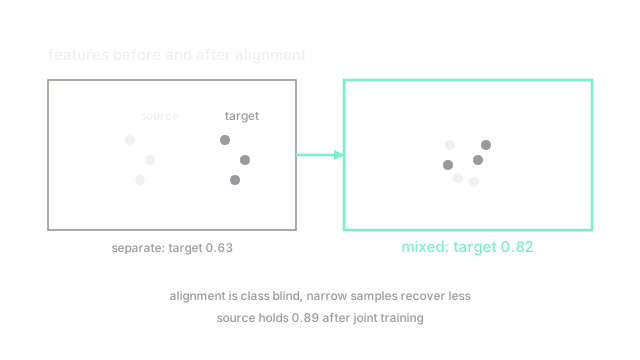
Train the classifier on labeled source images while a second objective pulls source and target features into one distribution. Common pulls are moment matching across batches, correlation alignment of feature covariances, or a domain critic trained to tell domains apart while the encoder learns to fool it, which is the adversarial variant. Class balance in the target batch matters because the pull is class-blind.
Worked example with recomputed numbers
Daylight source at 0.91, night-rain target at 0.63 before adaptation. Joint training with a moment-matching term weighted to equal the classification loss lifts target accuracy to 0.82, recovering 0.19 of the 0.28 gap, while source accuracy settles at 0.89. Halve the target batch diversity by sampling one neighborhood and recovery drops to 0.73, which shows the method reads the target sample it is given, narrow or wide.
The contract
Requires unlabeled target images at training time plus permission to use them. Assumes the label sets overlap substantially. When the target holds new classes, pair with open-set recognition instead of forcing alignment.
Watch Out For
Aligning away the class boundaries
Strong alignment pressure merges nearby classes across domains, and target accuracy on confused pairs falls below the unadapted baseline. The symptom is better domain confusion scores with worse per-class target accuracy. Fix it with class-conditional alignment or a lower alignment weight chosen on held-out target labels, not on the confusion score.
The Quick Version
- Uses labeled source plus unlabeled target images together at training time.
- The worked shift recovers 0.63 to 0.82, keeping source at 0.89.
- Alignment is class-blind, so narrow target samples give narrow recovery.
- Needs overlapping label sets; new target classes need open-set handling.
- Report a second unseen site, or adaptation-set tuning inflates the gain.