Domain Generalization and Adaptation
Models trained in one visual domain fail in another. Adaptation uses target data to adjust, generalization prepares for unseen domains without any.
Why Does This Exist?
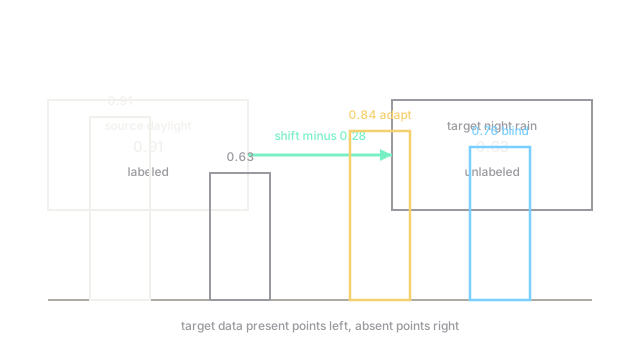
Daylight training meets night rain, synthetic renders meet real streets, one hospital scanner meets another. Accuracy falls off the same cliff every time: 0.91 on the source domain, 0.63 on the new one in the running example. The field splits on one question: is any target data available. When yes, adapt with it. When no, generalize blind.
This page is the map, not the methods. Unsupervised adaptation aligns with unlabeled target images, source-free adaptation adapts without revisiting source data, domain generalization trains for unseen domains, adversarial alignment matches features through a domain critic, and sim-to-real crosses the render gap. The existing companion is domain adaptation for vision.
Think of It Like This
Rehearsing in one hall, performing in another
A choir rehearses in a dry studio and performs in a stone cathedral where every note echoes. Adaptation is a soundcheck in the cathedral with the room's echo to adjust against. Generalization is rehearsing in five different rooms so no single room's acoustics become the performance. The analogy stops at features: choirs adjust balance, while networks must adjust representations that no listener can hear directly.
How It Actually Works
Residual only: name the split and the price of each side. Adaptation methods read target images and close most of the gap, here from 0.63 back toward 0.84, but need target access at training or test time and can overfit a narrow target sample. Generalization methods train over multiple source domains with invariance penalties and hold 0.76 on an unseen domain with no target data, but trail adaptation wherever target data exists. The worked gap is the decision aid: 0.28 lost to shift, about 0.21 recoverable with target data, about 0.13 without.
How to choose in one pass
Target images available plus permission to use them points to unsupervised or source-free adaptation. Source data locked behind policy points to source-free methods. No target data at all points to multi-source generalization. Simulation as the only source points to sim-to-real techniques. Each child page states its own data contract.
Watch Out For
Evaluating adaptation on the adaptation set
Tuning on the same target split that is reported inflates recovery by several points, and the model then meets a second target site unprepared. The symptom is published gains that vanish on the next hospital or city. Hold out a second unseen site and report it alongside the adapted one.
The Quick Version
- Domain shift costs 0.28 here, 0.91 down to 0.63, with no change to labels.
- Adaptation uses target data and recovers most of the gap.
- Generalization prepares blind across sources and recovers less but needs nothing new.
- Data availability and policy decide the branch, not accuracy tables.
- Children teach each mechanism; this page only routes.