EdgeNeXt Splits Convs for Edge Speed
EdgeNeXt splits channels into conv plus attention paths with transposed attention, so edge chips run global models fast.
Why Does This Exist?
Edge NPUs run depthwise well but large token attention poorly. Full spatial attention stalls them.
EdgeNeXt transposes attention to channels. It fits efficient architectures, rivals mobilevit latency, and uses convolutional layers splits.
Think of It Like This
Splitting checkout lanes by cash plus card
One long lane jams mixed buyers. Split to cash plus card lanes with a shared manager and both move.
Splits are lanes, transposed attention is the manager. Where it stops: too many lanes starve each, just as thin splits lose capacity.
How It Actually Works
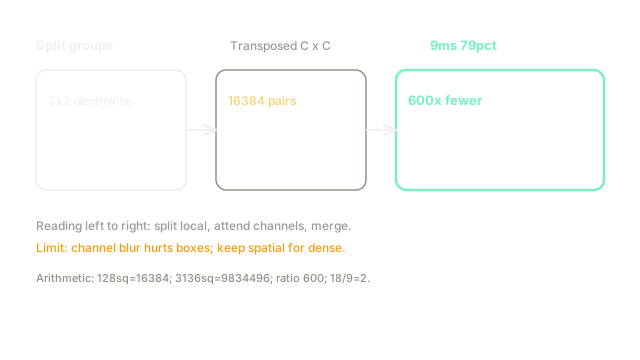
Split into groups. Run depthwise per group plus Split Depthwise Transpose Attention over not . Merge with .
Worked example
, . Spatial pairs M. Channel pairs , about times fewer (). Latency ms to ms on Jetson runs at percent.
Watch Out For
Transposing when spatial order leads accuracy
Channel attention blurs where. Symptom: classification holds but detection sags. Fix: keep spatial blocks for dense heads and use transposed mainly for classification stages.
The Quick Version
- EdgeNeXt splits to depthwise groups plus channel attention.
- Transposed pairs replace spatial pairs.
- Fixture times fewer pairs at percent.
- Edge latency halves on Jetson class runs.
- Keep spatial attention where location leads.