Efficient Models Shrink Vision Cost
Efficient families fuse light convs with slim attention and scaling rules, so phones run vision near server accuracy.
Why Does This Exist?
Server ViTs need GFLOPs per image. Phones budget near GFLOP with heat limits.
Efficient nets close the gap. This overview links mobilenet, efficientnet, and mobilevit components.
Think of It Like This
City bikes versus race bikes
Race bikes win tracks but fail commutes. City bikes trade top speed for racks, lights, and low upkeep while staying fast enough.
Heavy backbones are race bikes, efficient nets city bikes. Where it stops: city frames cannot win races, just as efficient nets trail giant pretraining.
How It Actually Works
Combine depthwise convs ( weights), slim attention on low-res maps only, and compound scaling of width plus depth. Distill from heavy teachers. Details live in MobileViT, EfficientFormer, EdgeNeXt, TinyViT pages.
Worked example
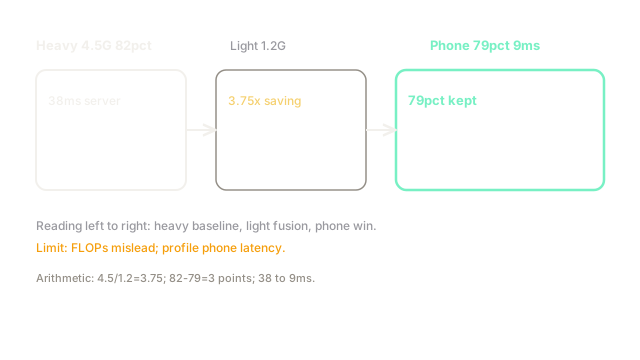
Baseline GFLOPs at percent. Depthwise plus stride cuts to GFLOPs, a times saving (). Accuracy percent, a point cost for percent less compute. Latency ms to ms on phone CPUs in reported runs.
Watch Out For
Comparing FLOPs without measuring latency
Low FLOPs with fragmented ops runs slow. Symptom: 1 GFLOP model slower than 2 GFLOP baseline. Fix: profile on target phones and fuse ops before publishing gains.
The Quick Version
- Efficient nets mix light convs with slim low-res attention.
- Fixture to GFLOPs saves 3.75 times at 3 points cost.
- This is an umbrella; blocks live in component pages.
- Scale width plus depth jointly, then distill.
- Measure phone latency, not just FLOPs.