Ethics in Computer Vision
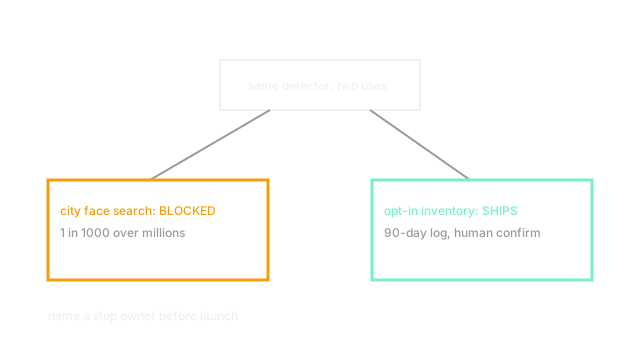
The same detector counts inventory or tracks protesters. Ethics in vision is the deployment review that decides which uses ship, with what limits, and who can stop them.
Why Does This Exist?
Detection, re-identification, and generation transfer across uses without changing code. An inventory counter becomes a crowd tracker with a new gallery; a portrait generator becomes a forgery tool with a new prompt. The model cannot tell which deployment it serves.
Ethics review exists to decide at deployment time, per use: who is affected, what consent covers, what error costs, and who can halt the system. It draws on fairness and bias for slice evidence, privacy for data limits, and deepfake detection plus image forensics for misuse screening. No capability page repeats this review; they link here.
Think of It Like This
A pharmacy and its prescription counter
The same chemistry stocks painkillers and controlled drugs, and the building does not decide who gets what. A pharmacist checks prescriptions, IDs, quantities, and interactions before anything restricted leaves the counter, and refuses sales that fail the check.
Deployment review is that counter. Capabilities sit behind it; each use needs its own authorization with dosage limits (who, where, how long), interaction checks (slice errors, function creep), and a refusal path. The analogy stops at reversibility: a refused sale ends the harm, while a shipped model keeps acting until somebody pulls it.
How It Actually Works
A review names the use, the affected people, and the decision the system drives. It sets numeric gates in advance: maximum false-match rate, maximum slice gap, retention ceiling, and human-override coverage. It records consent basis, signage, access lists, and a named owner with stop authority. High-risk uses (face search, emotion judgments, covert scoring) face a default-deny posture: they ship only with explicit written justification, tight galleries, and case-level redress for false matches.
A worked gate
A demo face-search proposal reports a 1-in-1000 false-match rate at 0.98 recall, with errors doubling on one documented slice. The review blocks general search: at city scale, 1-in-1000 over millions of comparisons yields thousands of false leads, concentrated on the already weak slice. It approves a narrowed inventory use instead (staff opt-in gallery, 90-day retention, every match human-confirmed), where the same error rate produces a handful of reviewable cases. The error number did not change; the deployment did.
Watch Out For
Consent paperwork as a substitute for limits
Signed forms do not fix an unbounded gallery or an unreviewable error rate. The symptom is a lawful deployment that still misidentifies at scale. Paperwork records the basis; numeric gates and stop authority carry the protection.
The Quick Version
- Capabilities transfer across uses; the review decides per deployment, not per model.
- Every review sets numeric gates on errors, slices, retention, and override coverage.
- High-risk uses default to deny and need written justification plus redress.
- On the demo numbers face search blocks while narrowed opt-in inventory ships.
- Name a stop owner before launch, not after the first incident.