Evidential Learning in Vision
Instead of one probability vector, the model outputs evidence per class in a single pass. More total evidence means more confidence, and the math stays cheap.
Why Does This Exist?
Ensembles buy uncertainty with five training runs and five forward passes. Dropout buys it with twenty passes. Both bills hurt on edge cameras and video streams that must decide every frame.
Evidential learning pays once. The network outputs non-negative evidence per class, treated as pseudocounts of a Dirichlet distribution, and uncertainty falls out in closed form. Strange inputs earn little total evidence, so the model says unsure without any sampling. Pair it with uncertainty estimation for routing policy; this page covers the single-pass mechanism.
Think of It Like This
Ballot boxes per candidate instead of one vote
A normal classifier casts one vote. An evidential classifier runs a ballot box per candidate and counts slips: 12 slips for dog, 2 for cat, 1 for car. Twelve against two is a confident win; one slip per box with three boxes is a shrug.
Total slips are the confidence. The analogy stops at training: ballot boxes just count, while evidence heads must be trained with a loss that rewards high evidence only for correct classes and penalizes fake confidence.
How It Actually Works
Let class receive evidence from a softplus head. Define Dirichlet parameters and total strength . Here is collected support, shapes the distribution, and measures total confidence. Predicted probability is and uncertainty is with classes: more evidence shrinks uncertainty directly.
Worked example
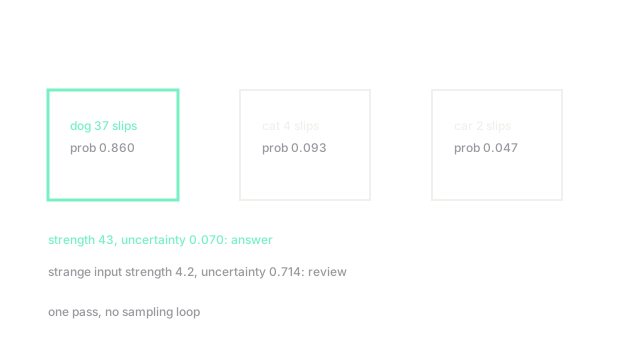
A demo image over 3 classes outputs evidence . Then and . Dog probability is , cat , car . Uncertainty is . A strange input outputting gives and uncertainty . Same head, no sampling: 0.070 means answer, 0.714 means route to review.
Watch Out For
Reading evidential probabilities as calibrated
Evidential probabilities rank well but overshoot absolutely without calibration. The symptom is a 0.86 that behaves like a 0.70 on held-out data. Fit a temperature or isotonic map on held-out scores before wiring probabilities to actions.
The Quick Version
- One head outputs evidence per class; strength sets confidence in closed form.
- Uncertainty needs no ensemble and no sampling loop.
- On the demo image evidence gives dog 0.860 at uncertainty 0.070.
- Strange inputs earn little evidence, so uncertainty spikes toward 0.714.
- Calibrate the probabilities before acting on them.