Image Denoising
Image denoising separates true signal from random sensor noise, recovering clean photos by learning what noise looks like at every brightness level.
Why Does This Exist?
Sensors count photons, and dim scenes deliver few. Shot noise and read noise then rival the signal itself: night phone photos carry grain that no exposure slider removes, because the slider amplifies noise with signal. Classical smoothing blurs away the grain along with the detail it was meant to save.
Learned denoisers separate the two statistically. Noise is unpredictable from neighbours; signal is. Networks trained on noisy-clean pairs learn that split at every brightness and texture, recovering edges classical filters melt. The task map is image-to-image tasks, and the training-data trick behind early learned denoisers is the denoising autoencoder.
Think of It Like This
A sound engineer removing tape hiss
An old concert tape hisses under the music. The engineer cannot simply mute high frequencies; cymbals live there too. Instead they sample a silent passage to learn the hiss fingerprint, then subtract that fingerprint everywhere, music preserved.
The noise model is the hiss fingerprint and residual learning is the subtraction. It fails on sounds the fingerprint misdescribes: a cymbal crash with hiss-like statistics gets subtracted as noise, which is the texture-loss limit below.
How It Actually Works
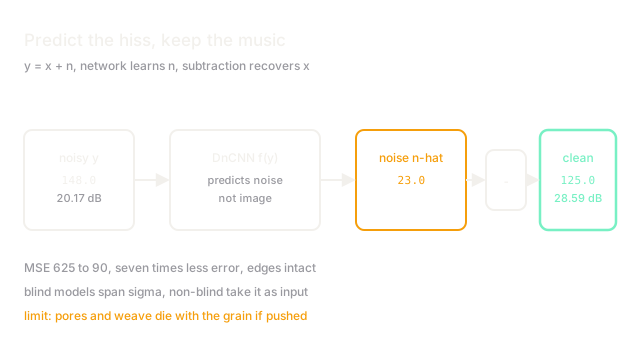
Model the capture as with Gaussian of standard deviation . Residual networks like DnCNN predict the noise and return , an easier target than the clean image because noise has simpler statistics. Blind denoisers handle a range of ; non-blind ones take as input and specialise per level:
Burst methods average aligned frames for effectively noiseless ground truth, and self-supervised variants train on noisy pairs alone using the Noise2Noise insight that the mean of noisy targets is clean.
Worked example
Pixel-scale –, noisy MSE (). PSNR is dB. After denoising, MSE : PSNR dB. Error falls sevenfold and grain visibly dissolves while edges hold, the signature win of learned over classical filtering.
Code
Residual denoising arithmetic on one noisy pixel.
def denoise_pixel(noisy: float, predicted_noise: float) -> float: """Subtract the predicted noise layer from the capture.""" return noisy - predicted_noise
print(denoise_pixel(148.0, 23.0)) # -> 125.0 near the true valueWatch Out For
Over-smoothing fine texture into plastic
Aggressive denoisers erase skin pores, fabric weave, and foliage along with grain. Faces turn waxy at exactly the noise levels where users most want help.
Validate on textured crops at full zoom, not just smooth walls. Prefer denoisers with texture-preserving losses for portraits and nature.
Training noise that mismatches the sensor
Gaussian training meets Poissonian low-light sensor noise in deployment, and performance crumbles. Noise family matters more than network depth past a point.
Calibrate to the target sensor: measure its noise profile or train blind across families. Synthetic Gaussian benchmarks flatter mismatched models.
The Quick Version
- Denoising models capture as clean signal plus noise and predict the noise layer.
- Residual learning subtracts from , an easier target than itself.
- Our example climbs PSNR dB as MSE falls .
- Burst averaging and Noise2Noise supply ground truth without clean captures.
- Waxy texture loss and sensor-mismatched training noise are the standing traps.