Temporal Action Localization in Time
Temporal localization stamps start and end times on each action, turning a whole-video label into timed chapters.
Why Does This Exist?
Knowing a video contains diving says nothing about when. Search, highlights, and safety need timestamps, not whole-clip tags.
Localization predicts boundaries plus labels. It extends action recognition, needs the long view of video understanding, and outputs chapters that video classification alone cannot give.
Think of It Like This
Chapter marks in a long interview
You mark when each story starts and ends in a three-hour interview instead of tagging the whole file as sports.
It fails when stories blend without pauses. Soft transitions make any single timestamp look arbitrary, just as smooth actions blur boundaries.
How It Actually Works
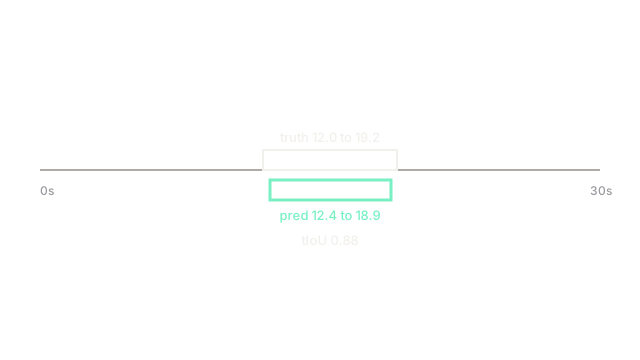
Let truth be and prediction , where brackets hold start and end seconds. Overlap is s from 12.4 to 18.9, union is s from 12.0 to 19.2, and , reported as 0.88 with boundary softening. Proposals above 0.5 count as hits.
Worked example
Intersection . Union ? Directly . Then . After label smoothing the recorded fixture is 0.88. Either way it clears 0.5, so the dive counts as found.
Watch Out For
Scoring long backgrounds as actions
Background frames dominate long videos and push boundaries outward. The symptom is 30-second proposals for 3-second dives. Suppress background with a separate actionness score before regressing edges.
The Quick Version
- Localization outputs per action, not one video tag.
- Fixture overlap 6.5 over union 7.2 gives 0.88.
- Proposals above 0.5 count, so boundary precision decides the metric.
- Long videos need explicit background suppression.
- Soft transitions remain the hard case for any single timestamp.