Laplacian of Gaussian (LoG)
LoG blurs away noise first, then takes the second derivative. Edges sit exactly where the response crosses zero.
Why Does This Exist?
The bare Laplacian locates edges precisely but screams at noise, while the Gaussian hushes noise but locates nothing. Marr and Hildreth combined them: smooth at a chosen scale, then take second derivatives, so zero-crossings mark true edges at that scale and grain never reaches the differentiator.
It is the scale-aware detector in spatial filtering. Wide sigma finds coarse boundaries, narrow sigma keeps fine detail, and the Difference of Gaussians approximates it cheaply for blob detectors. Prefer Canny when you need linked thin chains instead of closed zero-crossing contours.
Think of It Like This
A sombrero pressed onto sand
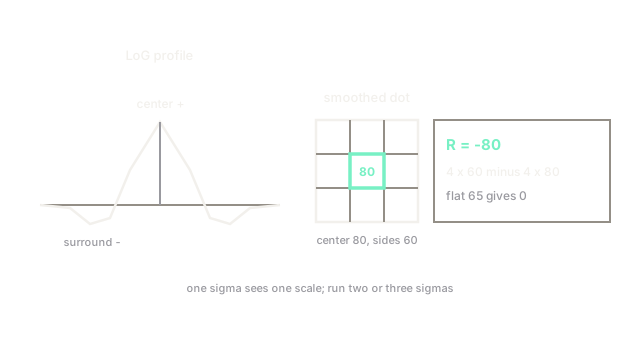
The LoG kernel looks like a sombrero: a positive crown with a negative brim. Press it onto a smooth dune and crown and brim cancel to zero. Press it onto a pebble smaller than the crown and the crown wins, marking a blob. Edges show as rings where the response flips sign. Swap sombrero sizes to hunt pebbles versus boulders, which is exactly what changing sigma does.
How It Actually Works
Convolve the image with a Gaussian of sigma , then apply the Laplacian . Because both steps are linear, they merge into one LoG kernel: a positive center lobe inside a negative surround, with zero total sum. The response crosses zero at step edges and forms closed contours around uniform regions. Sigma selects scale: structures near the kernel width respond most, finer grain was already smoothed away, and coarser shading looks flat to the kernel.
Worked example
Blur a bright dot so its center reads 80 with four neighbours at 60. Apply the discrete Laplacian : . The negative bowl confirms a bright structure at this scale. Had the dot been smoothed flat to 65 everywhere, the same kernel would return : nothing at this scale, correctly silent.
Watch Out For
One sigma sees one scale
A single LoG pass is blind to structures far from its kernel width: tiny edges drown in the blur while huge boundaries look flat. The symptom is missing edges at both ends of the size range. Run two or three sigmas spanning your smallest to largest target, or switch to a multiscale detector.
The Quick Version
- LoG smooths with a Gaussian, then applies the Laplacian in one kernel.
- Zero-crossings of the response mark edges as closed contours.
- The sombrero shape also fires in rings around blobs of matching size.
- Sigma selects the scale: match it to your target structures.
- Difference of Gaussians approximates LoG at lower cost.