Laplacian Operator in Images
The Laplacian fires wherever brightness curves, marking both sides of every edge with one kernel. Zero-crossings pin the boundary down.
Why Does This Exist?
First-order detectors like Sobel report edge strength but leave the exact boundary somewhere inside a wide response. The Laplacian takes the second derivative, which swings positive on one side of an edge and negative on the other, so the boundary sits precisely where the response crosses zero. One kernel also sees all orientations at once, with no Gx/Gy pair to combine.
It is the second-order detector in spatial filtering. Pair it with prior smoothing as LoG, and reuse its kernel for sharpening.
Think of It Like This
Feeling a speed bump
Drive over a speed bump and you feel pushed up, then pulled down; the bump's peak is where the push flips to pull. The Laplacian reports that flip: positive lobe on the approach, negative lobe past it, zero-crossing at the crest. First derivatives only tell you that you are tilted, which leaves the crest location vague. Second derivatives find the exact top by watching the tilt change sides.
How It Actually Works
The Laplacian sums unmixed second partials, , and the discrete kernel is:
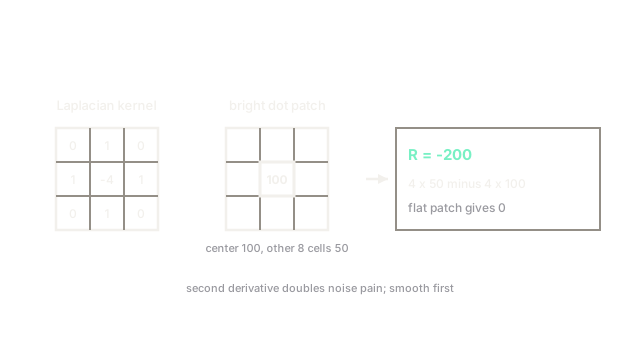
The center counts negative four times while the four direct neighbours count once each. Uniform regions sum to zero. Bright dots on dark ground return large negative spikes, dark dots return positive ones, and step edges produce a positive-negative doublet whose zero-crossing marks the boundary.
Worked example
Center a bright pixel among mid-grey neighbours:
Response is . A single 50-step above its surroundings yields a crisp -200, showing both the sensitivity and why lone noisy pixels scream through this filter.
Watch Out For
Second derivatives double noise pain
Differentiating twice amplifies high-frequency grain far worse than Sobel does, so raw Laplacian maps of noisy photos look like static. The symptom is dense salt-and-pepper spikes drowning real doublets. Smooth with a Gaussian first, which is exactly the LoG recipe, and never trust a Laplacian on unsmoothed grain.
The Quick Version
- The Laplacian sums second derivatives in x and y with one kernel.
- Step edges give positive-negative doublets; zero-crossings mark boundaries.
- Isolated dots spike hard, which suits blob spotting and punishes noise.
- It sees all orientations at once, unlike Gx/Gy pairs.
- Smooth first on noisy images, or use LoG instead.