Object-Centric Learning
Scenes contain objects that move, hide, and count separately. Object-centric models split the image into per-object slots first, then reason about each one.
Why Does This Exist?
A CNN feature map mixes every object into shared channels: moving one ball means re-encoding the whole scene. Counting, tracking, and editing stay brittle because the representation never decided which pixels belong to which thing.
Object-centric learning binds pixels to a small set of slots before any decision. Each slot explains one object with its own mask and features, so downstream heads count slots, compare slots, and edit slots independently. The umbrella is causal and structured vision; the mechanisms are slot attention, MONet, and IODINE.
Think of It Like This
Cookie cutters on rolled dough
A sheet of dough holds three cookies merged at the edges. Pressing three cutters stamps each shape with its own outline, and from then on you lift, count, and decorate cookies one by one instead of smearing the sheet.
Slots are the cutters. Binding decides the outlines; downstream reasoning handles cookies. The analogy stops at overlap: dough cutters never share crumbs, while real objects occlude, so slots must explain depth order and hidden parts too.
How It Actually Works
Residual only: the binding contract shared by all three methods. An encoder lifts the image to features, a competition step assigns each feature location to slots (by attention weights or sequential masks), each slot decodes its own mask plus appearance, and masks compose the scene by depth order. Training is unsupervised: reconstruct the pixels from slots, and the bottleneck forces the split. Supervision, when present, only names which slot is which.
The numbers that order them
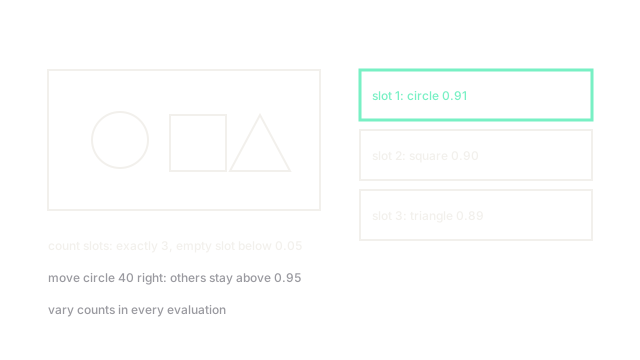
On a demo scene of three shapes (circle, square, triangle, one partly hidden): the model binds 0.90 mean mask overlap with 3 slots for 3 objects. Counting reads exactly 3 by counting non-empty slots. Moving the circle's slot 40 pixels right re-renders only the circle, leaving the other two masks above 0.95 unchanged. A fourth empty slot stays below 0.05 fill, proving slots are object-bound rather than tiled regions.
Watch Out For
Setting slot count from the test scene
Slots tuned to exactly the visible object count look perfect and shatter on the next scene with one more object. The symptom is clean demos and merged masks in deployment. Train and test with varying counts and report the over- and under-slot behavior explicitly.
The Quick Version
- Object-centric models bind pixels to slots before deciding anything.
- Each slot carries its own mask and features, composed by depth order.
- On the demo scene three slots reach 0.90 overlap with exact counting.
- Edits to one slot leave the others above 0.95 unchanged.
- Vary slot and object counts in every evaluation.