Robotics Vision
Robotics vision connects seeing to doing, turning images into poses, grasps, and navigation commands a moving body can execute safely.
Why Does This Exist?
A photo model is done when it labels correctly. A robot is done when the gripper holds the mug without crushing it, which needs timing, calibration, and contact. Robotics vision exists as the umbrella for that closed loop: perceive the scene, estimate poses, choose grasps or paths, servo to them, and recover when contact surprises. Errors here break hardware, not just metrics.
This page keeps only the loop and its budgets. Mechanisms live in the children: servoing, grasp detection, 6D pose, manipulation, scene understanding, navigation, and visuomotor policies. Sim-to-real transfer is owned by the reinforcement-learning plan and linked from the visuomotor page rather than duplicated here.
Think of It Like This
Cooking while watching your hands
You watch the knife, adjust the grip mid-cut, and stop when the tomato gives. Vision, motion, and touch update together. A robot does the same with cameras, controllers, and force limits. The analogy stops at skin: the robot needs explicit calibration between eye and hand that you learned as a child.
How It Actually Works
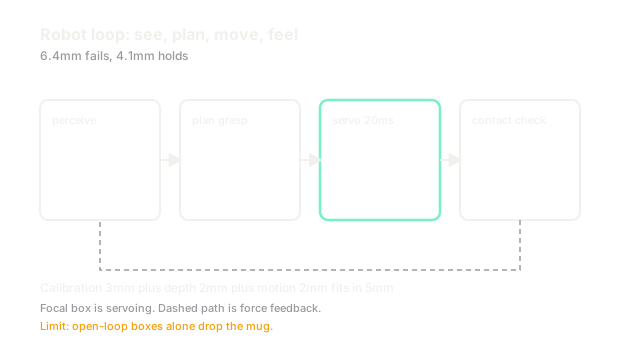
Cameras observe the workspace. Perception produces poses and masks in the robot frame through eye-hand calibration. A task planner picks targets and motions. A controller servos the arm or base toward them using visual feedback at tens of hertz. Force and slip monitoring gate contact. The loop repeats until success or a recovery triggers, with latency and calibration error budgeted like accuracy.
Worked example
A grasp needs 5 mm precision. Eye-hand calibration errs by 3 mm, depth errs by 4 mm, and control lags 40 ms during 0.1 m per s motion for another 4 mm. Root-sum-square gives about 6.4 mm total, which fails. Cutting latency to 20 ms and refining depth to 2 mm brings the total near 4.1 mm, which succeeds. That budget arithmetic decides hardware before any model choice.
Watch Out For
Open-loop grasps from perfect detections
A 0.95 mAP detector still drops the mug when calibration or depth bias shifts every grasp 8 mm sideways. The symptom is excellent vision metrics with empty grippers. Close the loop with visual servoing and touch confirmation, and score grasp success on hardware rather than boxes alone.
The Quick Version
- Robotics vision ends in contact and motion, not labels.
- Calibration, latency, and force limits join accuracy in the budget.
- This page maps the loop; child pages own each mechanism.
- Sim-to-real transfer links out to its owner plan.
- Score task success on the body, not just vision metrics.