Sim-to-Real Adaptation for Vision
Renders are cheap and labels are free, but real streets punish the render gap. Randomize simulation and adapt so real images feel familiar.
Why Does This Exist?
Labeling real driving or warehouse footage costs fleets and months, while a renderer produces a million labeled frames overnight. Models trained on clean renders then meet real sensor noise, lens grime, and weather the renderer never modeled, and accuracy drops from 0.90 in sim to 0.58 on real streets here. Sim-to-real adaptation closes that render gap without real labels.
It combines two moves: randomize the simulation so widely that reality looks like one more variation, then apply unsupervised adaptation or adversarial alignment against unlabeled real footage. The umbrella is generalization and adaptation.
Think of It Like This
Flight simulators with turbulence dialed up
Pilots train in simulators that exaggerate turbulence beyond any real flight, so actual skies feel calm by comparison. Randomizing lighting, texture, and camera noise beyond realistic ranges plays the same role: reality lands inside the practiced envelope. The analogy stops at physics: simulators model flight well, while renderers miss whole phenomena like retroreflection that no randomization of wrong physics can span.
How It Actually Works
Randomize every rendering axis the engine exposes: sun angle, exposure, texture palettes, background clutter, camera pose jitter, and sensor noise. Train the detector on the randomized stream with labels free from the renderer. Then align against unlabeled real footage with a light adaptation pass. Measure the gap per axis by ablating randomization groups, which tells which axis still leaks.
Worked example with recomputed numbers
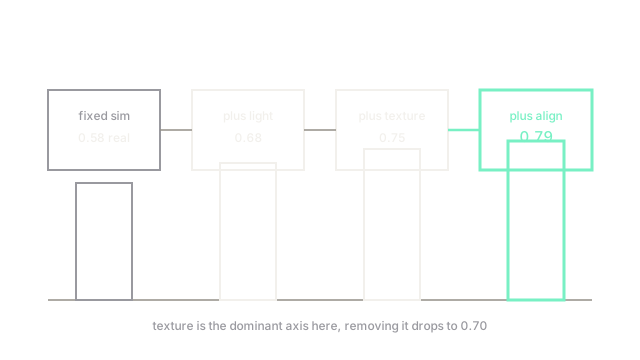
Baseline renders with fixed noon lighting score 0.90 in sim and 0.58 on real streets. Randomizing sun angle plus exposure lifts real accuracy to 0.68. Adding texture and background randomization reaches 0.75. A final unlabeled-real alignment pass lands at 0.79, recovering 0.21 of the 0.32 gap with zero real labels. Removing texture randomization alone drops the result to 0.70, naming texture as the dominant axis here.
What randomization cannot do
Effects absent from the renderer, such as motion blur from rolling shutters or wet-road reflections, stay unspanned no matter the range. When the residual gap concentrates on one such effect, collect targeted real data or upgrade the renderer instead of widening already-spanned axes.
Watch Out For
Randomizing past physical plausibility
Neon-green roads and floating shadows force the model to spend capacity on impossible inputs, and real accuracy falls below narrower randomization. The symptom is sim accuracy collapsing alongside stagnant real accuracy. Keep ranges beyond but near reality, and validate each axis contributes on real footage before widening it.
The Quick Version
- Renders give free labels but a 0.32 gap to real streets here.
- Randomizing lighting, texture, and background recovers to 0.75 label-free.
- A light real-footage alignment pass adds 0.04 more, landing 0.79.
- Ablate axes to find the dominant gap, texture here.
- Unmodeled physics stays unspanned; widening the wrong axis wastes capacity.