Super-Resolution and Image Restoration
Discover how deep learning models recover lost details, remove noise, and upsample low-quality images into crisp, high-resolution outputs.
Why Does This Exist?
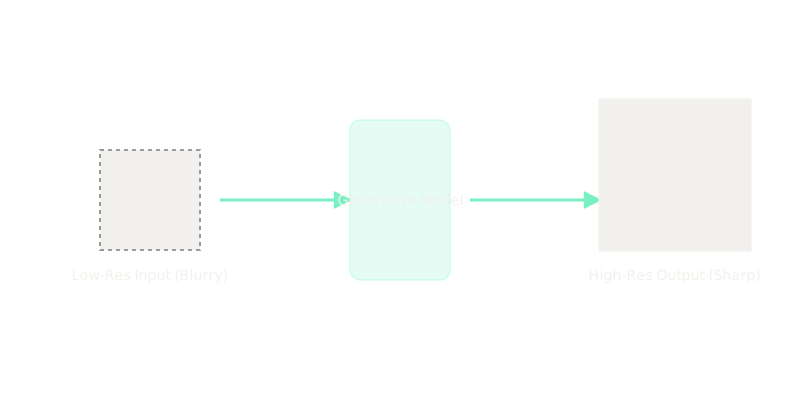
Cameras, sensors, and compression algorithms inevitably degrade image quality. Whether it's zooming in on a small object, recovering an old photograph, or processing medical scans, there is a fundamental need to reconstruct high-fidelity details from corrupted or low-resolution inputs. Traditional interpolation methods (like bicubic) only blur the image further, whereas modern AI actually "hallucinates" the missing information realistically.
Think of It Like This
A master restorer
Imagine an art restorer looking at a severely faded, blurry painting. Instead of just smudging the remaining colors together (which is what traditional math does), the restorer uses their vast knowledge of how paintings usually look to infer what the missing brush strokes must have been. They paint in new details that fit perfectly, making the image sharp and clear again.
How It Actually Works
Image restoration formulates the problem as an inverse mapping: given a degraded observation, find the most likely original high-quality image.
- Degradation Modeling: The model is trained on pairs of high-res and synthetically degraded low-res images (injected with blur, noise, and compression artifacts).
- Feature Extraction: A deep convolutional or Transformer-based network extracts hierarchical features from the low-res input.
- Upsampling & Generation: The network progressively increases the spatial resolution. Generative Adversarial Networks (GANs) or Diffusion Models are heavily used here to ensure the output looks perceptually realistic, adding high-frequency textures (like pores on skin or leaves on a tree).
- Reconstruction Loss: The network is penalized using a combination of pixel-wise loss (L1/L2), perceptual loss (comparing deep feature maps), and adversarial loss (trying to fool a discriminator into thinking the generated image is real).
Code
# -> Conceptual representation of an image restoration pipelineimport numpy as np
def generate_high_res(low_res_image): # Simulate a network extracting features and upsampling (x2) h, w, c = low_res_image.shape high_res_canvas = np.zeros((h * 2, w * 2, c)) # "Hallucinate" details by adding synthetic high-frequency signals hallucinated_details = np.random.normal(0, 0.1, (h * 2, w * 2, c)) # A real model would combine features; we just return the shape return high_res_canvas + hallucinated_details
low_res_input = np.ones((64, 64, 3))restored_image = generate_high_res(low_res_input)
print(f"Upsampled from {low_res_input.shape} to {restored_image.shape}")# -> Upsampled from (64, 64, 3) to (128, 128, 3)Watch Out For
Hallucination Risks
Because these models generate details that look realistic, they might invent structures that were never there in reality. In fields like medical imaging or security surveillance, this can lead to false diagnoses or misidentification. Always treat super-resolved images as "plausible reconstructions", not ground-truth facts.
The Quick Version
- Super-Resolution upscales images while maintaining or enhancing sharpness.
- Image Restoration fixes specific degradations like noise, blur, or JPEG artifacts.
- Traditional methods rely on simple math, while AI uses learned priors from massive datasets.
- Modern approaches rely on GANs and Diffusion models to generate perceptually convincing high-frequency details.