Advanced Graph Architectures
Advanced graph architectures break past message passing limits by rewiring graph topologies and lifting representations into higher-order subgraphs.
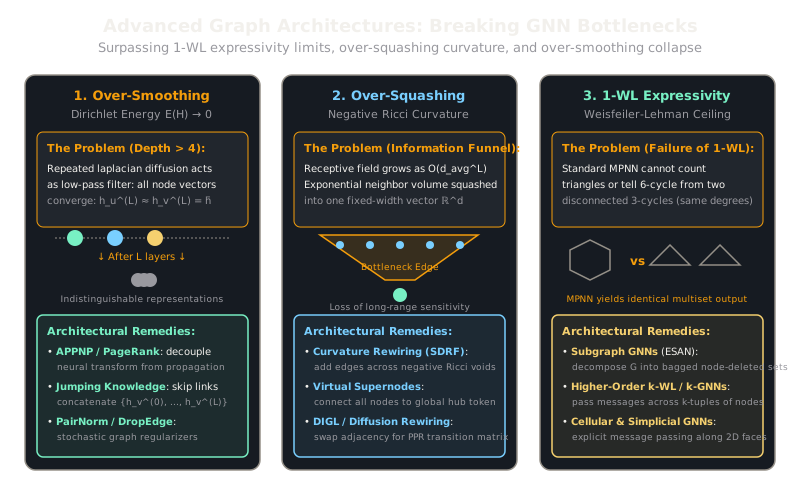
Why Does This Exist?
In computer vision and natural language processing, stacking dozens or hundreds of layers systematically improves performance (as seen in ResNets and Transformers). In classical graph neural networks, stacking more than 3 or 4 layers almost universally degrades test accuracy. Practitioners who attempt to capture long-range dependencies in graphs run directly into a destructive wall composed of three fundamental mathematical pathologies:
- Over-smoothing: Repeated Laplacian smoothing forces all node embedding vectors to collapse toward a single uniform consensus state, wiping out local discriminative features.
- Over-squashing: Graphs often exhibit negative discrete Ricci curvature (tree-like or bottleneck structures), forcing an exponentially growing neighborhood volume into a fixed-width vector representation.
- The 1-WL Expressivity Barrier: Anonymous message passing cannot distinguish between graphs with identical degree multisets (such as telling a single 6-node cycle apart from two disconnected 3-node triangles).
Advanced graph architectures exist to dismantle these boundaries. By introducing structural graph rewiring, topological simplicial complexes, and subgraph decomposition ensembles, they enable deep, expressive graph learning capable of modeling complex molecular geometries and planet-scale web graphs.
Think of It Like This
A crowded auditorium playing telephone through drinking straws
Imagine a conference hall where 500 attendees sit at irregular desks. To solve a group puzzle, everyone can only whisper to their adjacent desk neighbor once per minute.
- Over-smoothing is what happens if you play telephone for 20 rounds: every desk ends up with the exact same muddy drone of background noise, completely erasing the distinct opinions people started with.
- Over-squashing is what happens when two massive auditorium wings are connected by a single narrow doorway. If 200 people on the left side need to send their detailed reports to the right side through the one person standing in the door, that person's limited working memory collapses under the flood of information.
- The 1-WL ceiling is what happens when you try to figure out whether desks are arranged in a circular ring or two small triangles: because every participant only sees "two adjacent desks", local conversations can never verify the global geometric shape.
Advanced architectures solve this by installing overhead loudspeakers (virtual supernodes), knocking down walls to build express bridges (curvature rewiring), and inspecting photographic snapshots of individual desk clusters (subgraph GNNs).
How It Actually Works
Overcoming the Triple Pathology of Graph Networks
1. Controlling Over-Smoothing via APPNP and Dirichlet Energy
Over-smoothing occurs because graph convolution acts as a low-pass filter on graph signals. As network depth , the Dirichlet energy of the feature matrix :
To maintain high Dirichlet energy across deep layers, architectures like APPNP (Approximate Personalized Propagation of Neural Predictions) decouple feature transformation from message passing via teleport probability :
Because the root signal is injected back at every step, the network can propagate signals 30 to 50 hops deep without collapsing into consensus.
2. Resolving Over-Squashing via Curvature Rewiring
Topping et al. (2022) proved that the sensitivity of node 's output at layer with respect to node 's input feature decays exponentially according to the discrete Ricci curvature of the bottleneck edges between them:
When edges have strongly negative Ricci curvature (classic bottlenecks like bridges connecting two dense clusters), the derivative vanishes, causing information over-squashing.
Stochastic Discrete Ricci Flow (SDRF) addresses this by dynamically rewiring the input graph:
- Compute balanced Forman Ricci curvature for all edges .
- Identify edges with the most negative curvature (severe bottlenecks).
- Add supporting shortcut edges between non-adjacent 2-hop neighbors that support those bottlenecks, increasing positive curvature and dissipating information pressure.
3. Surpassing 1-WL via Subgraph GNNs (ESAN)
The Equivariant Subgraph Aggregation Network (ESAN; Bevilacqua et al., 2021) breaks the 1-WL ceiling by representing a graph not as a single monolith, but as a "bag" of subgraphs formed by systematically removing one node at a time. By running a Siamese GNN over the subgraph bag with equivariant cross-subgraph pooling, ESAN can provably distinguish strongly regular graphs, count 3-cycles, 4-cycles, and cliques, achieving higher expressive power than any standard MPNN.
Worked Example
Consider APPNP propagation on a 2-node graph connected by an edge (). We compare standard GCN propagation against APPNP across 2 steps with teleport .
Initial MLP feature vectors: Normalized adjacency with self-loops .
-
Standard GCN Propagation (No Teleport):
- Step 1:
- Feature difference ! The two nodes completely over-smoothed in a single step.
-
APPNP Propagation (, ):
- Step 1: Feature difference is now .
- Step 2: The system reaches a stationary personalized PageRank equilibrium where node identities remain strongly separated regardless of how many diffusion steps are applied.
Code
import numpy as np
def appnp_propagation( initial_features: np.ndarray, # Shape: (N, d) adjacency: np.ndarray, # Shape: (N, N) teleport_alpha: float = 0.15, num_iterations: int = 10,) -> np.ndarray: """APPNP PageRank-based propagation preserving Dirichlet energy across deep hops.""" num_nodes = initial_features.shape[0]
# Add self-loops: A_tilde = A + I a_tilde = adjacency + np.eye(num_nodes) degrees = np.sum(a_tilde, axis=1)
# Symmetric normalization: D^(-1/2) * A_tilde * D^(-1/2) deg_inv_sqrt = np.power(degrees, -0.5) deg_inv_sqrt[np.isinf(deg_inv_sqrt)] = 0.0 d_mat = np.diag(deg_inv_sqrt) norm_adj = d_mat @ a_tilde @ d_mat
# Iterative Personalized PageRank propagation h_curr = initial_features.copy() for _ in range(num_iterations): diffused = norm_adj @ h_curr h_curr = (1.0 - teleport_alpha) * diffused + teleport_alpha * initial_features
return h_curr
# 3-node path graph: 0 - 1 - 2adj = np.array([ [0.0, 1.0, 0.0], [1.0, 0.0, 1.0], [0.0, 1.0, 0.0],])features = np.array([ [10.0, 0.0], [0.0, 1.0], [-10.0, 0.0],])
propagated = appnp_propagation(features, adj, teleport_alpha=0.2, num_iterations=20)print("Initial feature difference (0 vs 2):", np.linalg.norm(features[0] - features[2]))# -> 20.0print("Propagated feature difference (0 vs 2):", np.round(np.linalg.norm(propagated[0] - propagated[2]), 4))# -> ~4.7434 (nodes retained distinct representations even after 20 hops!)Watch Out For
Over-rewiring breaks topological inductive biases
While graph rewiring algorithms (such as SDRF or adding virtual nodes) relieve over-squashing bottlenecks, aggressively adding shortcuts destroys the graph's intrinsic sparsity and spatial locality. If you rewire too many edges, the effective diameter of the graph drops to 1, effectively turning the network into a dense, noisy clique.
Always evaluate rewiring on a strict validation split. Measure whether the gain in long-range transfer offsets the loss in high-frequency local structural signals. In domains like molecular chemistry, where exact chemical bond connectivity dictates 3D conformation, preserve the original chemical bonds as distinct typed relations rather than treating rewired shortcuts as real covalent bonds.
The Quick Version
- Over-smoothing causes deep node representations to homogenize due to Dirichlet energy decay; decoupled PageRank propagation (APPNP) keeps deep features distinct.
- Over-squashing occurs when negative discrete Ricci curvature bottlenecks choke exponential neighborhood volume into fixed-width vectors.
- Subgraph GNNs (like ESAN) break the classical 1-WL expressivity barrier by processing ensembles of node-deleted subgraphs.